

Building production models that are linked along the value chain in general, and safe and sustainable chains in particular, is the shortest path to improving the quality of life and income for farmers; and to building a modern, sustainable agricultural sector that is competitive in the market.
The Duong Hoa Cuong Tea Cooperative (Hai Ha district) was established in 2017 – the most difficult time for Hai Ha tea. At that time, tea could not be exported, domestic consumption was limited, tea prices were low, people stopped harvesting tea, and some households even considered cutting down their tea plants to replace them with other crops. Faced with this situation, Hai Ha tea growers decided to unite, emphasizing solidarity and mutual support, and sit down together to assess the situation and find ways to overcome the difficulties.
Mr. Nguyen Sy Dung, Director of Duong Hoa Cuong Tea Cooperative, said: "We have over 40 people, all of whom are tea growers and processors. We have agreed to change our farming methods towards organic farming; dividing the time and types of tea for processing into fine and coarse tea; avoiding mass harvesting at the same time, avoiding producing the same type of tea and selling it to the same market, because that would be like shooting ourselves in the foot..." Mr. Nguyen Duc Minh (village 8, Quang Long commune), a member of Duong Hoa Cuong Tea Cooperative, said: "My family chose to apply the VietGAP process to farming, limiting the use of chemical fertilizers and pesticides, replacing them with biological substances; ensuring sufficient irrigation for the plants, gradually switching from machine harvesting to hand harvesting, meeting the requirement of 1 bud and 2 leaves to be able to process into delicious dried teas."
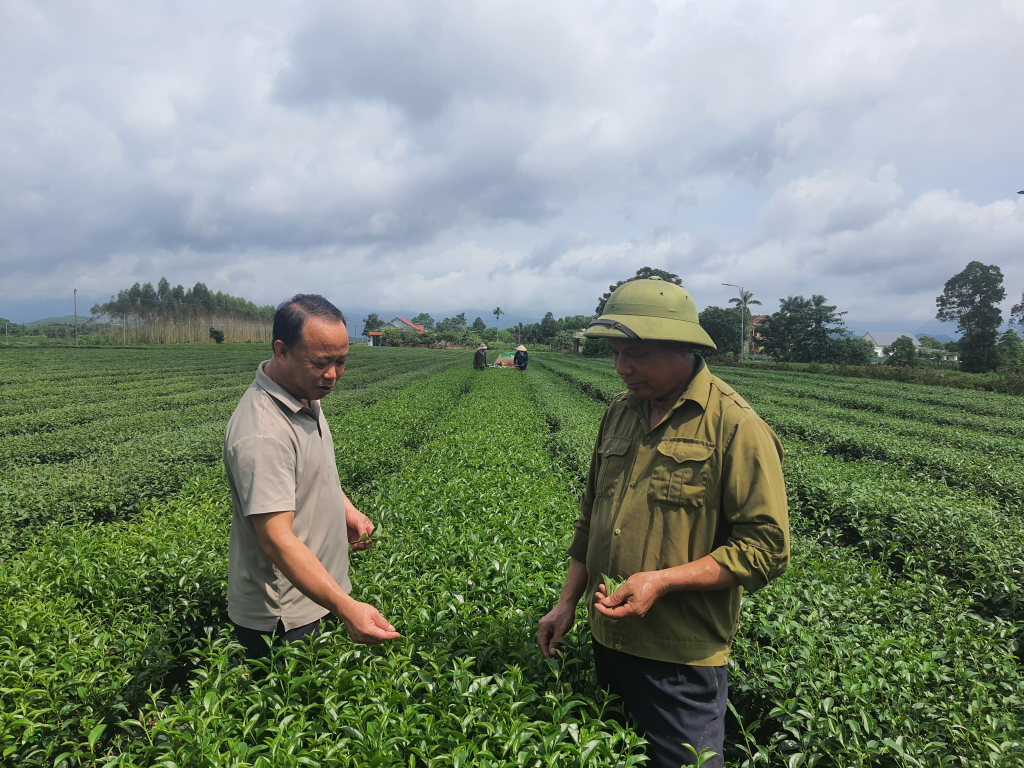
After a period of adhering to the general principles set forth by the Duong Hoa Cuong Tea Cooperative, Hai Ha tea has shown signs of stable consumption. Since 2019, the selling price of Hai Ha tea has gradually increased, and tea growers are making a profit. Currently, the total production of dried tea in Hai Ha is about 1,000 tons, of which 60% is exported as raw material to foreign markets, and the rest is refined tea products consumed domestically. Profits from domestic consumption are three times higher than those from exporting raw tea. "Unity and cooperation are the operating principles, and also the foundation for achieving results. Hai Ha tea will not be subject to price dumping if the 43 of us continue to sit together and 'shake hands' to do business," affirmed the Director of the Duong Hoa Cuong Tea Cooperative.
Along with Hai Ha tea, many other agricultural products throughout the province are part of production, processing, or consumption chain models, promoting agricultural development and generating revenue and profits for the people. For example, the project linking the cultivation of DT37 rice between 190 farmers in Hamlet 2, Nguyen Hue Commune (Dong Trieu Town) and the Nguyen Hue Agricultural Production, Business and Service Cooperative and Quang Ninh Seed Company. Similarly, the linked cultivation of Codonopsis pilosula in Thanh Lam Commune (Ba Che District) with Dap Thanh Forestry Products Trading Company is a stepping stone for Thanh Lam Commune to aim for planting over 10 hectares of Codonopsis pilosula annually, becoming a center for supplying high-quality Codonopsis pilosula tubers to the entire region by 2025.
To promote integrated production, Quang Ninh aims to develop cooperatives and cooperative groups, using them as core production organizations to boost the collective economy in agriculture. In the Phuong Nam early-ripening lychee growing area (Uong Bi City), the Phuong Nam Early-Ripening Lychee Cooperative is a pioneer in leading its members and lychee growers in applying advanced science and technology in cultivating early-ripening lychees, prioritizing organic farming, minimizing and eventually eliminating the overuse of chemical fertilizers and pesticides, and replacing them with biological fertilizers and pesticides. In Dong Trieu town, with active technical support and input supply from the Binh Khe Agricultural Production, Business, and Service Cooperative, nearly 200 hectares of lychee trees in Binh Khe commune have developed very well for many years. The cooperative also directly links production with models applying high technology and techniques, such as growing green vegetables and cucumbers in greenhouses and polytunnels…
Production linkages and collaborations for mutual benefit are essential requirements in the overall trend of economic development, particularly in agricultural development. Farmers in Quang Ninh have been implementing this relatively well, creating a united front and collective strength to achieve success.
Source
![[Photo] Life on both banks of the river returns to its bustling pace on the day the Long Bien Bridge opens to traffic.](https://vphoto.vietnam.vn/thumb/1200x675/vietnam/resource/IMAGE/2026/05/28/1779949763708_cau-long-bien-minh-duy-7-3610-jpg.webp)



![[Photo] The heat at the fireworks display site on the opening night of the Da Nang International Fireworks Festival 2026](https://vphoto.vietnam.vn/thumb/1200x675/vietnam/resource/IMAGE/2026/05/27/1779889741485_ndo_br_z7872039145157-fecaba5112f39e8352544099d7ef4738-5140-jpg.webp)
















































































Comment (0)