

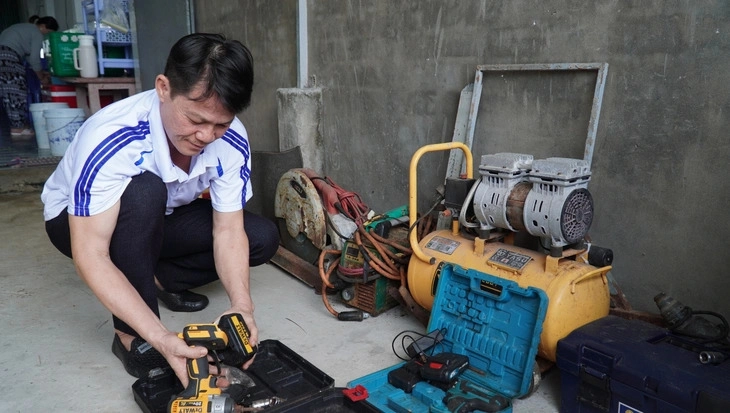
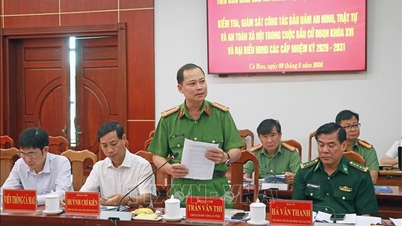
Teacher Tran Van Tam made supplies for the school but became entangled in legal troubles for embezzlement - Photo: THANH HUYEN
The incident occurred at Tam Giang Tay Secondary School in Ca Mau province. According to the Ca Mau Provincial Police's decision to suspend the investigation, teacher Tran Van Tam used invoices with prices higher than the actual cost when purchasing equipment for the school.
The amount of money identified as misappropriated is 6,140,000 VND, and the amount spent in violation of financial principles is 6,900,000 VND.
As early as July 2024, the defendant voluntarily paid 23,000,000 VND, more than the amount that needed to be repaid. More importantly, the investigation's conclusion acknowledged that the assets created benefited the school, and their actual value was higher than the amount spent.
What is commendable here is that the prosecuting authorities chose to stop. Clause 2 of Article 8 of the 2015 Penal Code has long established a fundamental principle that acts that, while showing signs of a crime, pose insignificant danger to society, are not considered crimes and should be dealt with through other measures.
A discrepancy of over 6 million VND, which was rectified early on, in a matter that ultimately benefited the school, can hardly be considered a threat to society.
The exemption from criminal liability under point a, clause 2, Article 29, based on point a, clause 1, Article 230 of the Criminal Procedure Code, is therefore a reasonable way out that the law has already provided.
Previously, the appellate court overturned the initial verdict and returned the case for further investigation, after which the investigating agency granted bail to the defendant. This is a self-correcting process within the system, and today's conclusion marks a fitting end to that process.
This decision has implications that extend beyond a single individual. The entire country is talking extensively about clearly distinguishing criminal, administrative, and civil liability.
Resolution 68 of the Politburo on the development of the private economy requires prioritizing the application of civil, economic, and administrative measures before considering criminal action.
That spirit applies to the private sector, but the underlying principle is not unique to any one entity. A fundamental financial error, if its consequences are minor and have been rectified, should be dealt with through disciplinary action and recovery, not necessarily through arrest.
An incorrect invoice is a minor issue that can be overlooked. However, it must still be dealt with through appropriate administrative sanctions, and the person responsible for the error must still be held accountable in terms of management. Welcoming the suspension decision is not an encouragement of leniency, but rather an encouragement of fairness. Using the right tools for the right type of violation is the hallmark of a restrained judicial system.
The greatest benefit doesn't lie in a verdict that wasn't pronounced. It lies in the signal sent to the heads of grassroots organizations that if they act honestly for the common good, the law won't rush to turn them into defendants. That's what keeps people willing to take action.
The school in Tam Giang Tay will still need someone to take care of it, from the desks to the equipment, tomorrow. A decision made at the right time, when it comes to stopping, ultimately also shows concern for schools like this.
Source: https://tuoitre.vn/biet-dung-lai-dung-luc-cung-la-cong-ly-20260531082029323.htm

![[Video] Sunset at Lap An Lagoon – Where the sun sets over the fishing nets](https://vphoto.vietnam.vn/thumb/1200x675/vietnam/resource/IMAGE/2026/05/31/1780192137701_beach-landscape-sea-water-nature-grass-745871-pxhere-com.jpeg)



















![[Video] Sunset at Lap An Lagoon – Where the sun sets over the fishing nets](https://vphoto.vietnam.vn/thumb/800x450/vietnam/resource/IMAGE/2026/05/31/1780192137701_beach-landscape-sea-water-nature-grass-745871-pxhere-com.jpeg)










































































Comment (0)