

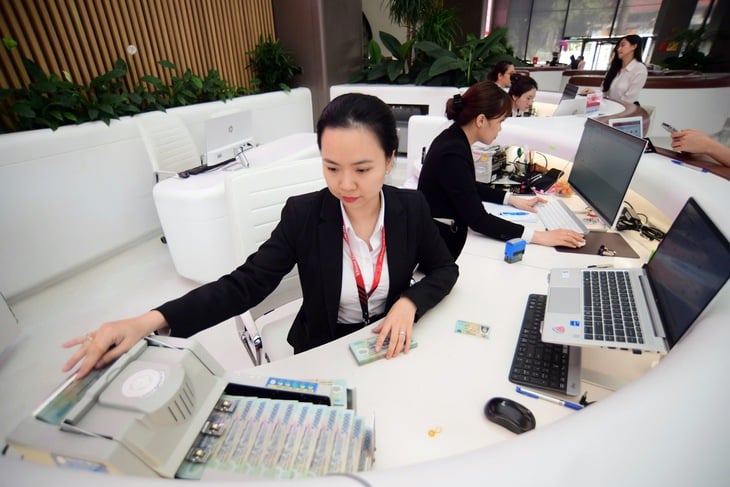
The State Bank of Vietnam announced it will carefully assess and report to the Government on the roadmap for removing credit limits - Illustration photo: QUANG DINH
At a press conference on the banking sector's performance in the first six months of the year, organized by the State Bank of Vietnam (SBV) on July 8th, Mr. Pham Chi Quang, Director of the Monetary Policy Department (SBV), affirmed this when discussing with the press the Prime Minister 's directive to remove credit limits (room).
According to Mr. Quang, the State Bank of Vietnam will conduct a thorough assessment before reporting to the Government on the roadmap for removing credit limits.
Moving towards abolishing credit limits.
According to Mr. Quang, the State Bank of Vietnam's management of credit growth since 2012 faced many difficulties, with credit growth sometimes reaching a rapid 32% per year, and in some years even up to 54%, exceeding the control capacity of credit institutions. At the same time, interest rates in the market rose very high and fell into a spiral of unhealthy competition.
To address this issue and contribute to macroeconomic stability, inflation control, and the safety and stability of the credit institution system, the State Bank of Vietnam (SBV) has been managing credit growth limits since 2012. However, according to Mr. Quang, no tool is permanent. Over time, the SBV has implemented a roadmap for improving and innovating its monetary policy management.
Specifically, in 2024, the State Bank of Vietnam (SBV) assigned credit growth targets to credit institutions at the beginning of the year. By 2025, the SBV removed the requirement to assign credit growth targets to foreign banks, branches of foreign banks, joint venture banks, and institutions of non-bank credit organizations. Thus, only domestic commercial banks are assigned credit growth targets.
"This is a roadmap towards completely abolishing credit growth targets in the near future. However, past consequences and difficulties in the credit system still persist. Therefore, to abolish credit limits, the State Bank of Vietnam needs to have measures and policies that are appropriate to Vietnam's specific conditions."
"The goal is to both enhance the proactive role of credit institutions and ensure the safety of the system, economic security, and control inflation," Mr. Quang said.
According to Mr. Quang, removing credit limits would risk raising interest rates. One of the measures recommended by international organizations is that the State Bank of Vietnam (SBV) must be very proactive in managing interest rates. "Therefore, the SBV will carefully consider and thoroughly assess the policy impact before reporting to the Government and the Prime Minister on the roadmap for removing credit limits in the near future," Mr. Quang added.
The risk of inflation rising again remains.
Also at the press conference, Deputy Governor of the State Bank of Vietnam Pham Thanh Ha stated that early on the morning of July 8th, the US announced tariffs of 25-40% on 14 countries, effective from August 1st, and warned that it would increase tariffs if these countries retaliated, indicating that the global economy remains highly uncertain in the coming period.
"Although inflation has cooled down to the target level, there is still a potential risk of it rising again. Therefore, the potential risks in the global financial and monetary markets are putting pressure on the management of monetary policy, exchange rates, and interest rates domestically, as well as on achieving the goal of supporting economic growth of 8% or more in 2025," Mr. Ha said.
Meanwhile, according to Mr. Pham Chi Quang, since the beginning of the year, the US government has changed its policies rapidly, including economic, fiscal, and especially monetary policies. This has led to significant fluctuations in the USD, which has fallen by about 10%, and even more than 10% in some periods. The decline of the USD has benefited many currencies, especially those in the Asian region.
However, the VND continues to depreciate, having fallen by approximately 2.7-2.8% against the USD so far. According to Mr. Quang, to maintain the strength of the currency, it must be attractive. This attractiveness is partly achieved through interest rates. However, in recent times, the State Bank of Vietnam has implemented monetary policies aimed at maintaining low interest rates to support economic growth.
"To have low interest rates, there must be certain trade-offs, including exchange rates, because when maintaining low interest rates, the interest rate differential between the Vietnamese Dong and the US Dollar will become negative. As a result, institutions will convert to other, more attractive currencies to hold," Mr. Quang said, adding that although Vietnam's balance of payments remains stable and its trade balance is still in surplus, the withdrawal of foreign capital from the stock market since 2024 has put pressure on the foreign exchange market.
"Vietnam's economy is highly open, with a large export market, especially to the US, so tax policies will affect exchange rates and interest rates in the coming period as capital flows shift between countries," Mr. Quang commented.
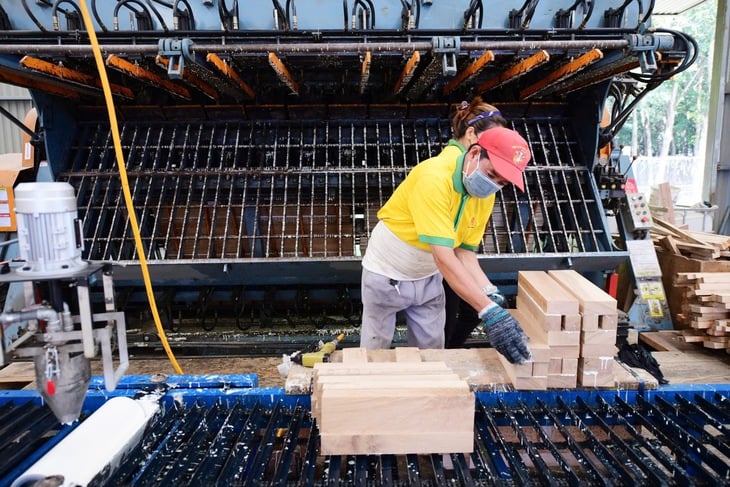
The agriculture, forestry, and fisheries sector accounted for 6.7% of the credit structure in the first half of this year - Photo: Q.D.
Over 17.2 million billion VND has been injected into the economy.
Speaking to the press at the press conference, Mr. Pham Thanh Ha said that as of June 30, total credit in the entire system reached 17.2 million billion VND, an increase of 9.9% compared to the end of 2024. This is the highest growth rate since 2022. Regarding the average lending interest rate (applied to new loans), the current average lending interest rate is 6.24%/year, a decrease of 0.64% compared to the end of 2024.
Of that total, agriculture, forestry, and fisheries accounted for 6.37%; manufacturing accounted for 12.84%; and construction accounted for 7.53% (including infrastructure investment projects that the Government is directing to accelerate investment).
The wholesale and retail trade sector; repair of automobiles, motorcycles, and other motor vehicles has the largest outstanding loan balance in the entire system, accounting for 23.74%. Real estate business activities account for 18.47%. Activities involving employment in households, production of physical goods and services for self-consumption by households account for 12.91%.
Several sectors with a large share of total outstanding credit in the economy continued to grow significantly. These included sectors contributing to growth, such as agriculture, rural areas, and small and medium-sized enterprises (SMEs), which continued to account for a large proportion of total outstanding credit in the economy, at 23.16%, 17.51%, an increase of 5.31%, and an increase of 5.71% respectively.
The supporting industries and high-tech enterprises sectors experienced higher credit growth rates than the overall economic growth rate, at 15.69% and 17.59% respectively.
The State Bank of Vietnam affirms that it closely monitors macroeconomic developments and domestic and international financial and monetary markets to develop appropriate operational scenarios, proactively, flexibly, promptly, and effectively manage monetary policy, and coordinate synchronously, harmoniously, and closely with fiscal policy and other macroeconomic policies to prioritize promoting economic growth while maintaining macroeconomic stability.
According to Mr. Pham Chi Quang, credit growth plays a very important role in supporting economic growth of over 8% this year. Credit growth as of June 30 reached nearly 10%, the highest increase since 2022, 2.5 times higher than the same period in 2024.
"We are not being complacent about inflation but are closely monitoring developments to manage credit according to the set targets and focusing on priority areas. In addition, bad debts are under control, and the State Bank of Vietnam will continue to adjust the credit growth margin from now until the end of the year at a reasonable level, ensuring it contributes to economic growth," Mr. Quang informed.
Removing credit limits is appropriate.
Speaking to Tuoi Tre newspaper, Mr. Nguyen Quoc Hung, General Secretary of the Vietnam Banking Association, said that removing credit limits is very appropriate to increase the autonomy of banks, especially in the context of large banks having already adopted Basel 3 standards. Furthermore, the financial capacity of banks is improved as charter capital is increased annually.
"In addition, based on their ability to raise capital and the market's borrowing needs, banks will proactively provide loans."
"We must avoid a situation where banks have capital but cannot lend it out because they are constrained by credit growth limits," Mr. Hung said, adding that to be independent in credit growth, banks must build their own safety ratios to ensure the safety of their capital and the ability to recover loans.
From a regulatory perspective, according to Mr. Hung, the State Bank of Vietnam needs to develop a set of criteria for safety indicators to manage and supervise the credit growth of banks.
"For example, regarding the safety ratio for real estate lending, what is the ratio of short-term capital mobilization to long-term lending?... The goal is to ensure the safety of the credit institution itself as well as the safety of the system," Mr. Hung suggested.
Source: https://tuoitre.vn/bo-room-tin-dung-tang-chu-dong-cho-ngan-hang-20250709080024604.htm


![[Image] Shipbuilders exposed to steel and record-breaking heat.](https://vphoto.vietnam.vn/thumb/1200x675/vietnam/resource/IMAGE/2026/06/04/1780545781745_ndo_br_img-5402-4683-jpg.webp)























































![[Video] Sunset at Lap An Lagoon – Where the sun sets over the fishing nets](https://vphoto.vietnam.vn/thumb/1200x675/vietnam/resource/IMAGE/2026/05/31/1780192137701_beach-landscape-sea-water-nature-grass-745871-pxhere-com.jpeg)




































Comment (0)