

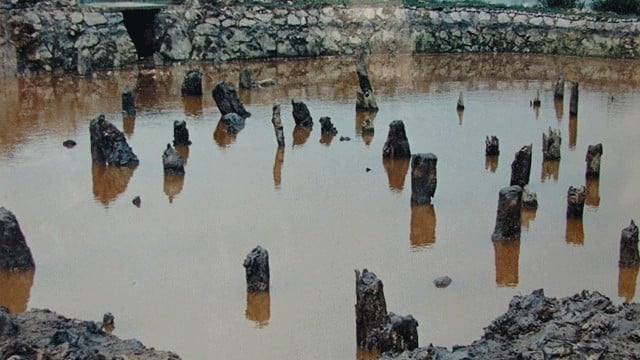
The stake field of the Battle of Bach Dang. (Photo: Xuan Tan)
The Battle of Bạch Đằng in 1288 is a glorious milestone in our nation's history of resisting foreign invaders, closely associated with the outstanding military art of the national hero, Hung Dao Dai Vuong Tran Quoc Tuan.
Yen Giang, Dong Van Muoi, and Dong Ma Ngua – three unearthed stake fields from the Battle of Bach Dang, located within the Bach Dang Victory Historical Site – are important archaeological evidence reflecting the scale and structure of the Bach Dang campaign, leaving its mark on a vast area of Quang Yen in the past, along the Chanh, Rut, Kenh, and Bach Dang rivers.
The first Bạch Đằng stakes were discovered in 1953 when people were digging the land to build dikes. At that time, many stakes had been pulled up to be used as roof beams or straw piles, and some were taken by museums for display.
In 2012, the site was classified as a Special National Monument. The pile samples were dated using the C14 method, with results indicating they date back to the 13th century.
Of the three unearthed pile fields, Yen Giang is the only one with an open-air pile pond covering an area of approximately 120m2. The other two pile fields, Dong Van Muoi and Dong Ma Ngua, were filled in after excavation to preserve them intact. All pile fields have been documented.
From 2005 to the present, surveys and research have continued in the Nam Hoa and Yen Hai wards of Quang Yen town (now Phong Coc ward, Quang Ninh province) and Yen Giang ward (now Quang Yen ward, Quang Ninh province). New research methods, using advanced equipment such as GPS to locate relics, ultrasonic edge scanning and magnetic field measuring devices to survey unusual objects at the riverbed or underground, and exploratory drilling to study changes in river flow and ancient topography, have clearly established the characteristics of the ancient topography, geomorphology, and landscape environment, contributing to clarifying the strategy and tactics that Tran Hung Dao developed for the Battle of Bach Dang.
From the perspective of years of research, Dr. Nguyen Van Viet, Director of the Southeast Asian Prehistory Center, shared: The Bạch Đằng wooden stakes have survived for over 700 years thanks to the anaerobic mangrove sediment environment at the estuary. To properly preserve the Bạch Đằng stakes requires adherence to strict procedures.
The wooden piles that have been removed from their natural environment need to be soaked in a neutral water solution to remove sulfur salts, then gradually soaked in a solution of polyethylene glycol (PEG). The PEG compound will gradually replace the water in the wood. This compound stabilizes the wood structure, prevents cracking and deformation as the wood dries, and maintains its original shape. Finally, a slow drying process ensures that the wood remains rigid and intact. Other wooden piles should be left in their natural state, enclosed and protected from environmental and human damage.
According to Ngo Dinh Dung, Vice Chairman of the People's Committee of Phong Coc Ward, Quang Ninh Province, based on recent activities, it is clear that investing human resources and finances appropriately in a research, excavation, and conservation plan is crucial.
Besides the support of experts and equipment from international organizations and individuals, the investment and attention of Quang Ninh province in the project to preserve and promote the value of the Bach Dang historical site, including the three Bach Dang stake fields, needs to be implemented soon. Currently, the three stake fields have been documented and are part of the Yen Tu, Vinh Nghiem, Con Son, and Kiet Bac complex of historical sites and scenic spots, submitted to UNESCO for recognition as a World Heritage site.
Mr. Pham Chien Thang, Deputy Head of the Standing Committee of the Management Board of Relics and Scenic Spots, Department of Culture, Sports and Tourism of Quang Ninh province, said: Before implementing the rearrangement and merger of administrative units, the People's Committee of Quang Yen town submitted to the People's Committee of Quang Ninh province a project to study the planning and design of the construction of items to renovate the existing concrete embankment system so that the pile field in Yen Giang ward would be directly connected with the natural landscape (river water).
The project also proposes adding exhibition facilities to serve research and tourism purposes, such as pedestrian bridge/trench rest areas, with the pedestrian trench extending into the riverbed to help visitors better visualize the geological structure of the ancient river and the morphology of the piles...
Source: https://nhandan.vn/phat-huy-gia-tri-khoa-hoc-va-van-hoa-cua-di-san-bai-coc-bach-dang-post892992.html

























![[Video] MEDLATEC and its 5-standard operating principle](https://vphoto.vietnam.vn/thumb/402x226/vietnam/resource/IMAGE/2025/12/12/1765532978320_screenshot-2025-11-29-225928-4112-png.webp)



![[Photo] Prime Minister Pham Minh Chinh holds a phone call with the CEO of Russia's Rosatom Corporation.](/_next/image?url=https%3A%2F%2Fvphoto.vietnam.vn%2Fthumb%2F1200x675%2Fvietnam%2Fresource%2FIMAGE%2F2025%2F12%2F11%2F1765464552365_dsc-5295-jpg.webp&w=3840&q=75)






































Comment (0)