On the morning of February 1st, representatives from the Da Nang Obstetrics and Pediatrics Hospital announced the successful surgery of a 6-year-old boy suffering from trichobezoar (a hairball in the stomach) that had progressed to Rapunzel syndrome, an extremely rare condition.
Previously, the child was brought to the hospital by their family with persistent dull abdominal pain and poor appetite. Upon examination and CT scan, doctors discovered a large mass of hair occupying almost the entire stomach and extending through the duodenum into the small intestine, posing a risk of gastrointestinal obstruction.
Doctors in the Surgery Department of Da Nang Obstetrics and Pediatrics Hospital have ordered open gastric surgery to remove the hairball.
The surgery went smoothly, and the child's health is now gradually stabilizing.
According to Dr. Nguyen Phi Phong, Head of the Surgery Department at Da Nang Obstetrics and Pediatrics Hospital, trichobezoar is a condition where hair is not digested, accumulates in the stomach over time, and coils into a mass.
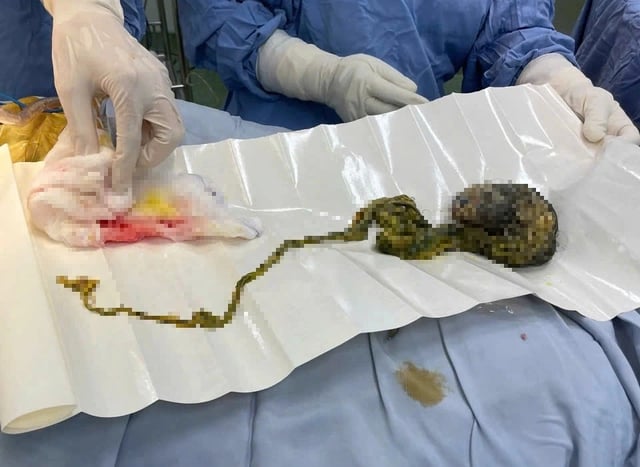
A large ball of hair occupied almost the entire stomach, extending down into the small intestine, requiring surgical intervention by doctors at Da Nang Obstetrics and Pediatrics Hospital.
PHOTO: D.X
What is Rapunzel syndrome?
In some exceptional cases, the hairball can extend down into the small intestine, causing a blockage, which is known as Rapunzel syndrome.
"Rapunzel syndrome is an extremely rare condition, primarily observed in children and adolescents, usually associated with prolonged trichophagia (hair-eating) due to an underlying psychological behavioral disorder. The majority of reported cases worldwide are girls aged 7-10. This case of a 6-year-old boy is very special," Dr. Phong stated.
According to doctors, the initial symptoms of trichobezoar are often nonspecific, such as prolonged abdominal pain, poor appetite, anemia, and malnutrition, making it easy to overlook. As the disease progresses, the hairball can cause intestinal obstruction, and even lead to dangerous complications such as inflammation and perforation of the intestine if not treated promptly.
Dr. Nguyen Phi Phong, a specialist in gastroenterology, emphasized: "Trichobezoar is not simply a mischievous behavior in children, but a real digestive disease. Surgery only addresses the mechanical consequences; to prevent recurrence, children need to be assessed and monitored psychologically and behaviorally after treatment."
Do not scold a child if you discover they are eating hair.
Doctors advise that scolding, punishing, or forcing children to stop hair-eating behavior abruptly is ineffective and may even increase psychological stress and cause them to hide the behavior. Parents should observe carefully, talk to their children gently, and take them to a medical facility if they suspect the behavior.
Notably, many children with trichobezoar continue to learn and develop normally, without exhibiting obvious psychological disorders, making it difficult for families to detect the condition early.
Therefore, diagnosis is often only made when the disease has progressed to a severe stage. Doctors advise parents to take their children for examination if they show signs such as: persistent abdominal pain of unknown origin, poor appetite, weight loss, anemia, or if they suspect their child is eating hair.
"Early detection and timely treatment play a crucial role in preventing serious complications and protecting children's long-term health," advised Dr. Nguyen Phi Phong, a specialist in pediatrics.
Source: https://thanhnien.vn/bui-toc-chiem-tron-da-day-be-trai-6-tuoi-185260201082752234.htm



![[Image] Hanoi Police officially crowned champions of V-League 2025/2026](https://vphoto.vietnam.vn/thumb/1200x675/vietnam/resource/IMAGE/2026/05/31/1780244769054_ndo_br_039d561b692be875b13a-jpg.webp)
![[Photo] The General Secretary, President and his wife begin their state visit to the Philippines.](https://vphoto.vietnam.vn/thumb/1200x675/vietnam/resource/IMAGE/2026/05/31/1780230559452_anh-man-hinh-2026-05-31-luc-19-28-11.png)

![[Photo] Solemn bathing ceremony and Buddha procession in Hue](https://vphoto.vietnam.vn/thumb/1200x675/vietnam/resource/IMAGE/2026/05/31/1780228263543_1-jpg.webp)
![[Photo] Admire the coral "masterpiece" amidst the million-year-old heritage of Dak Lak province.](https://vphoto.vietnam.vn/thumb/1200x675/vietnam/resource/IMAGE/2026/05/31/1780221235105_anh-man-hinh-2026-05-31-luc-16-53-27.png)


















![[Video] Sunset at Lap An Lagoon – Where the sun sets over the fishing nets](https://vphoto.vietnam.vn/thumb/340x192/vietnam/resource/IMAGE/2026/05/31/1780192137701_beach-landscape-sea-water-nature-grass-745871-pxhere-com.jpeg)



























![[Photo] Admire the coral "masterpiece" amidst the million-year-old heritage of Dak Lak province.](https://vphoto.vietnam.vn/thumb/402x226/vietnam/resource/IMAGE/2026/05/31/1780221235105_anh-man-hinh-2026-05-31-luc-16-53-27.png)
































Comment (0)