The numbers far exceeded expectations.
The coffee industry is one of the few agricultural sectors where production and trade data are compiled both annually and by crop year (from October of the previous year to September of the following year). In 2025, whether viewed from an annual or crop year perspective, the coffee industry still recorded extremely impressive export figures.
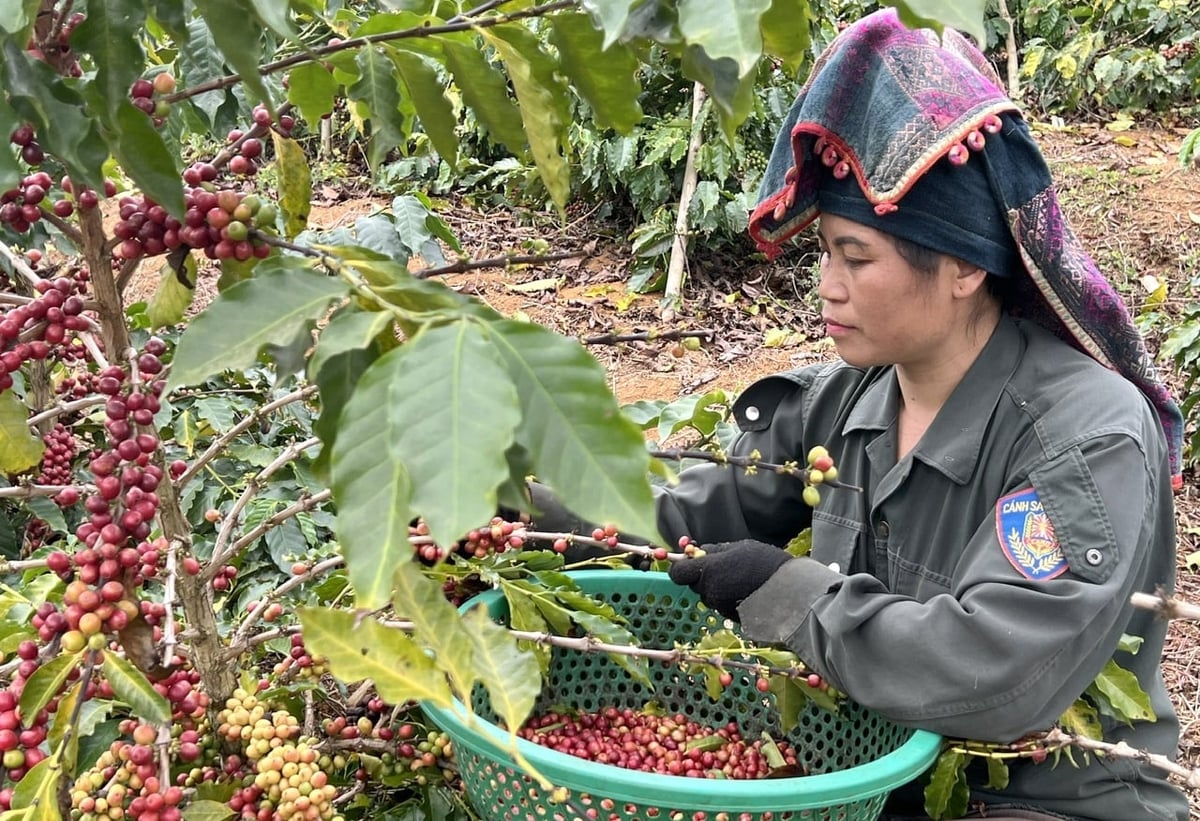
Farmers in Son La province harvest Arabica coffee. Photo: Thanh Son .
Looking at the crop year statistics, Mr. Do Ha Nam, Vice President of the Vietnam Coffee and Cocoa Association (VICOFA), said that in the 2024-2025 crop year (from October 2024 to September 2025), coffee exports reached over 1.5 million tons, with a value of more than 8.4 billion USD – the highest level in the history of any crop year to date.
If calculated on an annual basis, data from Vietnam Customs shows that from January 1, 2025 to mid-December 2025, coffee exports will reach 1.48 million tons, worth 8.36 billion USD, far exceeding the previous record of 5.62 billion USD in 2024. Thus, 2025 marks the first time in the history of Vietnam's coffee industry that export turnover – whether calculated by crop year or by year – will surpass the 8 billion USD mark.
Not long ago, when coffee exports were still above $3 billion, the coffee industry was grappling with the question of how to increase export revenue to $6 billion by 2030. Therefore, exceeding $8 billion in exports by 2025 is already well ahead of schedule and far beyond the goals the coffee industry had set.
The "sweet fruits" of coffee replanting.
Rising coffee prices on the world market are the main driving force for coffee exports to exceed $8 billion in 2025. In the 2024-2025 crop year, the average export price of Vietnamese coffee reached $5,610 per ton, a 52.7% increase compared to the previous crop year. In the first 11 months of 2025, the average export price reached $5,661 per ton, a 39.8% increase compared to the same period in 2024.
But high prices alone are not enough; if the coffee industry's internal strength is not solid, Vietnam will find it difficult to achieve record export figures. This internal strength has been continuously nurtured and improved through numerous programs and projects, most notably the coffee replanting program implemented from 2014 to the present.
Thanks to replanting and grafting, hundreds of thousands of hectares of coffee plantations have been "rejuvenated," improving productivity and bean quality, helping farmers feel secure in their commitment to coffee cultivation, and creating a solid foundation for the industry in the context of a volatile global market.
Currently, thanks to these efforts, Vietnam's coffee yield averages over 3 tons/ha, among the highest in the world, affirming its inherent strength and enabling the industry to confidently break through in the export market.
Speaking at the VICOFA's conference summarizing the 2024-2025 crop year and outlining the tasks for the 2025-2026 crop year, Deputy Minister of Agriculture and Environment Hoang Trung affirmed that replanting programs, specialty coffee programs, high-quality coffee programs, and coffee landscape programs implemented in many growing regions have significantly contributed to improving the quality and building a unique brand for Vietnamese coffee. Coffee currently ranks first in export value among all major crops in Vietnam.
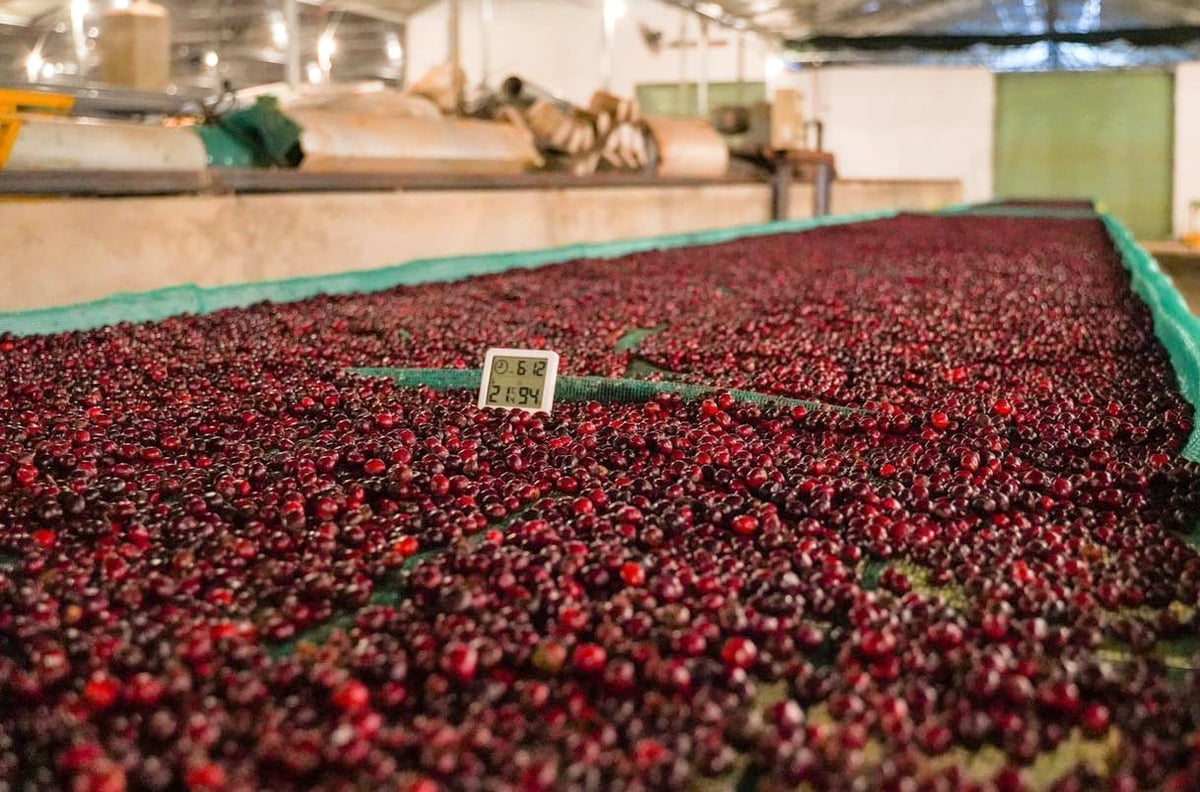
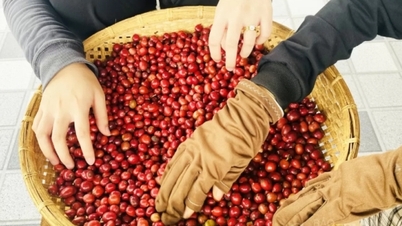
The coffee replanting program has improved the productivity and quality of Vietnamese coffee. Photo: Thanh Son .
The fact that Vietnamese coffee is ready to meet the European Union's Regulation on Deforestation (EUDR) is also a significant highlight for the Vietnamese coffee industry.
Deputy Minister Hoang Trung stated, "Over the past period, VICOFA and its member enterprises have closely coordinated with the Ministry of Agriculture and Environment and international partners to complete the traceability database for 137,000 hectares of coffee, which is expanding to 462,000 hectares – equivalent to 80% of the coffee area in the Central Highlands."
It is thanks to these efforts that the European Union has classified Vietnam as "low risk" in the implementation of the EUDR Regulation, inspecting only 1% of imported shipments. This is not only a recognition of the efforts of the Vietnamese coffee industry, but also a testament to the proactive, transparent, and responsible spirit of the nation."
Expanding the production of processed coffee
Another bright spot for Vietnam's coffee industry in 2025 is the continued strong and steady growth of processed coffee. According to VICOFA data, in the 2024-2025 crop year, the export value of processed coffee is expected to reach nearly $1.4 billion, mainly consisting of roasted and ground coffee and instant coffee.
According to a report by the US Department of Agriculture (USDA), Vietnam exported 500,000 bags of roasted and ground coffee (60kg/bag) in the 2024-2025 coffee season. It is projected that exports of roasted and ground coffee could increase to 700,000 bags in the 2025-2026 season. Also in the 2024-2025 season, Vietnam's instant coffee exports reached 2.5 million bags and are expected to reach 2.7 million bags in the 2025-2026 season.
To enhance the value of Vietnamese coffee, businesses have been accelerating the construction of coffee processing plants in recent years. Currently, the total capacity of instant coffee processing plants is approximately 110,000 tons of finished product per year, equivalent to about 250,000 tons of green coffee beans. It is projected that the production capacity of spray-dried and freeze-dried coffee in Vietnam will increase during the 2025-2026 period.
Amidst significant shifts in the global coffee market, particularly in China (where a coffee-drinking culture is gradually emerging, especially among young people and urban workers), Vietnamese coffee businesses are stepping up investment in raw material areas and deep processing with products such as roasted and ground coffee, instant coffee, and specialty coffee.
Boosting the production and export of high-value coffee products, sustainably certified coffee, and making good use of FTAs promises to help the coffee industry maintain high export turnover in the coming period.
Deputy Minister of Agriculture and Environment Hoang Trung affirmed, "Coffee is not only an agricultural product that brings high export value, but also the livelihood of millions of farming households, and a 'national brand' of Vietnam in the world agricultural market."
Source: https://nongnghiepmoitruong.vn/ca-phe-viet-nam-va-hanh-trinh-vuot-xa-ky-vong-d790368.html



![[Photo] Admire the coral "masterpiece" amidst the million-year-old heritage of Dak Lak province.](https://vphoto.vietnam.vn/thumb/1200x675/vietnam/resource/IMAGE/2026/05/31/1780221235105_anh-man-hinh-2026-05-31-luc-16-53-27.png)
![[Photo] The General Secretary, President and his wife begin their state visit to the Philippines.](https://vphoto.vietnam.vn/thumb/1200x675/vietnam/resource/IMAGE/2026/05/31/1780230559452_anh-man-hinh-2026-05-31-luc-19-28-11.png)
![[Image] Hanoi Police officially crowned champions of V-League 2025/2026](https://vphoto.vietnam.vn/thumb/1200x675/vietnam/resource/IMAGE/2026/05/31/1780244769054_ndo_br_039d561b692be875b13a-jpg.webp)
![[Photo] Solemn bathing ceremony and Buddha procession in Hue](https://vphoto.vietnam.vn/thumb/1200x675/vietnam/resource/IMAGE/2026/05/31/1780228263543_1-jpg.webp)
















![[Video] Sunset at Lap An Lagoon – Where the sun sets over the fishing nets](https://vphoto.vietnam.vn/thumb/340x192/vietnam/resource/IMAGE/2026/05/31/1780192137701_beach-landscape-sea-water-nature-grass-745871-pxhere-com.jpeg)

































































Comment (0)