

At the press conference announcing the Da Nang real estate market highlights for Q2/2025 by CBRE Vietnam (part of the US real estate services group CBRE), a reporter from Vietnam Business News interviewed Ms. Duong Thuy Dung - CEO of the company - about some unusual signs occurring in the area.
 CBRE Vietnam CEO Duong Thuy Dung presented a report on the highlights of the Da Nang real estate market in Q2/2025.
Ms. Duong Thuy Dung: According to CBRE Vietnam's records, the average selling price of high-rise residential buildings and apartments in the Da Nang market in the first six months of 2025 was approximately 85 million VND/m2, the highest in the country, exceeding even the average selling price in Ho Chi Minh City (82 million VND/m2) and Hanoi (79 million VND/m2); an increase of 27% compared to the same period last year (Hanoi increased by about 30-35%, Ho Chi Minh City increased by more than 20%).
Land prices in Da Nang are expected to increase by 15-20% in most major urban areas and key locations in the city during the first half of 2025; in some prime areas along the coast and riverbanks, the price increase could reach 20-25%. This is good news for the Da Nang market, however, in some aspects, the cost for buyers here is higher.
Currently, Da Nang seems to be experiencing a "land fever," a repeat of the situation in 2018-2020. In your opinion, is this a genuine land fever or a speculative bubble?
Ms. Duong Thuy Linh: When talking about land price surges, it's necessary to specifically investigate which areas are experiencing price increases to assess whether it's a land price surge or not. The definition of a land price surge includes both real and artificial price increases. In some areas, we observe many factors such as improved infrastructure, comprehensive master planning, and the participation of reputable investors contributing to the increase in land prices.
That's a real price increase. Buyers are now very knowledgeable; they can see that land prices there have indeed increased compared to before. However, they are still willing to spend money to buy because it's a genuine price increase. Nevertheless, there are also areas with artificial price increases, meaning prices are rising "following the trend."
This means there are areas where nothing has been developed yet, but "hearsay" there's talk of infrastructure development, mergers, or upcoming projects... leading to price increases. This "follow-the-trend" phenomenon does occur in Da Nang, but in our view, the artificial price surge in the area at this time is not as serious as it was in 2018-2020.
During the period of 2018-2020, Da Nang experienced a prolonged land price surge, but not many products were brought to the market. For several years afterward, there were also very few projects implemented in the area. However, in the last two years, many projects have been launched by reputable investors, and these projects have been selling very well.
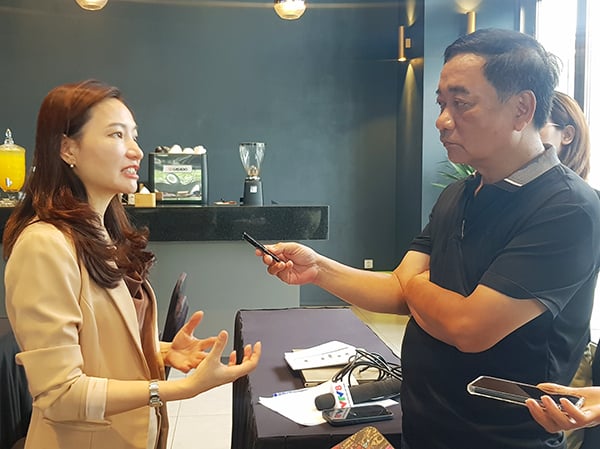
Ms. Duong Thuy Dung answers questions from a reporter of Vietnam Business.
Some argue that recently, when there's an oversupply of apartments, developers artificially inflate land prices to lure unsuspecting buyers into purchasing apartments instead of land. Then, when land projects launch onto the market, they use similar tactics to trick buyers into purchasing apartments instead. Do you believe such a practice of "luring unsuspecting buyers" exists, and what solutions are there to protect the legitimate rights of buyers?
Ms. Duong Thuy Dung: The "land speculation" phenomenon isn't just happening in Da Nang; it's also occurring in major markets like Hanoi and Ho Chi Minh City… Land prices that increase by more than 30% in just one day are definitely a bubble; it's impossible for land prices to increase so rapidly and genuinely. I can confidently say that savvy buyers would never accept such a price increase.
Perhaps the previous speculative land price surges were due to buyers fearing that someone else would buy them all if they didn't, but buyers are becoming increasingly savvy and will never invest in areas with such obvious speculative bubbles.
Whether or not there's a "scamming" tactic needs to be considered on a case-by-case basis, depending on the specific project. I think it could be a "ploy" to sell houses and land. This isn't unique to Da Nang; similar situations exist in other markets, such as Hanoi. Some projects even hire people to queue up to buy, but in reality, it's a fake queue…
The most effective solution to this problem must come from the buyers themselves, whether they are investing or buying for personal use. It is very difficult to prove that project owners or brokers intentionally inflate prices, and it is also very difficult for the authorities to intervene in this matter. Therefore, the best approach is for buyers to be vigilant and avoid falling into the trap of inflated prices.
Previously, buyers lacked information about price manipulation and scams, but now they are well-informed. They are now wise enough to assess the feasibility of their investment, rather than blindly following advertisements or promises from project owners, because even contractual agreements are often flimsy. More than anyone else, buyers themselves will be able to escape such traps.
Thank you, ma'am!
Source: https://doanhnghiepvn.vn/kinh-te/cach-nao-de-tranh-sap-bay-lua-ga-thoi-gia-bat-dong-san/20250724074618212
![[Photo] Prime Minister Pham Minh Chinh receives the Governor of Tochigi Province (Japan)](/_next/image?url=https%3A%2F%2Fvphoto.vietnam.vn%2Fthumb%2F1200x675%2Fvietnam%2Fresource%2FIMAGE%2F2025%2F12%2F16%2F1765892133176_dsc-8082-6425-jpg.webp&w=3840&q=75)
![[Photo] Prime Minister Pham Minh Chinh receives Lao Minister of Education and Sports Thongsalith Mangnormek](/_next/image?url=https%3A%2F%2Fvphoto.vietnam.vn%2Fthumb%2F1200x675%2Fvietnam%2Fresource%2FIMAGE%2F2025%2F12%2F16%2F1765876834721_dsc-7519-jpg.webp&w=3840&q=75)

![[Image] Leaked images ahead of the 2025 Community Action Awards gala.](/_next/image?url=https%3A%2F%2Fvphoto.vietnam.vn%2Fthumb%2F1200x675%2Fvietnam%2Fresource%2FIMAGE%2F2025%2F12%2F16%2F1765882828720_ndo_br_thiet-ke-chua-co-ten-45-png.webp&w=3840&q=75)

![[Live] 2025 Community Action Awards Gala](/_next/image?url=https%3A%2F%2Fvphoto.vietnam.vn%2Fthumb%2F1200x675%2Fvietnam%2Fresource%2FIMAGE%2F2025%2F12%2F16%2F1765899631650_ndo_tr_z7334013144784-9f9fe10a6d63584c85aff40f2957c250-jpg.webp&w=3840&q=75)







































![[Photo] Prime Minister Pham Minh Chinh attends the Vietnam Economic Forum 2025](https://vphoto.vietnam.vn/thumb/402x226/vietnam/resource/IMAGE/2025/12/16/1765893035503_ndo_br_dsc-8043-jpg.webp)


















Comment (0)