

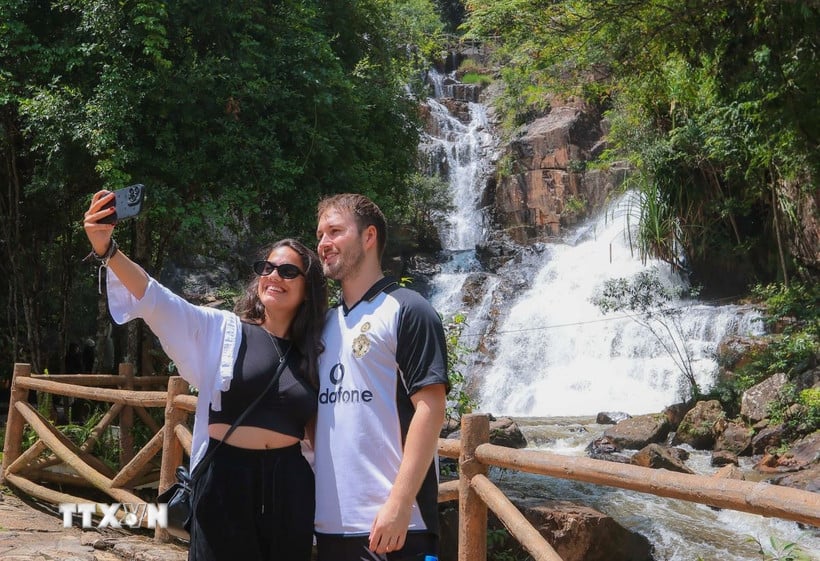
Tourists are delighted with the natural scenery of Datanla Waterfall (Photo: Hoang Hieu/VNA)
The Vietnamese passport has risen to 84th place out of 199 countries and territories, a significant increase from 91st place in Q1 2025 and three places higher than in 2024.
This is the official global announcement from Henley & Partners, dated July 22nd.
The fact that the Vietnamese passport has risen 7 places in the Henley Passport Index ranking for Q3 2025 is not only a positive sign for Vietnam's tourism industry to expand into the international market, but also opens up greater opportunities for Vietnamese citizens in tourism, trade, and global integration.
"A soft measure" of international trust.
The fact that the Vietnamese passport has risen 7 places in the Henley Passport Index 2025 is a positive sign, reflecting the international community's increased trust in Vietnam – a stable country with growth potential and a strong desire for integration.
This is one of Vietnam's biggest upgrades since Henley & Partners (based in London, UK) began compiling this index nearly 20 years ago, using proprietary data from the International Air Transport Association (IATA) to assess the freedom of travel for national passports.
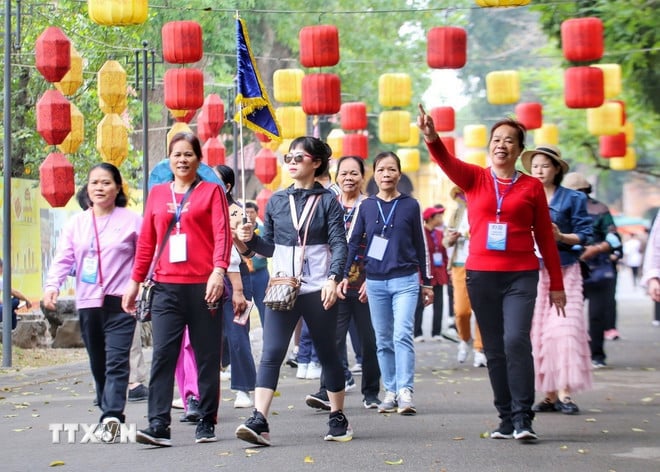
A group of Chinese tourists visiting the central historical site of Thang Long Imperial Citadel (Photo: Tuan Duc/VNA)
This result reflects positive developments in Vietnam's foreign policy, international prestige, and immigration management capacity.
The Henley Passport Index is assessed based on the number of countries and territories that a country's citizens can enter without a visa, or with only an e-visa, visa on arrival, or electronic travel authorization (ETA).
With 51 destinations allowing Vietnamese citizens to enter without a traditional visa, the Vietnamese passport now ranks alongside some other developing countries and is positioned in the lower-middle range globally.
However, this significant improvement in ranking in a short period of time is a noteworthy sign, indicating that the Vietnamese passport is gradually moving away from the bottom group, expanding travel opportunities for citizens in the context of increasingly deep international integration.
Currently, Vietnamese citizens can enter many countries across different continents without a visa or by applying for an e-visa.
This list includes ASEAN countries such as Brunei, Indonesia, Laos, Cambodia, Myanmar, Thailand, Singapore, and the Philippines. These are familiar destinations for Vietnamese people, both for tourism and trade.
In addition, Vietnamese citizens can also enter several African countries such as Burundi, Cape Verde, Comoros, Djibouti, Guinea-Bissau, Kenya, Madagascar, Malawi, Tanzania, as well as some South American and Central Asian countries such as Bolivia, Suriname, Panama, Kyrgyzstan, Kazakhstan and Tajikistan.
In Asia, Maldives and Iran are also destinations that do not require a visa for Vietnamese citizens.
Within Southeast Asia alone, the Vietnamese passport ranks above Laos (at position 92) and Myanmar (at position 93). Singapore continues to hold the most powerful passport in the region and globally , with its citizens enjoying visa-free access to 195 countries and territories.
Passport rankings are one of the tools that demonstrate a citizen's freedom of movement. In fact, passport rankings not only reflect the number of visa-free destinations but also serve as a "soft indicator" of international trust, political stability, public administration capacity, and the prestige of a country's citizens when traveling abroad.
A high-ranking passport reflects a safe, stable, and reliable country, attracting international visitors, especially high-end travelers from developed countries.
An increase in passport ranking is not simply a number; it reflects a citizen's access to the world, opportunities for education, business, and travel.
According to the General Statistics Office, in the first six months of 2025, the number of Vietnamese people leaving the country reached over 4 million, an increase of 53.9% compared to the same period in 2024.
Increase opportunities
Passport rankings are directly linked to bilateral diplomatic capabilities, transparency in administration, and trust in citizens. When countries value a nation's reputation, civic ethics, and immigration control system, they are more likely to ease visa requirements.
In recent years, Vietnam has made significant progress in these areas, from strengthening border security cooperation and improving e-passports to promoting bilateral visa waiver negotiations with countries in Asia, Africa, and the South Pacific region.
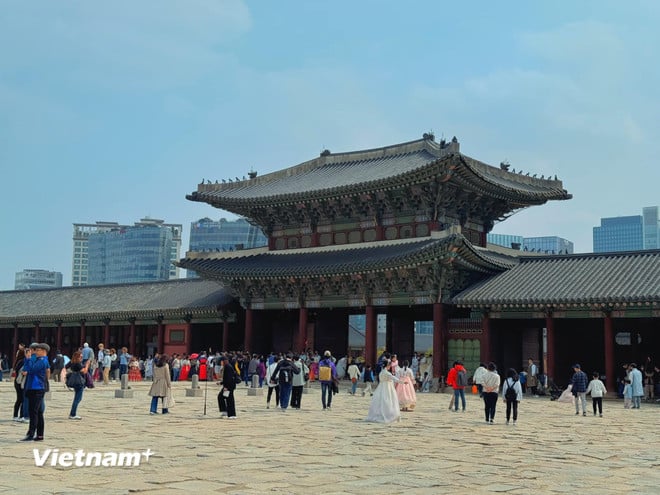
(Source: Vietnam+)
Ms. Dao Thi Kim Lan (Royal Tour) said that with visa exemption, Vietnamese people can easily travel abroad without facing visa barriers, thereby stimulating demand for overseas travel.
Domestic travel companies also have the opportunity to develop more products and services to take Vietnamese tourists abroad (outbound), thereby contributing to the development of the domestic tourism industry.
To increase the competitiveness and ranking of Vietnamese passports in the world rankings, according to Mr. Hoang Nhan Chinh, Head of the Secretariat of the Tourism Advisory Board (TAB), Vietnam needs to strengthen negotiations and sign visa exemption agreements, and promote bilateral cooperation with strategic partners such as ASEAN, the EU, and other developed countries.
At the same time, when traveling internationally, Vietnamese tourists also need to project a positive image because every citizen traveling abroad plays an important role in representing the national image.
Everyone needs to respect the customs and cultural norms of the host country, demonstrating understanding and appreciation for local traditions. By doing this, Vietnamese tourists will be even more respected when traveling abroad.
Mr. Vu Van Tuyen (General Director of Travelogy Vietnam) believes that passport rankings are not only the result of diplomatic efforts, but also reflect the image of Vietnamese citizens in the eyes of the world.
Each instance of law violation, illegal residency, or use of forged documents abroad can affect visa negotiation efforts between the two countries.
"Currently, Vietnam is striving to improve administrative efficiency, modernize passport issuance technology, and manage immigration. With the implementation of electronic chip passports, Vietnam is gradually catching up with international standards and enhancing security against forgery. These advancements will help increase the confidence of partner countries in the authenticity and transparency of Vietnam's document system. With current efforts and future potential, the increase in the ranking of Vietnamese passports is not only symbolic but also directly impacts the lives and opportunities of millions of people. These could be students wishing to study abroad, businesspeople needing to attend international trade fairs, workers seeking legal opportunities overseas, or simply tourists wanting to freely explore the world, because this is a key to enabling Vietnamese people to easily access the world – not only as tourists, but also as ambassadors of culture, education, commerce, and hospitality," Mr. Vu Van Tuyen shared. Share.
For the tourism industry in general, and outbound tourism in particular, upgrading passports means greater access to global tourism markets.
Vietnamese tourists will find it easier to obtain visas and will benefit from more favorable visa policies, especially in developed markets such as the EU, South Korea, Japan, and Australia.
The electronic passport system and transparent administrative data are crucial foundations for tourism businesses to develop high-end, specialized tour products targeting high-income customers and those seeking comprehensive service experiences – such as "conference tourism," "wellness tourism," or "luxury pilgrimage tourism" to markets like Europe, Australia, and North America.
This provides a strong impetus for tourism businesses to expand international tour products, enhancing Vietnam's competitiveness on the regional and global tourism map.
According to Vietnam+
Source: https://www.vietnamplus.vn/ho-chieu-viet-nam-tang-7-bac-co-hoi-nang-tam-du-lich-and-hoi-nhap-toan-cau-post1052071.vnp
Source: https://baolongan.vn/ho-chieu-viet-nam-tang-7-bac-co-hoi-nang-tam-du-lich-and-hoi-nhap-toan-cau-a199601.html


































































Comment (0)