
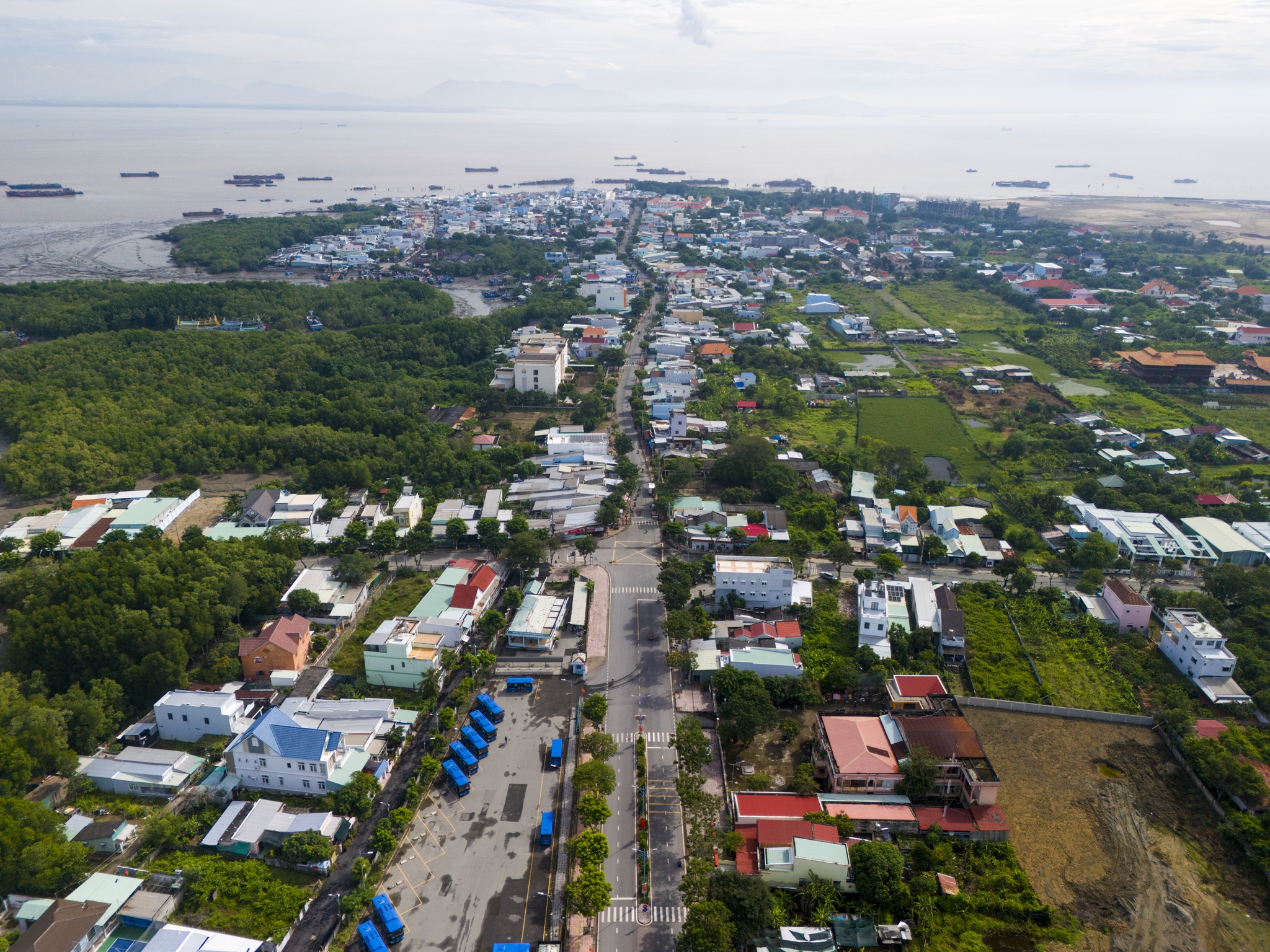
More than a year ago, whenever people and tourists visited Can Gio, they would easily encounter deserted roads, sparse shops, and limited accommodation options. But now, that picture has changed dramatically.
During peak hours, many roads experience localized traffic congestion as thousands of workers and engineers leave their shifts at major construction sites. The Binh Khanh ferry – almost the only connection between the center of Ho Chi Minh City and Can Gio – is also frequently overloaded with people and vehicles heading to the area.
These changes partly reflect the rapid transformation of Can Gio over the past year.
Can Gio was unrecognizable after just over a year.
In fact, for many years prior, Can Gio was largely outside the development wave of Ho Chi Minh City due to its geographical distance and limited infrastructure. Reliance on the Binh Khanh ferry resulted in long travel times, logistical difficulties, and significantly limited its ability to attract investment. However, over the past year or so, the area has entered an unprecedented period of rapid transformation.
The biggest turning point came with the presence of Vingroup Corporation in the Can Gio reclaimed land urban area project, commercially known as Vinhomes Green Paradise. This is a massive 2,870-hectare reclaimed land mega-urban area that commenced construction last April.
When the project first began, many were skeptical about the feasibility of realizing a large-scale urban development project on reclaimed land in Can Gio. However, after just over a year, the construction area has gradually taken shape, with many sections already leveled. The massive construction site now maintains thousands of workers on a regular basis.
According to Mr. Nguyen Duc Hoa, a real estate agent specializing in the Can Gio market, the influx of workers and engineers to the project, coupled with relatively high incomes, has led to rapid changes in the local service market.
"Previously, this area didn't have many services or restaurants. But as the number of people flocked here increased sharply, the demand for accommodation and daily necessities also increased, forcing the market to change to meet the demand," he said.
|
The Tắc Xuất road connects the Cần Giờ - Vũng Tàu sea ferry, passing through existing residential areas and heading straight into the Cần Giờ reclaimed land urban area. Photo: Quỳnh Danh. |
According to Mr. Hoa, the demand for rental space on main roads such as Duyen Hai and Thanh Thoi has increased sharply recently. A vacant plot of land of about 200 m2 can now be rented for around 15 million VND/month, whereas previously almost no one inquired about renting it.
Not only commercial properties, but the rental housing market has also become vibrant. Many investors are flocking to lease land to build rental properties, or landowners are investing in accommodation facilities themselves and then leasing them out to others for management to generate a stable income stream.
In particular, Thanh Thoi and Tac Xuat roads – the two main access routes to the Vingroup project – are becoming hotspots for rental space and accommodation demand. The Giong Ao area, in particular, is considered suitable for developing boarding houses to serve the workforce.
"A room with an area of about 15 square meters and air conditioning is currently being rented for 3-4 million VND per month," he added.
According to Mr. Hoa, it's not just large-scale businesses that are benefiting; many small-scale businesses such as selling breakfast food, coffee from pushcarts, or food stalls serving workers are also starting to generate significant income for local people.
Bustling infrastructure
Alongside the bustling service market, a series of infrastructure projects connecting Can Gio with the center of Ho Chi Minh City are also being accelerated.
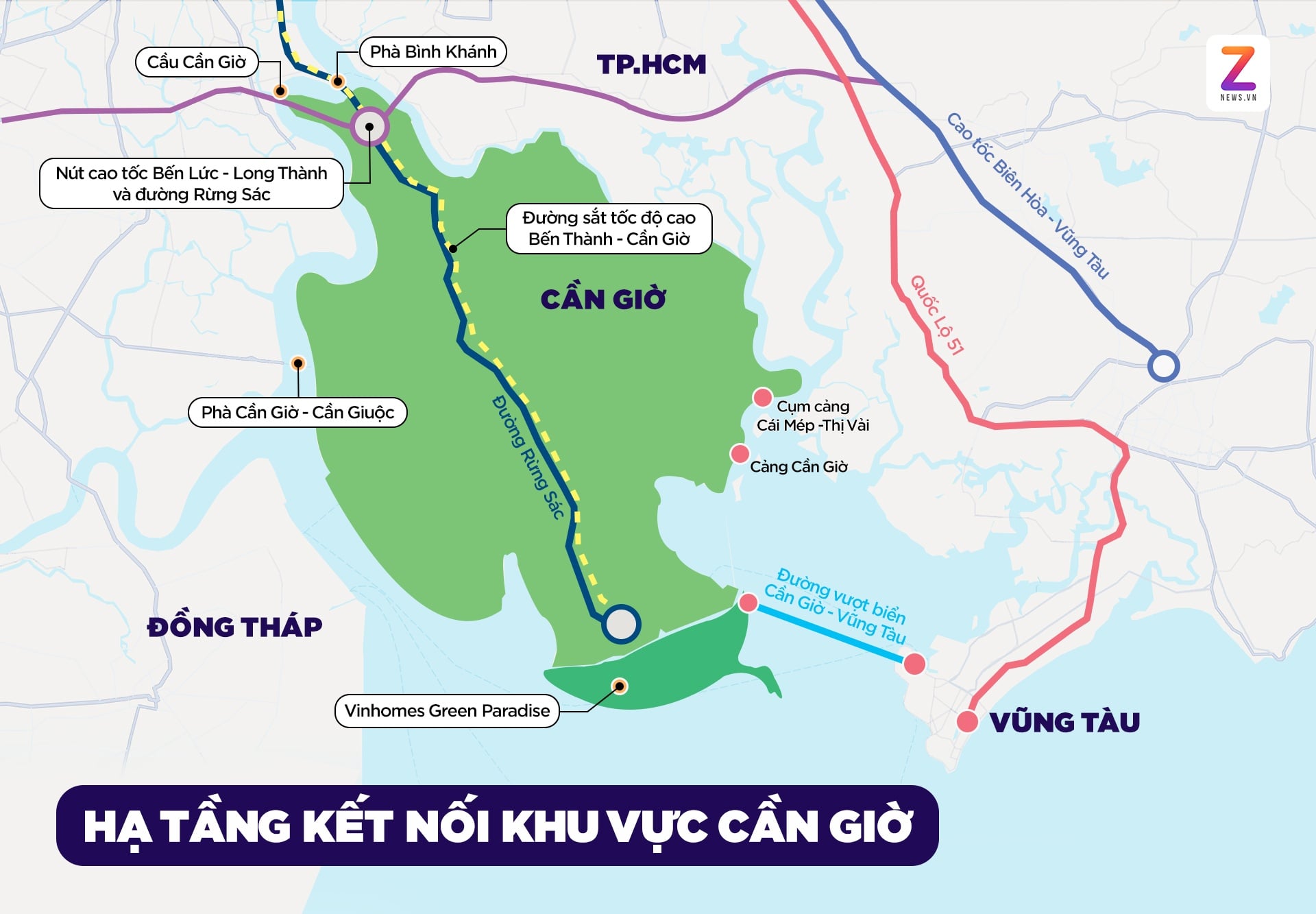
Earlier this year, the Can Gio Bridge project officially broke ground. The project has a total length of approximately 6.3 km, crossing the Soai Rap River to connect Can Gio with Nha Be. The project includes a main bridge nearly 3 km long along with a system of smaller bridges and access roads, designed with 6 lanes and a maximum speed of 80 km/h.
According to the plan, when completed in about three years, the travel time from the center of Ho Chi Minh City to Can Gio will be shortened to approximately 45-60 minutes. This is considered a major turning point for the connectivity and development of the marine economy , logistics, and tourism in the region.
Besides the Can Gio Bridge, many other large-scale projects are also being promoted, such as the Ben Thanh - Can Gio metro line, the Can Gio - Vung Tau sea-crossing road project, and the plan to expand the Rung Sac road.
Currently, most projects are still in the preparation or initial implementation phase, so they haven't yet created a significant impact on traffic. However, if implemented on schedule, this infrastructure system will open up entirely new development opportunities for Can Gio in the coming years.
|
Connectivity infrastructure in Can Gio. Graphic: Phan Nhat. |
These connecting infrastructure projects not only serve the transportation needs of the people but also aim to serve the future Can Gio international transshipment port. The $5 billion mega-port aims for a capacity of up to 17 million TEUs. At that time, the project could generate revenue of 34,000-40,000 billion VND per year, while creating 6,000-8,000 direct jobs and tens of thousands of indirect jobs.
According to economist Dr. Dinh The Hien, with its development orientation towards seaports, logistics, tourism , and urban areas, Can Gio could become one of the new growth drivers for Ho Chi Minh City.
According to him, in addition to its advantages in terms of seaports, this area also has the potential to develop ecotourism and attract high-quality labor thanks to its large land area and unique coastal landscape.
In fact, in Ho Chi Minh City's development plan, Can Gio is being identified as a new growth pole, especially in the fields of tourism and marine economy.
To prepare for this development phase, Ms. Vo Thi Diem Phuong, Vice Chairman of the People's Committee of Can Gio commune, said that the locality is simultaneously implementing many groups of solutions regarding infrastructure, urban models, and human resources.
According to her, many large-scale projects have already been invested in the area, creating a foundation for transforming Can Gio from a weekend tourist destination into a year-round service and tourism development zone.
Simultaneously, Can Gio commune is also implementing a roadmap to develop into a ward following the model of a coastal ecological urban area of Ho Chi Minh City. According to local leaders, this is not only an administrative change but also linked to the requirements of upgrading urban management, administrative reform, and digital transformation.
In addition to infrastructure and urban models, the locality is also orienting its economic structure towards trade, services, and marine ecotourism, while focusing on training human resources to meet development needs in the coming period.
Source: https://znews.vn/can-gio-da-khac-post1654907.html


![[Image] Nearly 125,000 Hanoi students completed the Literature exam for the 10th grade entrance exam.](https://vphoto.vietnam.vn/thumb/1200x675/vietnam/resource/IMAGE/2026/05/30/1780117233041_ndo_br_thiet-ke-chua-co-ten-2-png.webp)
















![[Photo] Admire the coral "masterpiece" amidst the million-year-old heritage of Dak Lak province.](https://vphoto.vietnam.vn/thumb/1200x675/vietnam/resource/IMAGE/2026/05/30/1780107638639_y25-jpg.webp)

















































Comment (0)