

Can Tho City will issue local government bonds to raise approximately 2,000 billion VND over the next two years to fund development investments.
The bond issuance plan is currently being implemented by Can Tho City. Accordingly, the amount raised, approximately 1,000 billion VND per year (2,000 billion VND over two years), will be invested in key local projects, resettlement projects, landslide prevention, and urban beautification. The funds will be repaid from the city's budget upon maturity.
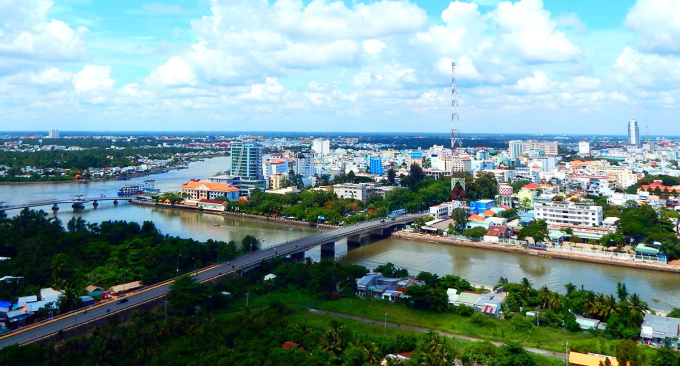
A view of Can Tho City in the central Ninh Kieu district. Photo: An Binh
The bond issuance is carried out in accordance with Resolution No. 45/2022 of the National Assembly on piloting some specific mechanisms and policies for the development of Can Tho City. Accordingly, the locality is allowed to borrow through the issuance of local government bonds from domestic financial institutions, foreign loans from the Government, etc., with the total outstanding debt not exceeding 60% of the city's allocated budget revenue.
In 2023, Can Tho's budget revenue was estimated at over 10,000 billion VND. Therefore, the locality will be eligible to borrow a maximum of over 6,000 billion VND. Of this, the total outstanding debt projected by the end of 2023 for Can Tho is 2,685 billion VND, so the additional loan amount is approximately 3,329 billion VND. In 2024, Can Tho's projected domestic revenue is over 11,600 billion VND. At that time, the local budget revenue will be 11,115 billion VND, corresponding to the city's maximum total outstanding debt of over 6,600 billion VND.
According to the plan for next year, the locality will continue to implement the Urban Development and Resilience Enhancement project using re-loan capital from the Government's ODA loan source with an amount exceeding VND 1,320 billion and is expected to issue local government bonds worth VND 1,000 billion. Thus, the total outstanding debt of the city is expected to not exceed the permitted limit (over VND 4,700 billion) by the end of 2024.
Can Tho is one of the five centrally-governed cities and the largest urban area in the Mekong Delta with over 1.2 million inhabitants. During the period 2015-2020, the locality achieved an average economic growth rate of 7.53% per year, per capita income reached 97.2 million VND (equivalent to 4,136 USD); and export turnover of goods and services earning foreign currency exceeded 11 billion USD (an average increase of 19.75% per year).
For the period 2020-2025, Can Tho aims for an economic growth rate (GRDP) of 7.5-8% per year. The average per capita gross regional product is targeted to reach 145-160 million VND by 2025, equivalent to 6,200-6,800 USD. The poverty rate is also targeted to be reduced to below 0.5% by 2025.
Can Tho is considered to have underdeveloped compared to its location and potential. The quality of urban planning is not high, and there are many shortcomings such as: inconsistent infrastructure, traffic congestion, increasing flooding, environmental pollution, illegal construction, etc.
During this term, the city will focus on building and developing into a civilized, modern urban center with a strong identity of the Southwestern region of Vietnam; a center of the Mekong Delta for industry, services serving processing industries and high-tech applied agriculture; education and training, specialized healthcare, etc.
An Binh
Source link

![[Photo] Solemn bathing ceremony and Buddha procession in Hue](https://vphoto.vietnam.vn/thumb/1200x675/vietnam/resource/IMAGE/2026/05/31/1780228263543_1-jpg.webp)
![[Image] Hanoi Police officially crowned champions of V-League 2025/2026](https://vphoto.vietnam.vn/thumb/1200x675/vietnam/resource/IMAGE/2026/05/31/1780244769054_ndo_br_039d561b692be875b13a-jpg.webp)

![[Photo] The General Secretary, President and his wife begin their state visit to the Philippines.](https://vphoto.vietnam.vn/thumb/1200x675/vietnam/resource/IMAGE/2026/05/31/1780230559452_anh-man-hinh-2026-05-31-luc-19-28-11.png)
![[Photo] Admire the coral "masterpiece" amidst the million-year-old heritage of Dak Lak province.](https://vphoto.vietnam.vn/thumb/1200x675/vietnam/resource/IMAGE/2026/05/31/1780221235105_anh-man-hinh-2026-05-31-luc-16-53-27.png)























![[Video] Sunset at Lap An Lagoon – Where the sun sets over the fishing nets](https://vphoto.vietnam.vn/thumb/340x192/vietnam/resource/IMAGE/2026/05/31/1780192137701_beach-landscape-sea-water-nature-grass-745871-pxhere-com.jpeg)



































![[Photo] Admire the coral "masterpiece" amidst the million-year-old heritage of Dak Lak province.](https://vphoto.vietnam.vn/thumb/402x226/vietnam/resource/IMAGE/2026/05/31/1780221235105_anh-man-hinh-2026-05-31-luc-16-53-27.png)
































Comment (0)