

European Vision
The European Union (EU) is in the final stages of agreements to operate the €5 billion Scaleup Europe fund, aimed at bridging the financing gap and retaining fast-growing technology companies (scaleups) in Europe.
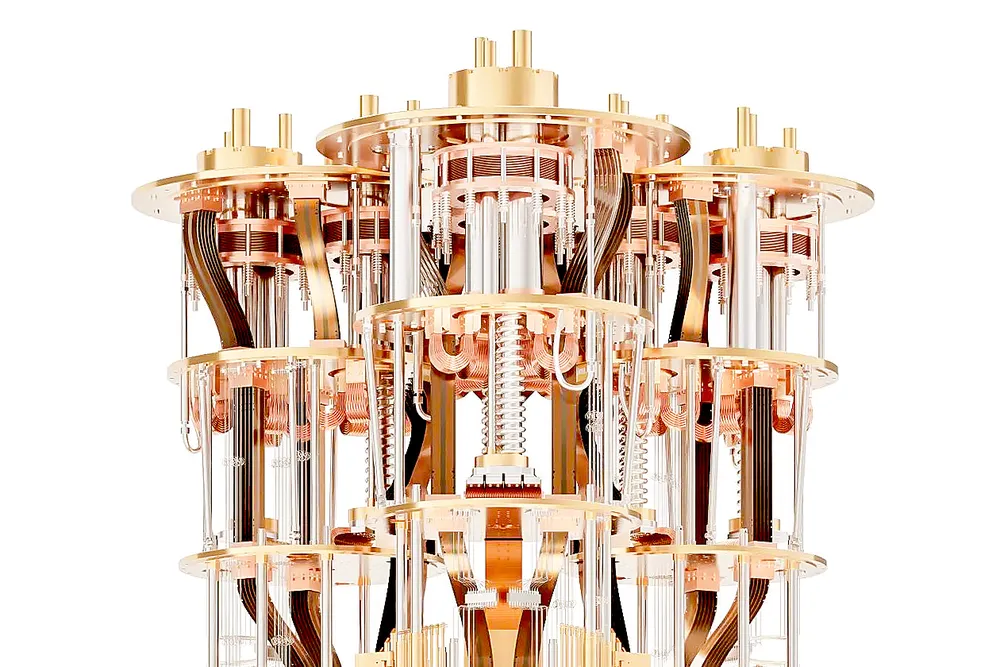
On May 22, President Emmanuel Macron announced that France would invest an additional €1 billion in quantum computing, following a €2.3 billion investment since 2021 in quantum research, including the defense sector. Speaking at the supercomputing center in Bruyères-le-Châtel, where the Lucy quantum computer was inaugurated in April, Macron called on the National Centre for Scientific Research (CNRS), the Atomic Energy Commission (CEA), and other French research institutions to form a European research and technology alliance.
This is a step towards asserting digital sovereignty and enhancing Europe's core competitiveness. Building a comprehensive quantum supply chain, from hardware and processing chips to cybersecurity infrastructure and application libraries, is expected to help the EU reduce its dependence on external sources and strengthen its security and defense foundations in the digital age.
According to National Business Daily, this month, China's quantum technology industry continues to make new strides with Origin Quantum launching its fourth-generation superconducting quantum computer, Origin Wukong-180; the Institute of Refrigerated Atomic Technology of the Chinese Academy of Sciences announcing what they describe as the world's first dual-core quantum computer; and the University of Science and Technology of China introducing the Jiuzhang 4.0 photonic quantum computer.
Macron emphasized that Germany's Helmholtz, Max Planck, and Fraunhofer Institutes; the Netherlands' TNO; and Belgium's Imec are potential partners in a common strategy prioritizing Europe, aiming to ensure the region's sovereignty over strategic technologies such as chips, quantum technology, and artificial intelligence.
According to the World Economic Forum, quantum technology in Europe is gradually integrating into the broader high-tech industrial ecosystem. Over the past five years, funding for quantum research and development (R&D) has reached record levels, with €2 billion from the EU's general budget and an additional €9 billion from the budgets of member states.
America's determination
Across the Atlantic, President Donald Trump's administration plans to invest more than $2 billion in nine quantum computing companies to build domestic quantum chip foundries. According to a May 21st announcement from the U.S. Department of Commerce, this investment is allocated under the CHIPS and Science Act, which supports domestic quantum research institutes and computing businesses, with the government holding minority stakes in each funded company. IBM will receive $1 billion and GlobalFoundries $375 million to establish Anderon, a quantum chip manufacturer in New York State, expected to become the first dedicated U.S. facility in this field. The remaining $538 million will be divided among seven companies (Atom Computing, D-Wave, Infleqtion, PsiQuantum, Quantinuum, Rigetti, and Diraq).
Following the announcement, shares of many quantum computing companies surged, with some rising by more than 30%. According to the Financial Times, this represents a significant intervention by the US government in the global quantum market, marking the first time Washington has directly acquired stakes in quantum computing companies, rather than merely funding research as before. This move suggests the quantum race is shifting from laboratory competition to state-level industrial competition.
This is the latest move by Washington to bolster strategic technology supply chains, reduce dependence on China, and have a significant impact on capital markets. According to Asia Times, shares of leading Chinese quantum computing companies have risen by about 20% in two trading sessions after the US announced a $2 billion funding package, as investors expect Beijing to retaliate to catch up in the global quantum computing race.
Quantum technology is a field that exploits the properties of quantum mechanics, such as superposition, entanglement, and quantum measurement, to develop computing, communication, sensing, and encryption systems with superior capabilities in a number of specialized tasks. This technology is prioritized by major powers because it can have a profound impact on information security, defense, and future technology.
Source: https://www.sggp.org.vn/chay-dua-lam-chu-cong-nghe-luong-tu-post854575.html


![[Photo] Standing Committee member of the Party Central Committee Tran Cam Tu working with the Central Inspection Committee](https://vphoto.vietnam.vn/thumb/1200x675/vietnam/resource/IMAGE/2026/05/28/1779969579668_ndo_br_bnd-2495-jpg.webp)






















































































Comment (0)