

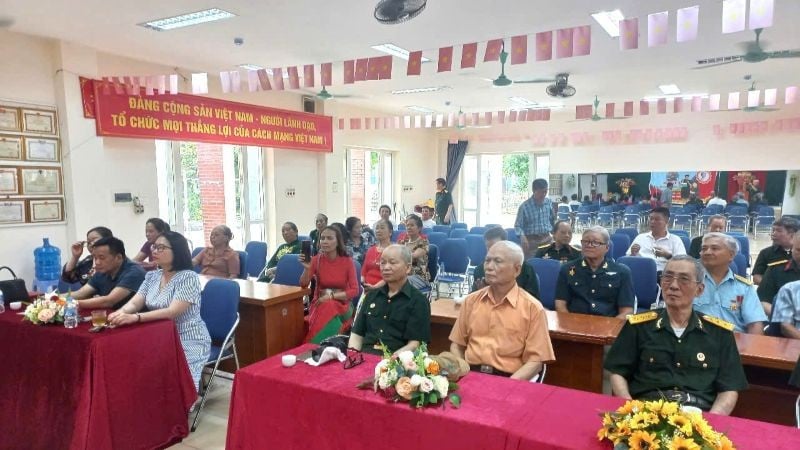
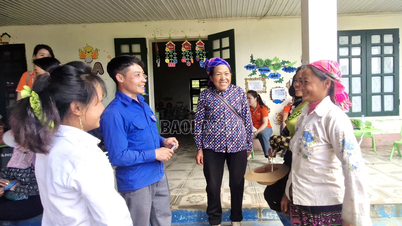
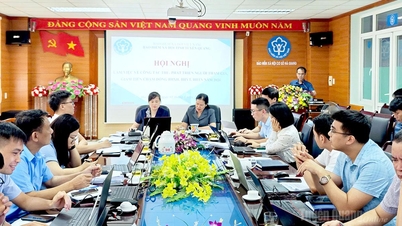
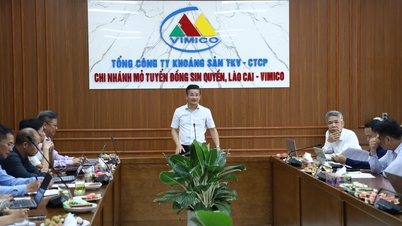
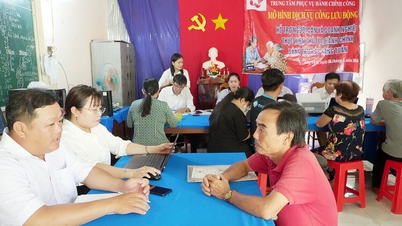
A scene from a neighborhood meeting in Tu Liem ward, Hanoi . (Photo: Reporter)
Accordingly, the review and streamlining of personnel will be carried out in conjunction with restructuring and improving the quality of cadres, civil servants, and public employees at the commune level to meet job requirements, ensuring that this is basically done within 5 years as stipulated.
The government also stipulated the termination of the use of part-time personnel at the commune level; assigned local authorities to consider and potentially arrange for part-time personnel at the commune level to meet job requirements and participate in work at the village and neighborhood levels; and implemented a policy of termination for part-time personnel at the commune level who are not assigned work as prescribed.
Based on population size, natural area, and socio-economic development level of commune-level administrative units, the Government directs the allocation of total local government staff positions at the commune level to localities (expected average of approximately 32 positions per commune). Based on this, the provincial-level local government is tasked with deciding the number of staff positions for each commune-level administrative unit within its jurisdiction to suit practical requirements.
According to the new regulations, part-time workers in villages and residential areas will be eligible for mandatory social insurance from July 1, 2025. Furthermore, the regulations state that part-time workers in villages and residential areas holding no more than three positions (including Party branch secretary, village head or residential area leader, and head of the Fatherland Front committee) will receive a monthly allowance.
Accordingly, when participating in compulsory social insurance, village heads will be entitled to the following benefits: sickness, maternity, retirement, death, occupational accident insurance, and occupational disease insurance as stipulated in the 2015 Law on Occupational Safety and Health.
For villages with 350 or more households; residential areas with 500 or more households; villages and residential areas belonging to key and complex commune-level administrative units in terms of security and order as decided by competent authorities; and villages and residential areas belonging to commune-level administrative units in border and island areas, the allowance fund is allocated at 6.0 times the basic salary.
In cases where a village with 350 or more households is transformed into a residential area due to the establishment of a commune-level urban administrative unit, the allowance fund will remain at 6.0 times the basic salary.
For villages and residential areas not covered by the regulations mentioned above, the allowance fund is allocated at 4.5 times the basic salary.
In cases where part-time officials at the commune, village, or neighborhood level concurrently perform the duties of other part-time officials at the same level, they are entitled to a concurrent duty allowance equal to 100% of the allowance stipulated for the concurrently held position.
However, the specific benefit level for each position will be determined based on: the allowance fund allocated by the central budget to each village and residential area; the budget allocated for salary reform; and the specific circumstances of each village.
Through this process, the People's Committee submits to the Provincial People's Council regulations on the allowance levels for each non-specialized position at the village level, including village head and neighborhood group leader.
According to nhandan.vn
Source: https://baotuyenquang.com.vn/xa-hoi/202509/chinh-sach-moi-cho-truong-thon-to-truong-dan-pho-29b0e16/
![[Photo] Secretary of the National Assembly Party Committee, Chairman of the National Assembly presides over the meeting of the Standing Committee and Executive Committee of the National Assembly Party Committee.](https://vphoto.vietnam.vn/thumb/1200x675/vietnam/resource/IMAGE/2026/06/03/1780480353201_ndo_br_bnd-2585-jpg.webp)
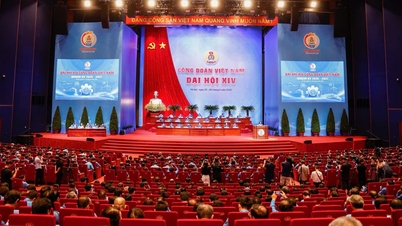
![[Photo] First session of the 14th Congress of the Vietnam Trade Union](https://vphoto.vietnam.vn/thumb/1200x675/vietnam/resource/IMAGE/2026/06/03/1780465947883_ndo_br_img-3852-jpg.webp)



![[Photo] General Secretary and President To Lam presides over a meeting with the Central Organizing Committee.](https://vphoto.vietnam.vn/thumb/1200x675/vietnam/resource/IMAGE/2026/06/03/1780482764658_a1-bnd-4741-3342-jpg.webp)










































![[Video] Sunset at Lap An Lagoon – Where the sun sets over the fishing nets](https://vphoto.vietnam.vn/thumb/1200x675/vietnam/resource/IMAGE/2026/05/31/1780192137701_beach-landscape-sea-water-nature-grass-745871-pxhere-com.jpeg)






























Comment (0)