

From May 15, 2026, Decree No. 90/2026/ND-CP officially comes into effect, supplementing penalties for the use of e-cigarettes and heated tobacco products. Specifically, the act of using e-cigarettes can be fined from 3 to 5 million VND; in cases where business owners allow others to use them on premises under their management, they can be fined from 5 to 10 million VND.
The new regulations are expected to contribute to improving public health protection and building a civilized public environment. However, at many cafes and beverage shops, the practical implementation also presents numerous challenges that require adaptation in the initial stages.
Observations at several businesses in Hanoi show that many establishments have begun adding signs prohibiting the use of e-cigarettes, and have also instructed staff to remind customers more frequently.

Duy Cuong's coffee shop in Hanoi.
Mr. Duy Cuong, the owner of a coffee shop in Hanoi, believes that the fine of 5 to 10 million VND for business owners is relatively strict and sufficient to deter businesses from taking responsibility for better management.
According to Mr. Cuong, the shop had proactively prepared before the decree came into effect. Staff were instructed to increase their vigilance in the common areas, and if they detected customers using or preparing to use e-cigarettes, they would promptly remind them.
"We cannot completely prohibit customers from exercising their privacy. However, if a customer needs to use the service, our staff will guide them to an outside area to avoid disturbing others," Mr. Cuong shared.
According to Mr. Cuong, in addition to posting visual signs prohibiting traditional cigarettes and e-cigarettes, direct reminders from staff are still more effective in practice.
"Many people, even though they know that using e-cigarettes in public is against the law, still intentionally use them. Therefore, subtle but firm reminders from staff will help raise customers' awareness better," Mr. Cuong said.
Regarding business operations, Mr. Cuong stated that strictly adhering to the new regulations did not significantly affect the shop's revenue because, from the beginning, the group of customers using e-cigarettes was not the main target customer base for the establishment.
From another perspective, some businesses believe that implementing the new regulations in practice will require more time for both businesses and customers to adapt.

Mr. Do Trung Duc, owner of Toor Coffee.
According to Mr. Do Trung Duc, owner of Toor Coffee, the measures many cafes can currently implement mainly involve posting notices or asking staff to remind customers.
"Regarding preparations, the shops can only put up signs or remind customers, but completely banning it is very difficult. It's like traditional cigarettes; in reality, it's very difficult to completely prevent customers from using them in all circumstances," Mr. Duc shared.
According to Mr. Duc, the number of customers using e-cigarettes is quite large nowadays, especially among young people. Therefore, if establishments refuse service or handle the situation too harshly, they may face the risk of losing a significant number of customers.
"When customers are reminded of the rules or refused service, there's a high chance the establishment will completely lose that customer base. Many customers even react negatively, saying that traditional cigarettes are still allowed in some places, while e-cigarettes, which don't have much of a smell, are not permitted," Mr. Duc said.
According to the business owner, while stricter regulation of e-cigarettes is necessary, efforts should be focused on raising user awareness and controlling the supply chain, rather than placing excessive pressure on businesses providing this service.

"My view is that people should be encouraged to report cases of illegal e-cigarette use. At the same time, we could consider not penalizing business owners in cases where customers use e-cigarettes on their own initiative, because if we strictly enforce penalties, many businesses will be significantly affected," Mr. Duc suggested.
E-cigarettes are still "living underground" on social media.
Besides enforcement at service points, the buying and selling of e-cigarettes online remains complex despite being strictly prohibited by Resolution No. 173/2024/QH15, which came into effect on January 1, 2025.


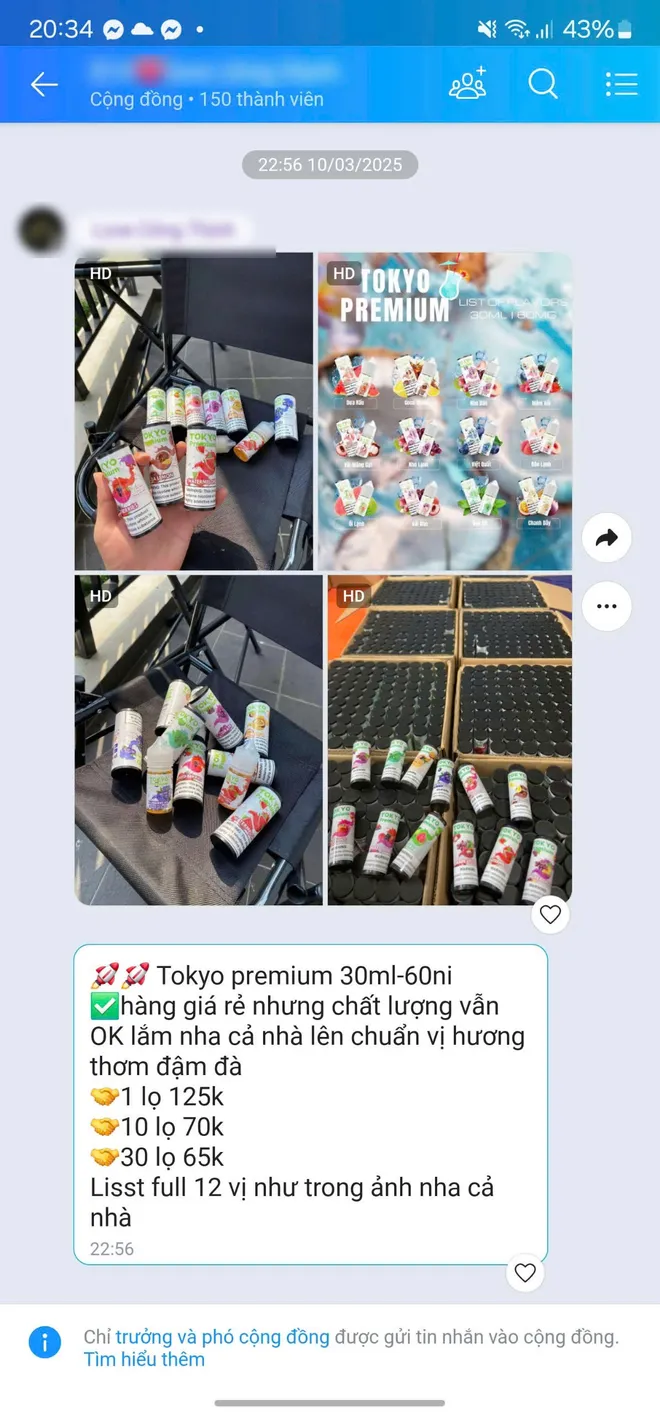
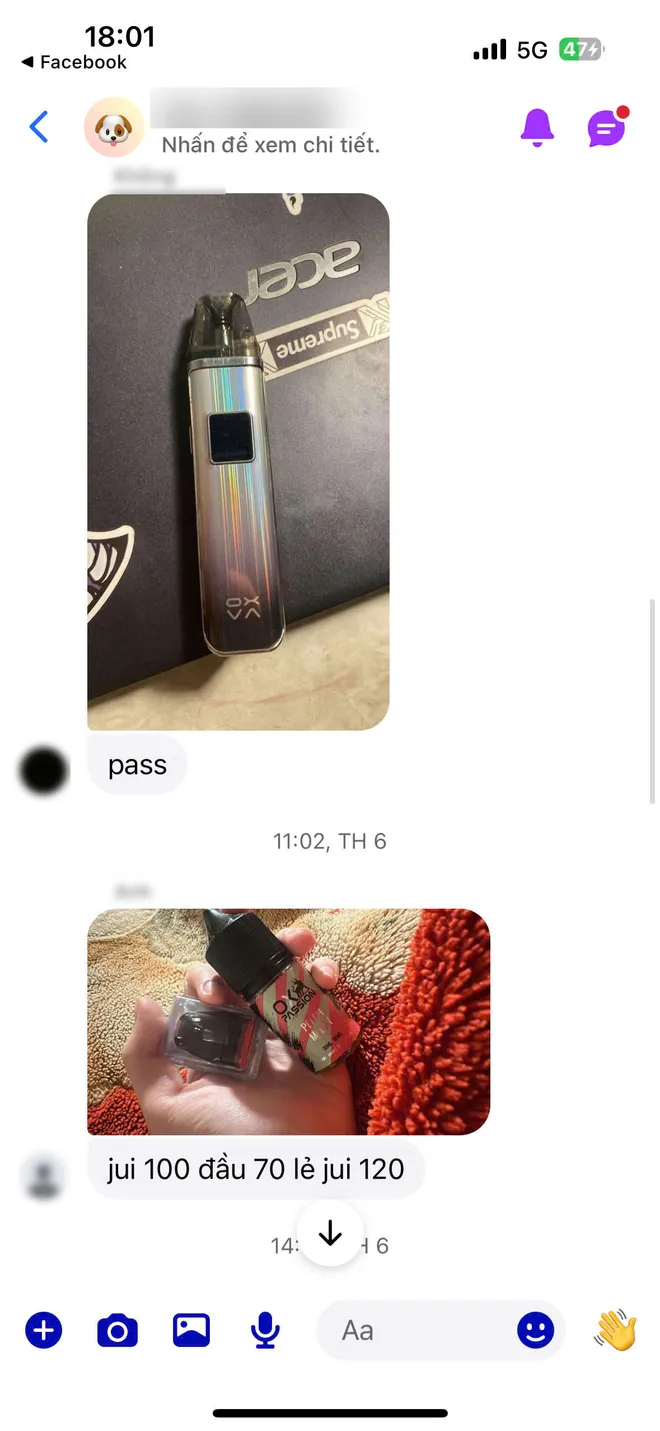
In reality, simply typing the keyword "pod system" into Facebook's search bar easily reveals numerous posts advertising and promoting e-cigarette products, along with many large, publicly accessible groups. To avoid censorship, many accounts even use slang terms like "juicer" or "juice maker" instead of the product's common name.



Most transactions are conducted through private messages or closed groups on Zalo and Instagram. After contacting the seller, buyers are instructed to pay online and receive goods via technology-based delivery services, making it difficult for authorities to inspect and handle violations.
Furthermore, the online sale of e-cigarettes also poses many risks of fraud and embezzlement against consumers.
Besides making management difficult, the online sale of e-cigarettes also poses many risks of fraud and embezzlement against consumers.
Recently, the Phu Tho Provincial Police have prosecuted and detained two individuals for fraud involving the sale of e-cigarettes on social media. According to investigators, the suspects created numerous Facebook pages advertising cheap "pod systems," then used cash-on-delivery (COD) shipping to swap out genuine products, defrauding thousands of buyers nationwide of nearly 3 billion VND.
Initially, authorities determined that, through this scheme, from February 2026 to the present, Nguyen Van Tung had fraudulently sold 5,108 orders, appropriating 1,567,639,759 VND; and from November 2025 to the present, Nguyen Van Dat had fraudulently sold 3,923 orders, appropriating 1,188,874,673 VND.

Suspect Nguyen Van Dat (left) and suspect Nguyen Van Tung (right). Photo: Provided by the police.
Notably, these scammers exploit buyers' reluctance to inspect goods, as these are prohibited items, by requiring customers to pay upfront before opening the package. Once buyers discover the product doesn't match the advertisement, the sellers immediately cut off communication.
The above incident shows that buying and selling e-cigarettes through social media groups and accounts not only poses a risk of violating the law but also carries many risks of fraud, information security breaches, and property loss for consumers. Authorities also advise people to be more vigilant and limit transactions of goods of unknown origin on social media, especially those that are prohibited or advertised as "imported goods" or "sensitive goods".
It is clear that adding penalties for e-cigarettes is a necessary step to enhance management effectiveness and protect public health, especially given the trend of younger users. However, from the experience of businesses providing these services, it is evident that for the regulations to be effectively implemented, in addition to penalties, authorities need to continue promoting awareness among users and strengthening control over online sales activities to limit supply and prevent the exploitation of the online environment for illegal activities.
According to Decree No. 90/2026/ND-CP, effective from May 15, 2026, many acts related to e-cigarettes and heated tobacco products have been supplemented with specific penalties to increase deterrence and improve management effectiveness.
- Using e-cigarettes or heated tobacco products: Fines ranging from 3 to 5 million VND.
- Allowing others to use a location under your management or ownership: A fine of 5-10 million VND.
- In cases where the offender is a grandparent, parent, child, grandchild, sibling, or spouse, no penalty will be applied for the act of harboring the offender.
Source: https://vtv.vn/chinh-thuc-xu-phat-su-dung-thuoc-la-dien-tu-van-con-nhieu-thach-thuc-100260521132023744.htm
![[Photo] General Secretary and President To Lam presides over a meeting with the Central Organizing Committee.](https://vphoto.vietnam.vn/thumb/1200x675/vietnam/resource/IMAGE/2026/06/03/1780482764658_a1-bnd-4741-3342-jpg.webp)

![[Photo] Secretary of the National Assembly Party Committee, Chairman of the National Assembly presides over the meeting of the Standing Committee and Executive Committee of the National Assembly Party Committee.](https://vphoto.vietnam.vn/thumb/1200x675/vietnam/resource/IMAGE/2026/06/03/1780480353201_ndo_br_bnd-2585-jpg.webp)
































![[Photo] First session of the 14th Congress of the Vietnam Trade Union](https://vphoto.vietnam.vn/thumb/1200x675/vietnam/resource/IMAGE/2026/06/03/1780465947883_ndo_br_img-3852-jpg.webp)



























![[Video] Sunset at Lap An Lagoon – Where the sun sets over the fishing nets](https://vphoto.vietnam.vn/thumb/1200x675/vietnam/resource/IMAGE/2026/05/31/1780192137701_beach-landscape-sea-water-nature-grass-745871-pxhere-com.jpeg)


































Comment (0)