

Telling stories of the homeland through games.
Inspired by the familiar Monopoly game, the "Recreating the Hue- Da Nang Campaign" board game created by 12th-grade students from Phan Chau Trinh High School has a completely different theme. The entire game revolves around the events, landmarks, and historical milestones of the Spring of 1975 in the Da Nang-Hue region. The "opportunity" and "fortune" squares are replaced with historical events; the game pieces are also transformed into images reminiscent of the wartime context.
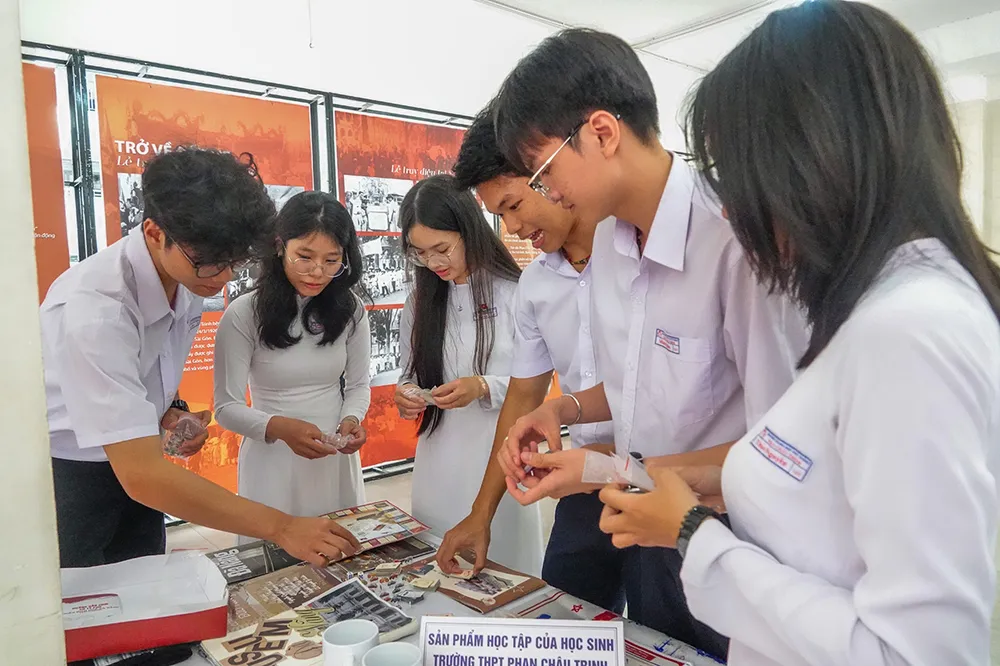
Ho Minh Quan, a student in class 12/3, recounted: "For many days, the group stayed up late searching for materials, cross-referencing information, and arranging historical stories to make them coherent… Working in a group, especially on a difficult topic like history, wasn't always smooth sailing. We argued and disagreed many times, but we all still sat down to revise every detail. The most memorable part was the image processing stage, which happened right before the exam. Everyone was busy, but we still dedicated a whole day to completing it," Quan shared.
According to Nguyen Thien Nhan, a student in class 12/3, the idea for the board game stemmed from a familiar concern: how to make history less dry for students. The team wanted to incorporate history into games so students could learn while playing. From this idea, the group experimented with various formats, from traditional folk games like O An Quan (a Vietnamese board game) and jump rope to modern games. After much consideration, Monopoly was chosen because it easily incorporated events and timelines. Importantly, the game had to be both entertaining and help players acquire knowledge naturally.
Learning history through experience.
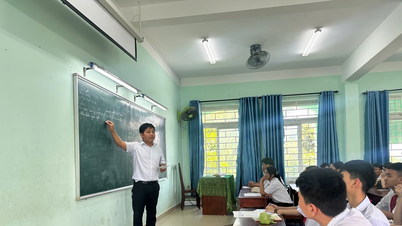
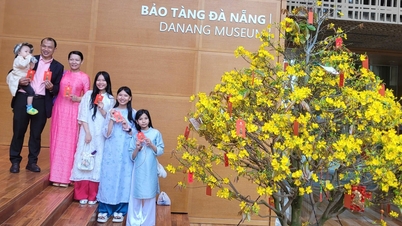
According to Ms. Nguyen Thi Viet Ha, Head of the History Department at Phan Chau Trinh High School, the students' creativity is in line with the experiential learning orientation of the 2018 General Education Program. From the beginning of the year, the department developed a plan for students to learn history through experience. They visited museums such as the Da Nang Museum, the Cham Sculpture Museum, the Hoang Sa Exhibition House, and the Military Region 5 Museum; or they independently organized group trips.
Each trip is designed as a “learning scenario,” from preparation and scouting to a system of specific questions and tasks. At the destination, students participate in “stations”: researching artifacts and recording information to gather materials. “Instead of writing reports, the school encourages students to find new ways of expression and create their own products to promote the country’s culture and history,” Ms. Ha said.
During that process, the 12/3 class students proposed the idea of creating a chess set "Recreating the Hue-Da Nang Campaign" and received support from their teachers. However, to complete it, they had to make many revisions. Some seemingly small details had to be redone due to inaccuracies, such as: the AI-reconstructed images of the Hai Van Pass in March 1975, the models of military vehicles, soldiers' uniforms, and attack directions… "Everything had to be historically accurate, requiring careful cross-referencing and verification of information," Ms. Ha shared.
Every detail was reviewed and adjusted, and the information was verified and referenced from multiple official sources. This process not only perfected the product but also helped students gain a deeper understanding of history. Mr. Pham Tan Ngoc Thuy, Deputy Director of the Department of Education and Training of Da Nang City, assessed that this new approach is suitable for the age group, contributing to making the subject of History more lively, relatable, and easier to understand, while also fostering creative thinking and teamwork skills among students.
On the "Recreating the Hue-Da Nang Campaign" chessboard, every detail is designed with a specific meaning. The moving pieces depict everything from rudimentary vehicles to tanks. The squares on the chessboard represent important milestones in the Hue-Da Nang campaign (March 1975). The process of creating this product is not only a learning experience but also a way for the students to find their own path to connect more closely with history.
Source: https://www.sggp.org.vn/choi-co-hoc-lich-su-post846824.html



![[Photo] Standing Committee member of the Party Central Committee Tran Cam Tu working with the Central Inspection Committee](https://vphoto.vietnam.vn/thumb/1200x675/vietnam/resource/IMAGE/2026/05/28/1779969579668_ndo_br_bnd-2495-jpg.webp)


























































Comment (0)