

 |
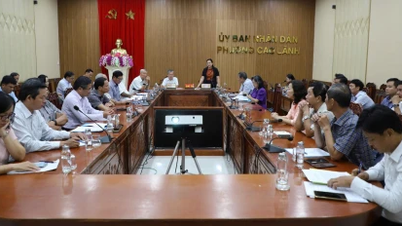
| Overview of the working session |
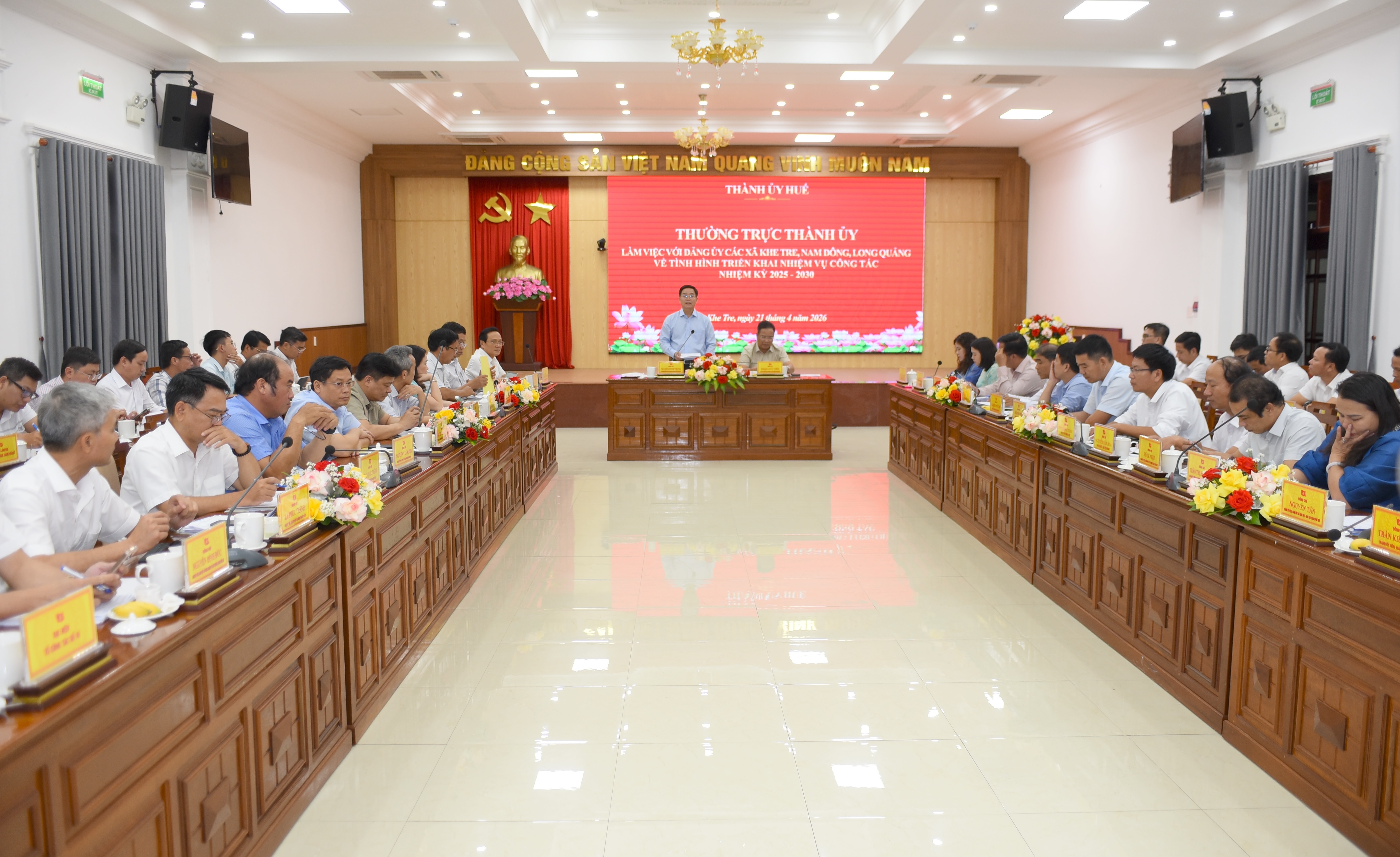
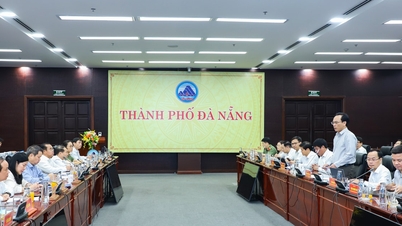
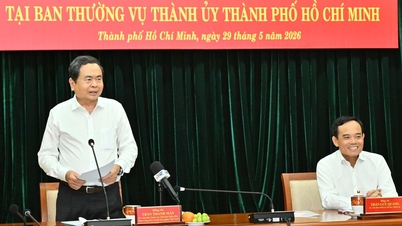
The working session was chaired by Comrade Nguyen Dinh Trung, Member of the Central Committee of the Party, Secretary of the City Party Committee, and Head of the City's National Assembly Delegation, and Comrade Pham Duc Tien, Permanent Deputy Secretary of the City Party Committee and Chairman of the City People's Council. Attendees included members of the Standing Committee of the City Party Committee, leaders of the City People's Committee, and representatives from relevant departments, agencies, and localities.
The foundation has been laid, and there is still plenty of room for improvement.
Following their establishment under Resolution 1675/NQ-UBTVQH15, the three communes of Khe Tre, Nam Dong, and Long Quang quickly stabilized their organizations and put their political systems into operation according to the two-tiered local government model. The Party committees issued relatively complete working regulations, action programs, and a system of guiding documents; Khe Tre alone issued 19 resolutions, 10 programs, 54 plans, and 9 directives, creating a foundation for the synchronized implementation of tasks.
The implementation of the resolution was carried out seriously, with many units achieving 100% participation from cadres and Party members. The administrative apparatus from the commune to the village level was streamlined; Party, government, Front, and mass organization agencies began operating in an orderly manner. The Public Administrative Service Center initially demonstrated effectiveness; inspection and supervision were strengthened, ensuring discipline and order.
In 2025, most socio -economic targets were met or exceeded: Nam Dong achieved 19 out of 20 targets, Long Quang achieved 12 out of 14 targets, and Khe Tre achieved 7 out of 8 targets. Long Quang's budget revenue reached 108% of the plan; average income reached 45.1 million VND/person/year; the health insurance participation rate reached 98%; and the poverty rate decreased to approximately 5.04%. Nam Dong completed all 19 criteria for new rural development.
Agricultural and forestry production remained stable, with no major disease outbreaks; forest management and protection were strengthened. Trade and service activities were basically stable; some community tourism models have initially proven effective. National defense and security were maintained, and 100% of the 2026 military recruitment target was met.
 |
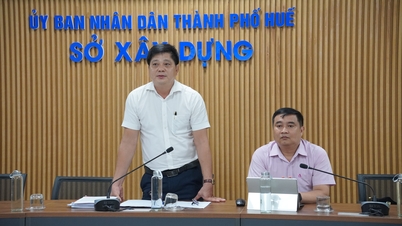
| Commune leaders exchanged views at the working session. |
However, some targets have not been met: Khe Tre has only achieved 56.5% of its budget revenue plan; Long Quang's growth is approximately 7.2%, lower than the target; and food production has reached 97.58%. The economy is still small, infrastructure is not yet synchronized, and investment resources are limited; attracting businesses remains difficult, especially in mountainous areas. Long Quang has 85.8% ethnic minority population, and the poverty rate is still around 3.27%. The staff is insufficient and unevenly distributed; some are still struggling in the digital environment, especially in the areas of land, planning, and construction investment.
Based on that experience, localities focused on proposing solutions to remove "bottlenecks" in planning, infrastructure, and mechanisms. Khe Tre proposed establishing a Type III urban planning scheme, investing in transportation, irrigation, embankment construction to prevent landslides, creating clean land funds, and completing digital infrastructure. Nam Dong proposed support for irrigation, production, and disaster prevention funding. Long Quang proposed investment in transportation, headquarters, markets, and addressing slow-moving projects.
During the working session, representatives from various departments and agencies assessed that the three localities have potential, but need to focus on removing "bottlenecks," first and foremost by completing the planning, especially for Khe Tre, according to the orientation of a type III urban area, ensuring a long-term vision and strengthening regional linkages. At the same time, it is necessary to review and build a list of urgent projects to be included in the medium-term public investment plan for the period 2026-2030; prioritizing transportation infrastructure, lighting, and essential works. The mobilization and integration of resources must be effective, linked to accelerating the progress of key projects.
The delegates also argued that it is necessary to promote the exploitation of local advantages, develop ecotourism and community-based tourism associated with the preservation of Co Tu culture; and expand regional linkages. Along with that, it is crucial to transform the production structure, apply science and technology, and achieve sustainable poverty reduction.
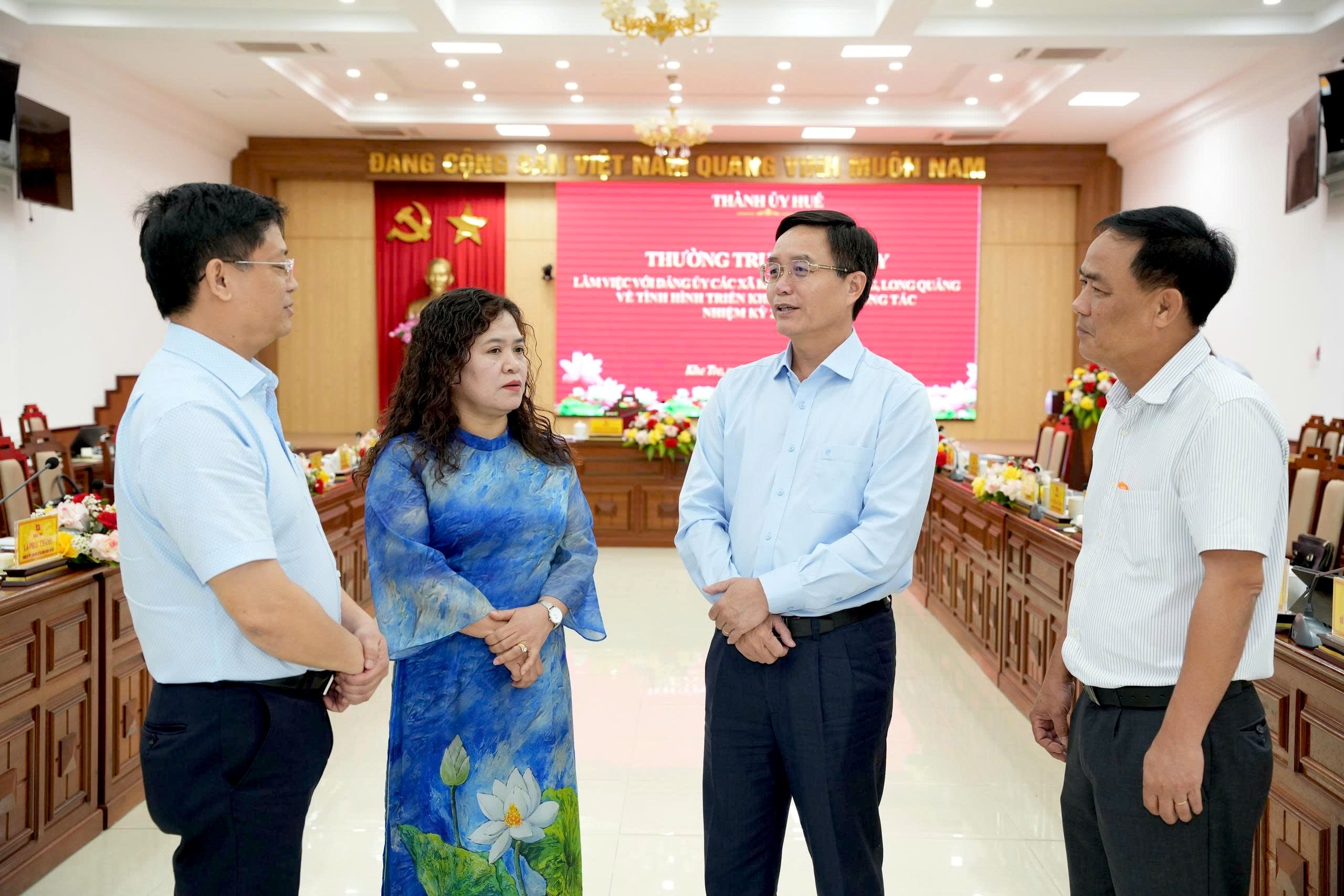 |
| Comrade Nguyen Dinh Trung exchanged views with delegates on the sidelines of the working session. |
Proactive adaptation and enhancement of leadership capabilities.
Concluding the meeting, City Party Secretary Nguyen Dinh Trung acknowledged and highly appreciated the efforts of localities in stabilizing organizations, maintaining security and order, and gradually promoting cultural identity. At the same time, he frankly pointed out limitations such as the slow pace of economic development, uneven quality of cadres, slow digital transformation, and the existing poverty rate and risk of re-poverty.
The Party Secretary emphasized that in the new phase, Party building and the political system must be one step ahead, linked with the renewal of leadership methods. Party committees need to provide comprehensive and thorough leadership at the grassroots level; the government must be close to the people, effectively implement tasks, and adapt flexibly to the new context.
Regarding decentralization and delegation of power, localities are required to promote proactiveness in accordance with the regulations of the Standing Committee of the City Party Committee (Regulation 137), especially in personnel work. At the same time, the quality of Party branch meetings, particularly at the village level, must be improved; the Party branch secretary must truly be a unifying force, playing a clear role in socio-economic development.
Regarding the operation of the apparatus, it is necessary to innovate working methods, strengthen the connection between the leadership of the Party committee and the implementation by the government and the role of the Fatherland Front, ensuring the "six clear principles". Localities must be proactive, not wait or rely on others; regularly update regulations, and promptly propose solutions to overcome obstacles.
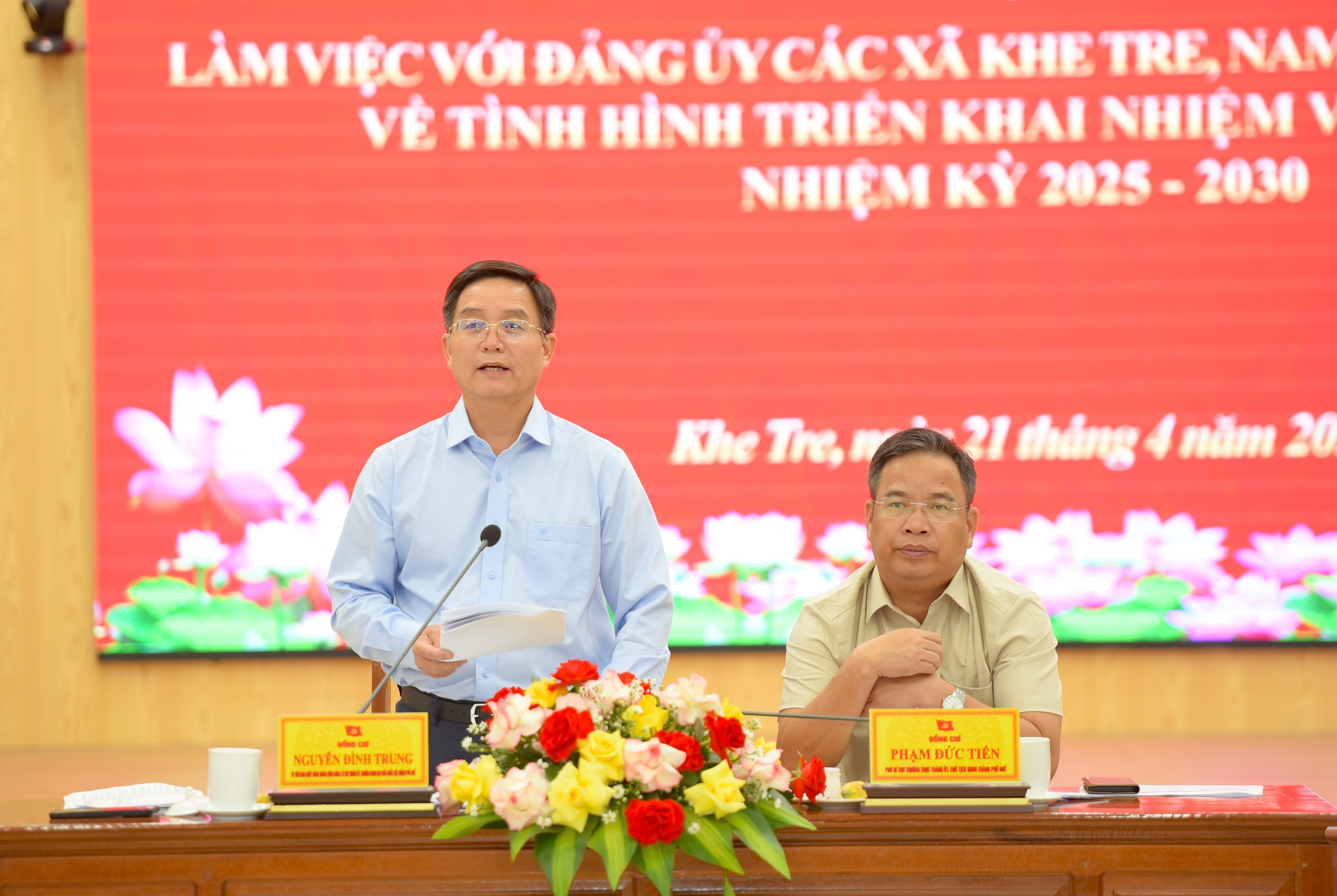 |
| Comrade Nguyen Dinh Trung, Member of the Central Committee of the Party, Secretary of the City Party Committee, and Head of the City's National Assembly Delegation, concluded the working session. |
In socio-economic development, City Party Secretary Nguyen Dinh Trung requested special attention to planning, especially inter-regional planning; departments and agencies need to coordinate and support localities in developing well-structured and feasible plans. At the same time, emphasis should be placed on preserving and promoting cultural identity; research should be conducted on organizing city-level cultural activities in the area to preserve and promote cultural values.
In agriculture, it is necessary to strengthen support for forestry development and research into concentrated livestock farming models. Ethnic minority policies must be given constant attention, aiming to improve living standards and access to healthcare for the people.
Regarding infrastructure, relevant departments are tasked with reviewing and selecting inter-communal transportation projects that offer connectivity, create momentum for development, serve the people's needs, and overcome isolation during the rainy season and floods. At the same time, communes are required to develop detailed poverty reduction plans, clearly identifying each household, the causes of poverty, and specific solutions.
Party Secretary Nguyen Dinh Trung also proposed strengthening planning and training of cadres; reviewing the effectiveness of infrastructure projects; and continuing administrative reform to create a favorable environment for attracting investment. These are important solutions to remove bottlenecks, effectively utilize potential, and create substantial changes in the development of the three localities in the coming period.
Source: https://huengaynay.vn/chinh-polit-xa-hoi/theo-dong-thoi-su/chu-dong-thich-ung-thao-go-cac-diem-nghen-de-phat-trien-164908.html
![[Photo] Ba Lang An Lighthouse - the "eye of the sea" amidst the "rock museum" of Quang Ngai province.](https://vphoto.vietnam.vn/thumb/1200x675/vietnam/resource/IMAGE/2026/05/29/1780038698840_anh-man-hinh-2026-05-29-luc-14-10-42.png)
![[Image] Pleasant weather helps students enter the 10th grade entrance exam with confidence.](https://vphoto.vietnam.vn/thumb/1200x675/vietnam/resource/IMAGE/2026/05/29/1780034401612_ngay-1-thi-lop-10-minh-duy-8-5009-jpg.webp)




































































Comment (0)