

Oil and gas stocks also hit the floor limit.
Yesterday, March 13th, the stock market continued to trade in the red, with the VN-Index closing down 13.37 points, or 0.78%, at 1,696.24 points; the HNX-Index fell 0.81% to 245.84 points. Selling pressure persisted across many stock groups, with even previously sought-after stocks like oil and gas experiencing heavy selling pressure and hitting their lower limit, such as GAS, PLX, and BSR …
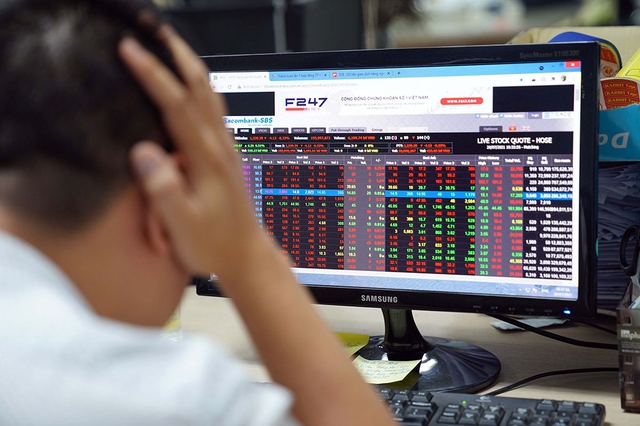
Investors cannot yet be optimistic about the short-term trend of the stock market.
PHOTO: NGOC THANG
Market liquidity on the HOSE reached 24,464 billion VND, an increase of 6.17% compared to the previous session, but still lower than the average of the last 20 sessions. This marks the third consecutive day of decline for the main indices.
In total, after one week, the VN-Index fell by 71.6 points, equivalent to a decrease of more than 4%. Compared to the end of February, the main stock market index has fallen by nearly 10% in just two weeks of trading. The continuous decline of the stock market is mainly attributed to the impact of the conflict in the Middle East.
According to financial market expert Phan Dung Khanh, the conflict in the Middle East has had a strong impact, causing global stock markets to decline, and the Vietnamese market has experienced a similar trend. What worries financial investors is that if inflation rises, central banks will be unable to lower interest rates, leading to other negative impacts on the economy. A second factor is the significant increase in the USD's value following this military conflict.
Yesterday, the USD-Index surged above 100 points – its highest level in the past four months. This is also a rather sensitive point in investor sentiment, reflecting the shift many people towards hoarding US dollars as they assess the US as having many advantages after the conflict in the Middle East. Notably, the VN-Index closed this week below the important resistance level of 1,720 - 1,730 points, further increasing investor anxiety due to the increased risk of further declines.
Sharing the same view, Mr. Huynh Anh Tuan - General Director of VikkiBankS Securities Company - commented that the conflict in the Middle East has a strong and immediate impact, causing crude oil prices to rise, potentially pushing inflation up in those countries. High inflation leads to reduced consumer spending and difficulties for businesses. In addition, there are concerns about disruptions to oil supply or potential disruptions to raw materials for production… In this context, rising bank interest rates and increasing margin lending rates also contribute to pressure on the stock market, compounding difficulties. Investors are worried about slowing economic growth while inflation rises. Since "these are enemies of the stock market," a market downturn is predictable. Investor sentiment remains quite cautious as input data is very difficult to estimate. In particular, the conflict between the US, Israel, and Iran is unfolding hourly and daily, and no one knows when it will subside, even though it has been going on for two weeks.
The outlook remains uncertain in the short term.
Amidst the pressure on the stock market, financial market expert Phan Dung Khanh analyzed: The market's liquidity in March remained relatively high, which is a positive sign. This shows that many people still have a positive view of the medium and long-term trend of stocks. However, with so many uncertain factors, it is difficult to predict any favorable scenario for the market, where the possibilities of both increases and decreases are equally likely.
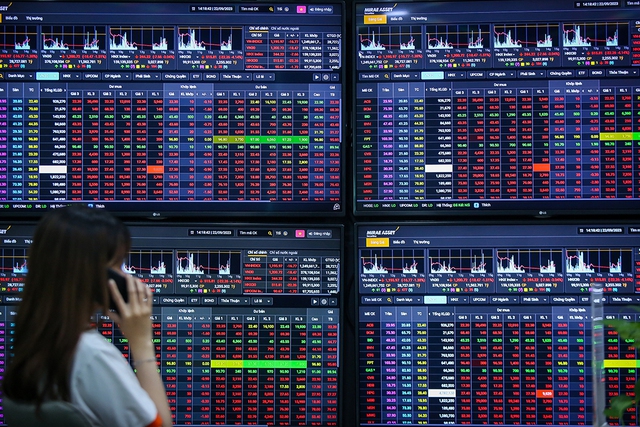
The stock market declined continuously in March due to regional tensions in the Middle East.
PHOTO: NHAT THINH
"The stock market is closed for trading on weekends, but given the ongoing conflict, there will be a lot of information, even unexpected news. Therefore, the first trading session of the week is very important as it can affect the trend of the following week. From my perspective, there aren't many signals yet that could help the VN-Index reverse, but it's also not too shocking to cause a sharp drop like at the beginning of the week," Mr. Phan Dung Khanh further shared.
According to Mr. Huynh Anh Tuan, the stock market reacted strongly this week. Negative investor sentiment caused the market to fall by almost the maximum limit of over 100 points in some sessions. Many stocks have dropped by 50-60% from their previous peaks, even though there was no negative news regarding the industry or the companies. The prices of many stocks have fallen to levels similar to when the VN-Index was around 1,300 points. Therefore, some investors holding cash with a medium- to long-term perspective continued to buy during sharp declines, helping to maintain a relatively high level of liquidity.
"The current difficulty lies in external factors, not internal ones within the Vietnamese economy. With international developments remaining complex, it's difficult for large investors to make strong short-term decisions. While it's also difficult to predict short-term market trends, the VN-Index is not expected to fluctuate too strongly for the remainder of March. Investors should prioritize portfolio management, account risk management, and avoid using margin for short-term trading," advised Mr. Huynh Anh Tuan.
Meanwhile, VNDirect Securities Company noted that, for the stock market, a sudden surge in oil prices usually has a negative impact in the short term, due to increased concerns about inflation, interest rates, exchange rates, and the outlook for corporate profit growth. Compared to previous periods, the current rate of oil price increase, if too rapid, will make it difficult for the market to adapt immediately, thus increasing volatility in the short term. Technically, the market is currently fluctuating around three key support levels: 1,660 - 1,600 - 1,500 points. Of these, the 1,500 level is crucial – if breached, the medium-term uptrend of the market will be officially broken. However, it should be noted that valuations below 1,660 points are becoming significantly more attractive. This company's base scenario suggests that the VN-Index could correct further to the 1,500-1,600 point range, where a combination of attractive valuations and expectations of stable oil prices would create a foundation for demand to support the index. From there, the market would have a basis to find momentum for a technical rebound.
In this context, a cautious sentiment may continue to dominate market movements in the coming sessions, and investors should prioritize risk management, closely monitor global oil price developments, and observe domestic policy responses to develop appropriate investment strategies.
Asian stock markets fell across the board.
At the close of trading on March 13, the Nikkei 225 index in Japan fell 633.35 points, or 1.16%, to 53,819.61 points; the Shanghai index in China fell 0.82% to 4,095.45 points; the Hang Seng index in Hong Kong fell nearly 1% to 25,465.6 points... A series of major markets in the region, including Singapore, South Korea, Thailand, Australia, India, Malaysia, Indonesia, etc., all recorded declines.
Analysts warn that the stock market will continue to face significant pressure. As long as the Strait of Hormuz remains blockaded, stocks will continue to face selling pressure.
Source: https://thanhnien.vn/chung-khoan-lien-tuc-giam-18526031321552681.htm
![[Photo] General Secretary and President To Lam presides over a meeting on the implementation of Directive No. 34-CT/TW of the Party Central Committee.](https://vphoto.vietnam.vn/thumb/1200x675/vietnam/resource/IMAGE/2026/05/19/1779187768672_a1-bnd-2350-631-jpg.webp)
![[Photo] National Assembly Chairman Tran Thanh Man attends the groundbreaking ceremony for the National Highway 1A spatial axis project.](https://vphoto.vietnam.vn/thumb/1200x675/vietnam/resource/IMAGE/2026/05/19/1779161360398_ndo_br_bnd-1412-jpg.webp)
![[Photo] Capturing the moment the tide recedes at Yen Binh Son rapids - a million-year-old scenic spot in Quang Ngai.](https://vphoto.vietnam.vn/thumb/1200x675/vietnam/resource/IMAGE/2026/05/19/1779175463885_yen9-1199-jpg.webp)





































































![[Photo] General Secretary and President To Lam receives Indian Defense Minister Rajnath Singh](https://vphoto.vietnam.vn/thumb/402x226/vietnam/resource/IMAGE/2026/05/19/1779184046302_anh-man-hinh-2026-05-19-luc-16-46-58.png)


































Comment (0)