

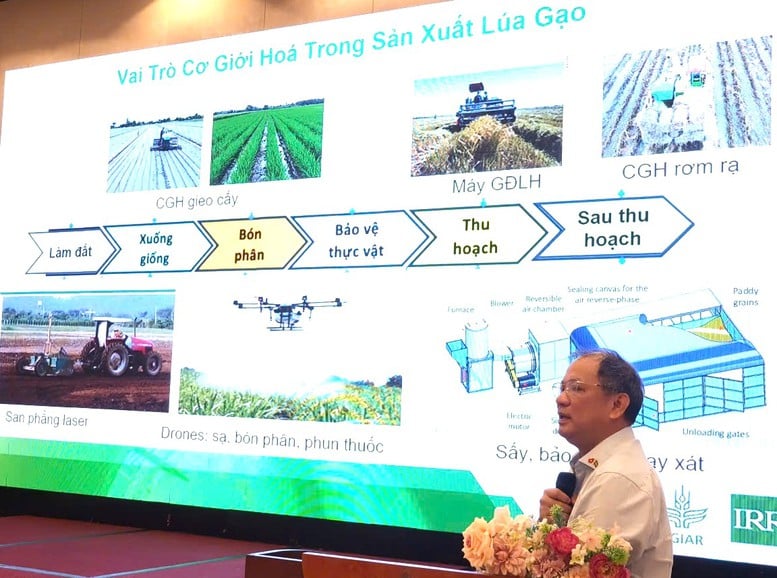
Associate Professor Dr. Nguyen Van Hung, senior expert at the International Rice Research Institute, presented his report at the workshop.
Photo: VGP/LS
At the workshop "Digitalization of Agricultural Mechanization to Optimize Investment, Management, and Improve Rice Production Efficiency," organized by the International Rice Research Institute (IRRI) in collaboration with the Department of Cooperative Economics and Rural Development and the Department of Agriculture and Environment of Can Tho City, many experts argued that digitalization of mechanization will be a crucial foundation for restructuring the rice industry towards modernization and sustainability.
The workshop was organized based on the results of the implementation of the "digitalization and mechanization of rice cultivation in the Mekong Delta" project in three communes of Can Tho City: Long Hung, Thanh Quoi, and Thuan Hoa.
Through field surveys, the implementation team has built a dataset on cultivated area, planting schedules, and the level of agricultural machinery use at each stage of production in 2025. Simultaneously, a mechanization adaptation map has been developed to assess the suitability of different types of machinery according to local conditions.
Mechanization is shifting from 'replacing human labor' to data-driven management.
One of the highlights of the workshop was the demonstration of digital tools and maps adapted to mechanization for management and decision-making in rice production.
According to Associate Professor Dr. Nguyen Van Hung, Head of the Mechanization and Post-Harvest Group at IRRI, the digitalization of mechanization helps to create a database that optimizes management and connects supply and demand between farmers and mechanization services; it also supports the development of appropriate equipment investment strategies based on the needs and farming efficiency of each locality.
According to Mr. Nguyen Van Hung, this data platform also supports the construction of suitable mechanization maps for rice cultivation in the Mekong Delta, serving the Project of 1 million hectares of high-quality, low-emission rice and creating a basis for the development of AI in smart farming and electronic agricultural extension.
Ms. Nguyen Thi Giang, Deputy Director of the Department of Agriculture and Environment of Can Tho City, stated that mechanization is no longer limited to replacing manual labor but is shifting towards a model of synchronized, precise mechanization based on digital data. This is one of the key solutions serving the implementation of the Project "Sustainable Development of 1 Million Hectares of High-Quality, Low-Emission Rice Specialization Associated with Green Growth in the Mekong Delta by 2030".
In recent years, many localities in the region have strongly applied modern mechanized equipment such as combine harvesters, rice transplanters, drones for spraying pesticides, fertilizer spreaders, and straw processing equipment.
In Can Tho City alone, land preparation and irrigation have been mechanized to 100% of the required capacity. Sowing and transplanting meet the needs of over 90% of the area; crop care reaches approximately 90%; and harvesting achieves 100% mechanization. Drones used for spraying pesticides, fertilizing, and sowing currently account for about 30% of the production area.
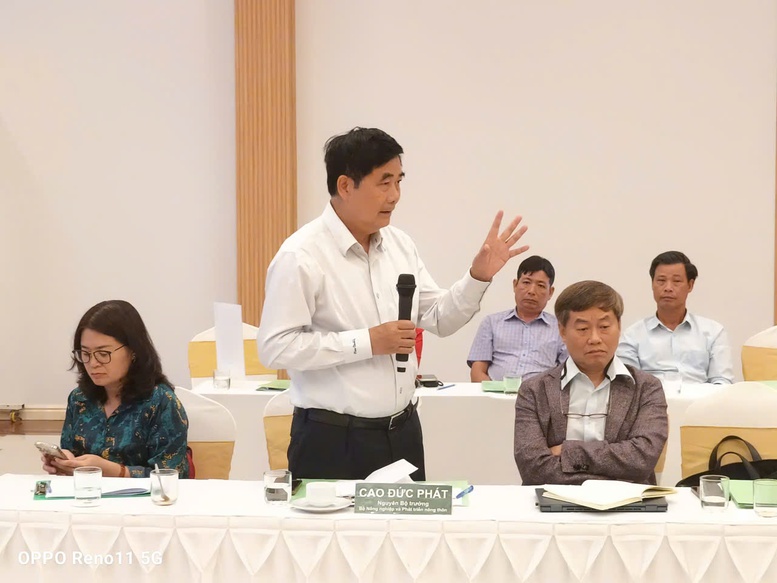
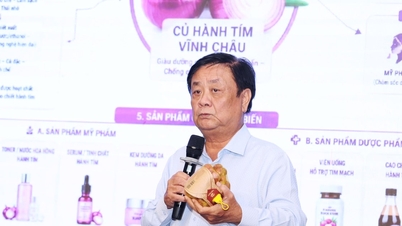
Former Minister of Agriculture and Rural Development Cao Duc Phat speaks at the workshop - Photo: VGP/LS
Towards green, circular, and low-emission agriculture.
In addition to increasing productivity, mechanization is also driving the development of circular agriculture models in the Mekong Delta.
Many models utilizing rice straw for mushroom production, organic fertilizer, or reuse in rice cultivation have yielded significant economic benefits. According to the Department of Agriculture and Environment of Can Tho City, the total added value from the straw recycling chain can reach approximately 33.5 million VND/ha/year. This is considered a suitable direction for the goals of "green agriculture" and "green growth" in the Mekong Delta region.
Associate Professor Dr. Nguyen Van Hung stated that surveys conducted in three pilot communes showed that mechanization in the Mekong Delta has now reached an industrial level in many stages such as land preparation, sowing, spraying pesticides, harvesting, drying, and rice processing.
However, the transition from mechanization to digitalization and automation still faces many limitations due to unsynchronized research, lack of connectivity, and overlapping research topics.
According to experts, one of the biggest bottlenecks today is the lack of digital databases to support the management of agricultural mechanization. While data is becoming the "soft infrastructure" of modern agriculture, many localities have yet to build a synchronized data system on growing areas, planting schedules, emissions, or mechanization service needs.
This makes coordinating machinery, creating appropriate maps for mechanization, and connecting farmers with mechanized services still challenging.
Furthermore, the fragmented and small-scale nature of production also reduces the effectiveness of investment in modern machinery. Many farming households lack the financial capacity to invest in high-tech equipment, while the formation of professional mechanization service organizations is uneven across localities.
Experts believe that mechanization must begin at the field level and be linked to large-scale production organization to achieve sustainable effectiveness. Simultaneously, it is necessary to promote digital transformation in agriculture, build databases for traceability, assign planting area codes, and manage emissions.
Completing the mechanization and digital data ecosystem.
At the workshop, many experts, businesses, and cooperatives proposed solutions to promote comprehensive mechanization for the rice industry in the Mekong Delta.
Experts also suggested strengthening support for businesses in research, innovation, and localization of agricultural machinery suitable for the conditions of the Mekong Delta. At the same time, it is necessary to build a system for data collection, data analysis, digital mapping, and production management dashboards to create a foundation for a modern, smart, and low-emission rice production model.
Dr. Cao Duc Phat, former Minister of Agriculture and Rural Development, believes that the inevitable trend in agriculture today is mechanization, automation, and digitalization; aiming towards a synchronized, smart, green, and sustainable agriculture based on all three pillars: economic, social, and environmental.
Through this workshop, the organizers hope to further refine the approach and promote the application of digital data in policy planning and mechanization investment, creating a foundation for large-scale implementation in the Mekong Delta.
Le Son
Source: https://baochinhphu.vn/chuyen-doi-so-mo-duong-cho-co-gioi-hoa-thong-minh-nganh-lua-gao-dbscl-102260513124342205.htm
![[Image] Pleasant weather helps students enter the 10th grade entrance exam with confidence.](https://vphoto.vietnam.vn/thumb/1200x675/vietnam/resource/IMAGE/2026/05/29/1780034401612_ngay-1-thi-lop-10-minh-duy-8-5009-jpg.webp)
![[Photo] Ba Lang An Lighthouse - the "eye of the sea" amidst the "rock museum" of Quang Ngai province.](https://vphoto.vietnam.vn/thumb/1200x675/vietnam/resource/IMAGE/2026/05/29/1780038698840_anh-man-hinh-2026-05-29-luc-14-10-42.png)










































































Comment (0)