

PV: From the perspective of someone with many years of experience in higher education management, what do you consider to be the most prominent message and strategic guiding principle of General Secretary and President To Lam regarding Vietnamese higher education?
Associate Professor Dr. Do Van Dung: It can be said that the statement by General Secretary and President To Lam regarding Vietnamese higher education is a powerful call to transform the role of universities: from centers for knowledge transmission to key drivers of national innovation and development. The most profound strategic message is that universities must become direct participants in building and implementing national development strategies based on science , technology, and innovation. This involves a fundamental shift from the traditional training model to an innovative university model, closely linking research with the needs of businesses and the development challenges of the country. The role of universities should not stop at training highly skilled professionals but must also generate technology, promote entrepreneurship, provide solutions for society, contribute to national competitiveness, and form an innovation ecosystem.
At the same time, the message from General Secretary and President To Lam also carries a profound warning: Opportunity always comes with pressure. If universities do not change quickly enough, do not produce research results with practical value, and do not demonstrate quality through concrete results instead of slogans, then the risk of falling behind and being eliminated from the game is very high. Competitive pressure will force universities to prove their capacity for international integration and make substantial contributions.
In summary, the statement by General Secretary and President To Lam is not only a guideline but also a call to action for the entire Vietnamese higher education system: A drastic change in mindset, organization, and operation is necessary to be a pioneering force in the country's industrialization and modernization. This is a historic opportunity but also a vital challenge. Universities that seize this opportunity and act effectively will have a distinct position in this new era.
PV: General Secretary and President To Lam has emphasized the role of universities in innovation and promoting national development. How does this open up opportunities for Vietnamese universities, sir?
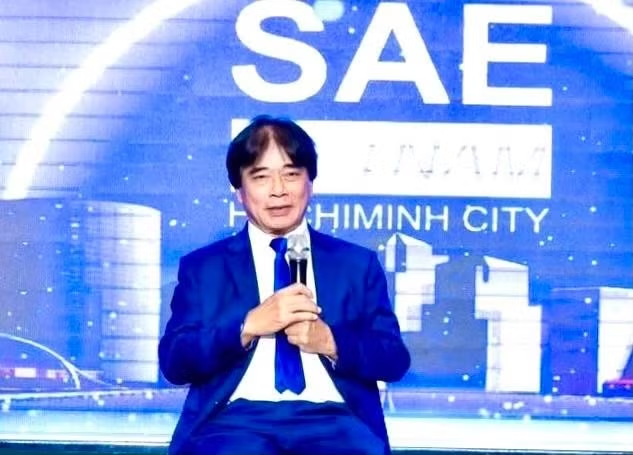
Associate Professor Dr. Do Van Dung: From the perspective of higher education management, I believe that the core message of General Secretary and President To Lam opens up a historic opportunity for Vietnamese universities. That is, universities can directly participate in the national development strategy based on science, technology, and innovation, instead of just being training centers. With an "open institutional framework" and resources prepared, universities can more easily build strong research centers, attract talent, cooperate internationally, and invest deeply in key areas: AI, semiconductors, biotechnology, and digital transformation. This is also an opportunity to rapidly transform from traditional universities to innovative universities, linking research with businesses and national problems, becoming centers for generating technology, startups, and practical solutions.
In short, this is a golden opportunity for universities to elevate their role, from imparting knowledge to driving national competitiveness, contributing to Vietnam's development by 2045. However, to transform "opportunity" into "results," the Vietnamese higher education system must implement deeper, faster, and more decisive reforms than it currently does. If successful, this will be a historic turning point; if only half-hearted changes are made, we will continue to lag behind the region and the world.
PV: In your opinion, what is the significance of building universities into centers of innovation and core research in the context of today's global competition for human resources? Specifically for Vietnam National University , Hanoi , how do you assess its pioneering role in realizing the innovative university model mentioned by General Secretary and President To Lam?
Associate Professor Dr. Do Van Dung: In the current context of global competition for human resources, building universities into core innovation and research centers has immense strategic significance. First and foremost, it's about attracting and retaining talent as countries fiercely compete to attract top experts and scientists. Research-intensive universities become a "magnet" for retaining domestic talent and attracting international talent, reducing the risk of brain drain.
Furthermore, universities will energize the knowledge economy by not only training but also generating technology, startups, and practical solutions, contributing to enhancing national competitiveness, creating high-quality jobs, and promoting sustainable growth. In addition, in the era of AI and digital transformation, core research universities will help the nation catch up with global trends, narrow the gap with technological powerhouses, and build an innovation ecosystem through connecting businesses, the government, and universities, creating a strong environment for entrepreneurship and technology transfer.
For Vietnam National University, Hanoi (VNU), this university clearly holds a pioneering position and is effectively implementing the direction set by General Secretary and President To Lam. VNU is currently one of the two leading national universities, with a solid foundation and a 120-year tradition. It has been directly tasked by the Party and State leadership with becoming a "symbol of Vietnamese intellect," a leading force in innovation, and a driving force in the higher education system. VNU has been building strong research institutes; promoting strategic cooperation with businesses and international partners; and developing an innovation ecosystem with hundreds of patents, international publications, startups, and a central role at Hoa Lac.
However, to truly become a "research, innovation, and creativity university of regional and international stature," VNU also needs to accelerate its pace: strengthening applied research with commercialized products, attracting international talent on a larger scale, and measuring concrete results (patents, successful startups, GDP contribution). This is a historic opportunity for VNU to affirm its pioneering role as expected by General Secretary and President To Lam.

PV : To realize the goal of building research and innovation universities on par with the region, what "bottlenecks" in terms of mechanisms, resources, and management mindset do you think need to be removed?
Associate Professor Dr. Do Van Dung: This request from General Secretary and President To Lam is a correct, urgent, and long-term strategic direction. In the context of the Fourth Industrial Revolution and global competition based on knowledge, Vietnam cannot stop at large-scale training but must have elite universities with strong research capabilities, capable of leading national innovation. The opportunities are immense as institutions are opening up and resources are being prioritized for science and technology. However, this is also a huge challenge, requiring a "breakthrough" rather than gradual improvement.
To realize the goal of building a research and innovation university on par with the region, it is necessary to remove the main "bottlenecks". Firstly, university autonomy is not yet strong enough due to remaining obstacles in finance, personnel, investment, and intellectual property rights related to research results; cumbersome administrative procedures and the "request-and-grant" mechanism still exist, limiting international cooperation and technology commercialization.
Secondly, there is a need for more specific mechanisms (sandboxes) for research universities, such as tax incentives, venture capital funds, and ownership of research results from the state budget; budget investment in basic and applied research is still low and fragmented.
Thirdly, attracting and retaining talent is still not truly competitive, as lecturer and scientist salaries are not attractive compared to the region and businesses, making it difficult to attract international experts; research facilities and infrastructure (modern labs, digital libraries, startup areas) are still limited in many universities.
Fourth, the mindset of "administrative management" still outweighs "strategic management and innovation"; there is a reluctance to accept risks in research, prioritizing safety over groundbreaking innovation; and a lack of a culture of evaluation based on practical results (number of patents, successful startups, economic contributions) instead of just quantifying publications and lecture hours. Fifth, the connection between universities, businesses, and the government remains weak; there is a lot of research but little application.
PV : General Secretary and President To Lam has emphasized the importance of attracting and utilizing talent. In the current context, what breakthrough policies do Vietnamese universities need to attract and retain talented scientists, sir?
Associate Professor Dr. Do Van Dung: Vietnamese universities need drastic and comprehensive changes in the following four main groups of solutions. First, they must have superior financial and material incentives through the application of a salary and bonus mechanism that exceeds the standard scale based on research results, patents, technology transfer, and startups; support for housing, children's education, high-end health insurance, and stable individual research funds; and prioritize the allocation of autonomous research funding, allowing scientists to retain the majority of benefits from commercialization results.

Furthermore, it is necessary to create a professional and open working and research environment, specifically through breakthrough policies such as building modern lab infrastructure, digital libraries, and world-class facilities; minimizing bureaucratic "request-and-grant" procedures; granting high autonomy to research groups in recruitment, international cooperation, and budget utilization; and building a culture of evaluation based on tangible results (number of patents, technological products, socio-economic impact) instead of focusing solely on publications and lecture hours.
On the other hand, universities also need to continue promoting autonomy and special mechanisms, including: genuine autonomy in organization, personnel, and finance according to the new Higher Education Law; applying a "sandbox" mechanism for research universities through preferential tax policies, clear intellectual property rights, and flexible employment contracts (not rigid staffing); creating shortcuts to attract international experts and overseas Vietnamese (visas, citizenship, working environment) to be able to compete with strong countries in the region such as Singapore and South Korea.
Finally, the solution involves changing management mindset and culture by shifting from administrative management to strategic management, daring to take innovative risks; building a closely linked university-business ecosystem so that scientists can see their research applied in practice; creating an open academic environment that respects creative freedom, and provides timely recognition and appreciation.
PV : In the era of AI and digital transformation, how do you think Vietnamese universities need to transform themselves to break through and avoid falling behind?
Associate Professor Dr. Do Van Dung: To break through and avoid falling behind in the era of AI and digital transformation, Vietnamese universities have no choice but to fundamentally, decisively, and urgently transform themselves. The immediate priority is for universities to quickly shift from traditional training models to research-innovation-entrepreneurship universities, focusing on generating technology and practical solutions.
Furthermore, emphasis should be placed on innovating training through rapid curriculum updates, comprehensive AI integration, and a focus on digital skills, creative thinking, and project-based learning. Universities and colleges also need to continue focusing on infrastructure development, such as investing heavily in AI labs, computing infrastructure, big data, and smart university campuses; designing policies to attract talent through special incentives, competitive regional salaries, clear intellectual property rights, and an open research environment.
Furthermore, universities and colleges need to strengthen their autonomy and governance by reducing bureaucracy, evaluating performance based on practical results (patents, startups, technology transfer), and increasing cooperation with businesses and internationally.
Interviewer: Thank you very much, Associate Professor, for this conversation!
Source: https://cand.vn/co-hoi-lich-su-de-giao-duc-dai-hoc-viet-nam-but-pha-post811775.html



![[Photo] Ba Lang An Lighthouse - the "eye of the sea" amidst the "rock museum" of Quang Ngai province.](https://vphoto.vietnam.vn/thumb/1200x675/vietnam/resource/IMAGE/2026/05/29/1780038698840_anh-man-hinh-2026-05-29-luc-14-10-42.png)













![[Image] Pleasant weather helps students enter the 10th grade entrance exam with confidence.](https://vphoto.vietnam.vn/thumb/1200x675/vietnam/resource/IMAGE/2026/05/29/1780034401612_ngay-1-thi-lop-10-minh-duy-8-5009-jpg.webp)






























































Comment (0)