

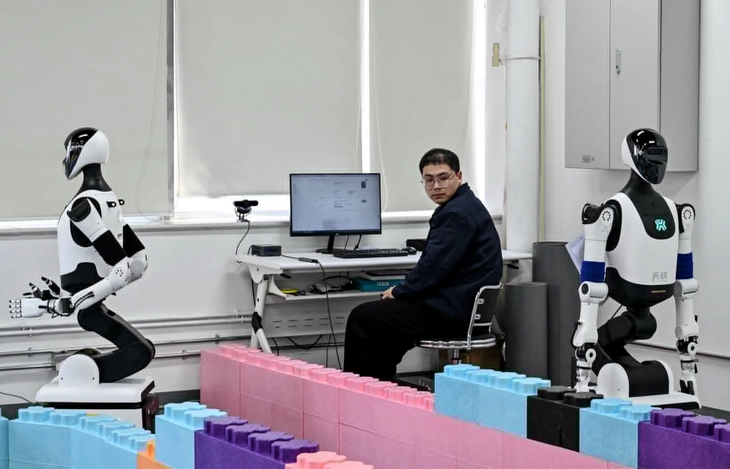
Many major Chinese technology companies are offering record-breaking incentives to attract AI engineers trained in Singapore - Photo: AFP
According to the Straits Times on May 25, major technology corporations such as Huawei, Alibaba, ByteDance, and many Chinese artificial intelligence (AI) startups have recently intensified their efforts to engage with students and researchers at top Singaporean universities, offering attractive incentives to entice them to work for them.
Closed-loop training model
Singapore becoming an ideal destination for AI companies is not a recent development. For many years, the island nation has pursued a rather unique approach, not viewing AI simply as a new technology, but rather as an integral part of its long-term national development strategy through the National AI Strategy 2.0 (NAIS 2.0).
With that vision, Singapore is not just focusing on attracting businesses to build technology infrastructure, but also aiming to create a generation of human resources capable of operating and driving the development of the entire AI ecosystem.
This strategic thinking is clearly realized in the education system. Over the past decade, autonomous universities in Singapore have enrolled an average of around 6,000 doctoral students annually in STEM fields (science, technology, engineering, and mathematics). Notably, about two-thirds of these are international students, with half coming from China.
This demonstrates Singapore's proactive efforts to "separate the wheat from the chaff" by attracting talented young people from around the world to study and conduct research here, instead of relying solely on domestic resources.
However, what sets Singapore apart is how closely they link their training process to the actual needs of the market.
Instead of separating these two elements, Singapore has built a strong link between schools, research centers, and technology companies. Students there not only learn about algorithms, large language modeling (LLM), or data science in the classroom, but also have the opportunity to participate in research, internships, and gain direct access to real-world projects from businesses.
This model is now expanding as more and more technology companies become directly involved in the workforce development process.
According to Singapore's CNA television channel, OpenAI recently announced a $234 million investment to develop the AI ecosystem in the island nation, as well as plans to expand its first applied AI lab outside of the United States.
The company plans to expand its engineering team and collaborate with educational institutions to develop training programs and conduct AI research.
Meanwhile, Oracle aims to train approximately 10,000 Singaporean students and workers in fields related to AI, cloud computing, and data science by 2027.
Judging from these actions, it's clear that the island nation is trying to build a closed-loop human resource development system – where learning, research, and recruitment are closely linked.
Instead of struggling to adapt to the job market after graduation, students can connect with businesses, participate in real-world projects, and gain experience while still studying.
This approach is helping Singapore create a high-quality workforce that can quickly adapt to the demands of the AI market.
The touchpoints that make Singapore a "magnet"
Investments in education, research, and the technology ecosystem have not only helped Singapore increase its AI workforce but also created a different type of workforce compared to traditional engineering training.
In the era of rapidly developing AI, businesses need more than just people who can build algorithms or write code.
As technology begins to be implemented in sectors such as finance, healthcare, manufacturing, and services, market demand is increasingly shifting towards a workforce that can combine specialized knowledge with the ability to apply AI to real-world problems.
Singapore calls this a group of bilingual AI talent – individuals who possess both specialized knowledge in their field and the ability to effectively utilize AI. This "point of contact" has made the country's workforce a magnet for international corporations.
According to the Singapore Digital Economy 2025 report, approximately three-quarters of surveyed workers in the country use AI in their daily work, while the percentage of technology jobs requiring AI skills increased from 11% (in 2019) to 14% (in 2024).
In Singapore, AI is gradually shifting from a specialized skill to a common competency in the workforce.
In this context, demand from China further highlights the value of human resources trained in Singapore.
According to McKinsey's forecast, Beijing could face a shortage of approximately 4 million AI professionals by 2030 as the demand for digital transformation soars across all industries.
This gap has intensified the competition for AI talent, forcing businesses to expand their recruitment efforts internationally, including to Singapore – a hub for highly trained AI students and researchers.
Ultimately, what businesses are looking for is not just pure academic qualifications, but hands-on experience and the ability to apply AI to optimize work performance. This is precisely the generation of workforce that Singapore is trying to cultivate.
Roll out the red carpet to welcome them.
According to Singapore-based recruitment firm Dada Consultants, the average annual salary for top AI candidates with master's and doctoral degrees working in China is currently around 1.5 million yuan (approximately $147,000), a significant increase from around 1 million yuan a year ago.
For top doctoral students, this figure can reach 3-5 million yuan per year ($441,000 - $735,000).
Some Chinese corporations, such as ByteDance, have increased their bonus budgets by 35% and their salary increases by 150% to retain AI talent, while tech giant Tencent is reportedly willing to pay double the salary to lure employees away from competitors.
Source: https://tuoitre.vn/cong-thuc-tao-nhan-tai-ai-cua-singapore-20260525221720235.htm

![[Photo] General Secretary and President To Lam presides over the meeting to approve the draft report on the results of the second inspection by the Politburo of the Standing Committee of the Hanoi City Party Committee.](https://vphoto.vietnam.vn/thumb/1200x675/vietnam/resource/IMAGE/2026/05/26/1779789811432_a2-bnd-4430-9620-jpg.webp)





























































Comment (0)