

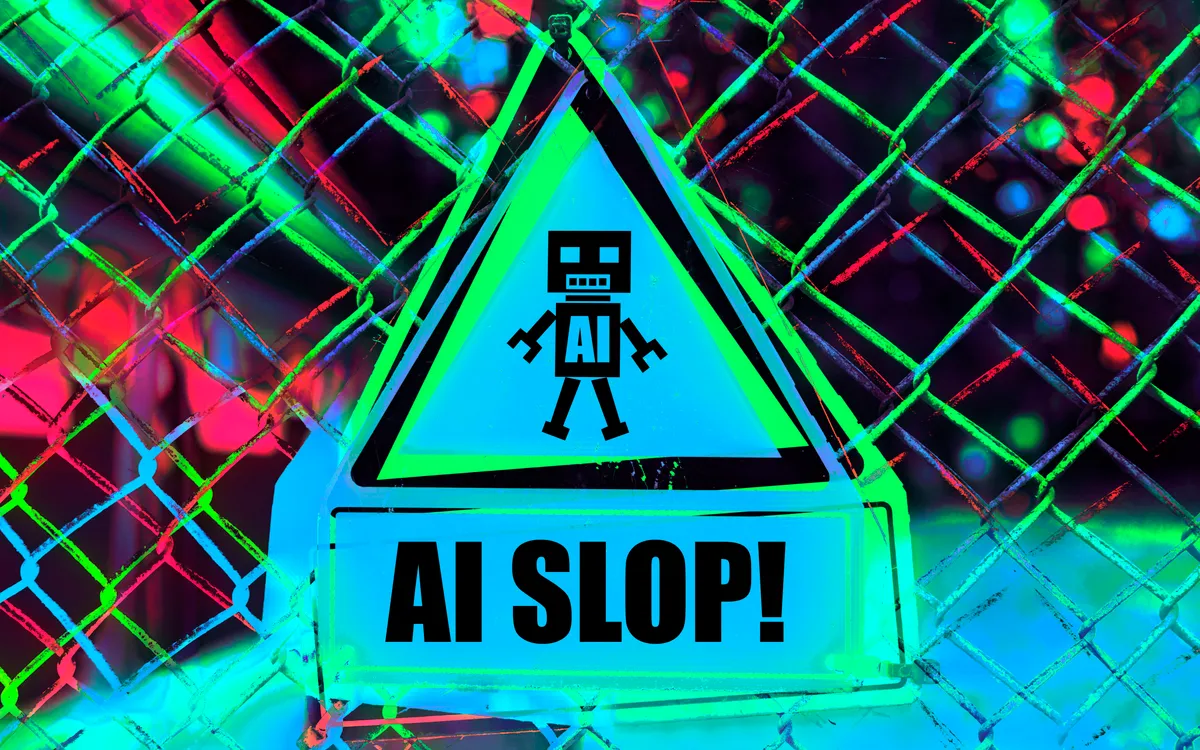
A warning sign featuring a robot and the words "AI Slop". (Photo: Reuters)
When many parents complain that their children can sit in front of computer screens for hours but struggle to concentrate on their studies, they perceive more than just a shift in entertainment habits. Behind the short, fast-paced videos , vibrant colors, and constant stimulating sounds lies an entire digital ecosystem designed to keep viewers engaged for as long as possible. Medical and public health organizations now view the issue in the same light: the story is no longer about "how many hours in front of a screen," but about the quality of the content, the context of use, and the platform's retention mechanisms.
In this context, a new term is increasingly appearing in international debate: "AI slop," which can be loosely translated as "AI garbage." This refers to mass-produced content using artificial intelligence tools, which is low-cost, high-speed, and prioritizes quantity, viewer engagement, and advertising revenue over educational value or consistency. Significantly, the current debate is not aimed at denying AI as a creative tool, but rather focuses on a very specific issue: When cheap, repetitive, and superficial content is amplified by algorithms, who will be held accountable for its impact on the most vulnerable user groups?
The issue intensified in April 2026, when over 200 organizations and experts sent a letter urging Google and YouTube to take more decisive action to protect children. The demands were quite clear: label all AI content, ban AI content from YouTube Kids, block recommendations to those under 18, add a parental control button to disable AI content, and stop investing in AI video production for children. In that open letter, Fairplay argued that top AI-powered channels targeting young children generated over $4.25 million in revenue annually. Behind those figures lies a familiar platform-era business logic: what is cheap, quick to produce, and keeps viewers engaged for a long time is easily amplified.
The Google logo is displayed on a phone, with the YouTube logo behind it on a computer screen in Ankara, Türkiye, on July 2, 2025. (AFP photo).jpg
What worries parents isn't just the quantity of content. The problem is that it's difficult to avoid. Fairplay cites international press research showing that after watching popular preschool programs like Cocomelon, about 40% of YouTube's next suggested videos contain AI elements. Another study cited by the press shows that about 21% of Shorts suggested to new user accounts are AI slop; 278 entirely AI-generated channels have garnered approximately 63 billion views, 221 million subscribers, and an estimated $117 million in annual revenue. From a content business perspective, this is no longer a "niche" but has become a truly profitable production line.
But why are experts paying particular attention to children? First, existing evidence suggests that the majority of videos young children watch on open platforms are not necessarily quality educational content. Common Sense Media notes that only about 5% of videos watched by children aged 8 and under have high educational value, while 75% have little or no educational value. The report also shows that 30% of videos contain at least mild physical violence, and 20% contain interpersonal violence such as teasing, bullying, or manipulative behavior. This means that even before the “AI wave,” the video environment for children on open platforms already needed closer monitoring. AI only makes the production of this type of content cheaper, faster, and more extensive.
The YouTube Kids app is displayed on a phone screen in Krakow, Poland, on June 7, 2025. (Photo: NurPhoto, AFP).jpg
Currently, YouTube's response hasn't completely reassured observers. The platform requires disclosure for compiled or edited content that appears authentic, but many animated videos for children fall outside that requirement. WIRED has pointed out that animated videos aimed at young children can slip through the deepfake labeling rule because they are considered "unreal," even though this is precisely the type of content that deeply infiltrates children's experiences. This is also why advocates argue that labeling alone is insufficient, especially when young children may not even know how to read to understand the descriptions. However, it should be noted that YouTube has publicly stated that addressing AI slop is a priority for 2026, and is also adding monitoring tools for families.
Looking at the bigger picture, "AI cleanup" isn't just for kids. The online world is revealing a different reality: digital harm can absolutely translate into real harm. The WHO/Europe reports that about one-sixth of teenagers have experienced online bullying; UNICEF notes that over one-third of young people in 30 countries say they have been victims of cyberbullying. For women and girls, UN Women reports that cyberbullying is prevalent between 16% and 58%, while international studies have found that 58% of girls and young women experience online harassment. As AI makes creating fake images, videos, and defamatory content cheaper and faster, this risk increases even further.
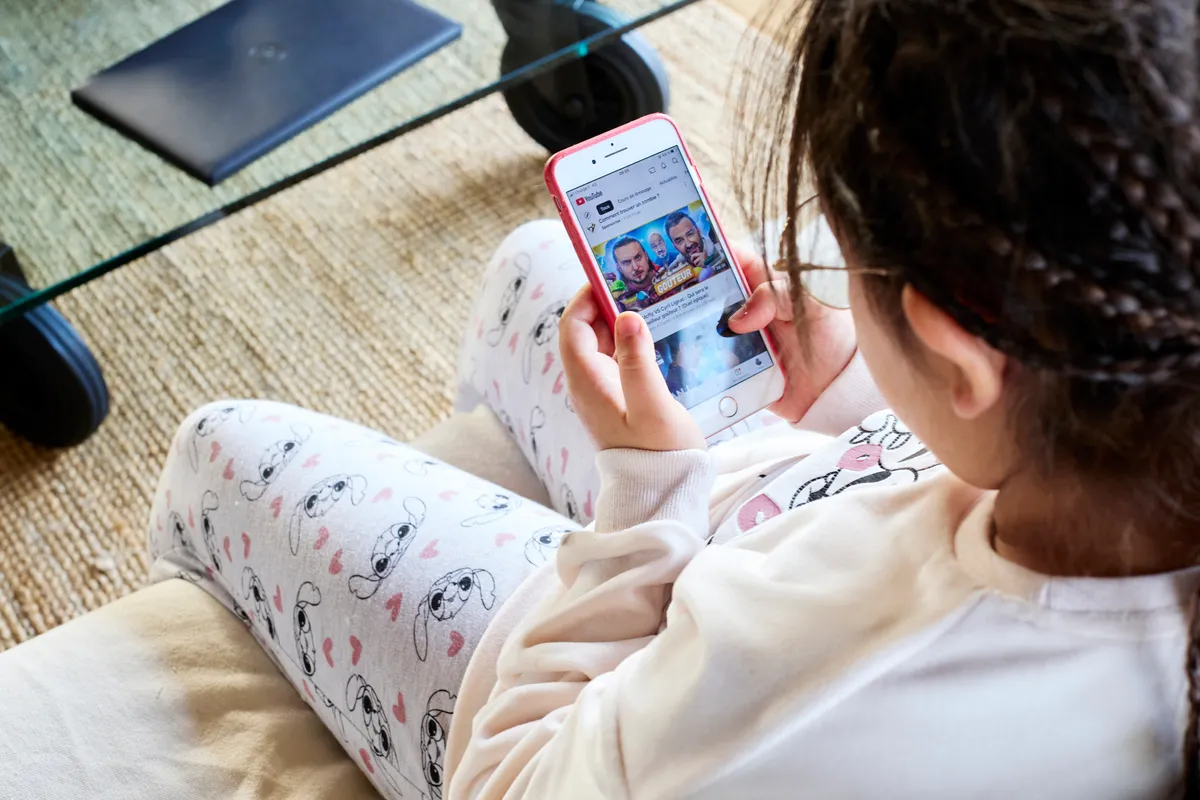
A teenager watches a video on his phone in France, January 3, 2026. (Photo: Reuters).JPG
So how should "AI cleanup" be understood? If we understand it as simply deleting a few offensive videos, we're only addressing the symptoms. In reality, we need to clean up the entire "pipeline" that delivers trash to users: clearer labeling rules; safer default designs for children; reduced reliance on algorithms that optimize viewing time; open data for independent research; and forcing platforms to respond more quickly to harmful content. The European Digital Services Act follows this direction by requiring major platforms to reduce risks to minors, allowing users to choose non-personalized feeds, and banning targeted advertising to children. On the family side, YouTube has also added time limits for scrolling Shorts, break reminders, and bedtime reminders for supervised accounts; for young children's accounts, parents can use content selection or manual video browsing.
For Vietnam, this issue needs to be approached with a more cautious rather than panicked perspective. Not all AI-powered content is "junk." But when platforms prioritize instant gratification over long-term value, when warning labels aren't clear enough for children, and when parents are constantly chasing after every single video, the problem is no longer a matter of individual skill alone. It's a problem of platform standards, digital safety education in schools, the responsibility of technology companies, and even the public regulatory framework.
In an increasingly saturated online environment filled with aggregated content, AI cleanup is therefore more than just cleaning up a few bad products; more fundamentally, it's an effort to clean up the mechanisms that are turning people's attention, especially children's, into an overexploited resource.
Source: https://vtv.vn/don-rac-ai-tren-moi-truong-mang-100260525192558675.htm


![[Photo] General Secretary and President To Lam presides over the meeting to approve the draft report on the results of the second inspection by the Politburo of the Standing Committee of the Hanoi City Party Committee.](https://vphoto.vietnam.vn/thumb/1200x675/vietnam/resource/IMAGE/2026/05/26/1779789811432_a2-bnd-4430-9620-jpg.webp)
































































































Comment (0)