

German startup Proxima Fusion in Munich has raised nearly $7.5 million in its first funding round to bring its stellarator fusion power plant to life.
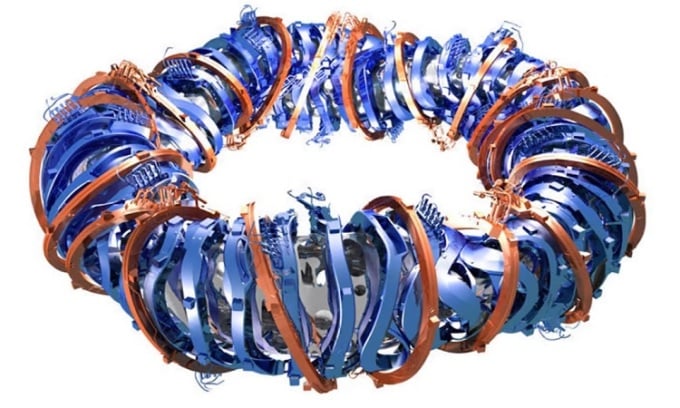
Design of the Wendelstein 7-X (W7-X) stellarator reactor. Photo: IPP
Proxima was founded by scientists and engineers who previously worked at the Massachusetts Institute of Technology (MIT), Google X, and the Max Planck Institute for Plasma Physics (IPP). Some of these researchers had experience developing IPP's Wendelstein 7-X (W7-X), the world's most advanced stellarator fusion reactor, Yahoo reported on May 31.
Most current fusion reactor designs can be divided into two types: tokamaks and stellarators. Both are magnetically controlled fusion devices in which hydrogen isotopes are heated to temperatures higher than the Sun. These excited particles become an energetic plasma that rotates in a circular chamber. Strong magnetic coils around the chamber restrain the charged plasma, where atoms fuse and release immense energy.
The tokamak is a ring-shaped magnetic deceleration device and a leading prototype for fusion reactors. The stellarator has a far more sophisticated design with a series of magnets coiled around the plasma. Using a complex array of electromagnets to decelerate the superheated plasma, the stellarator is more technically challenging than the widely used tokamak approach to fusion energy. However, if the challenges can be overcome, the stellarator offers several advantages such as steady-state operation and better management of excess heat. According to Proxima Fusion, research conducted by IPP since the W7-X became operational in 2015 could bridge the gap between tokamaks and stellarators, paving the way for commercialization.
"The progress made on the W7-X and recent breakthroughs in stellarator modeling have changed the landscape. Stellar reactors can now overcome key problems of tokamak reactors and scale up, contributing to improved plasma stability and high steady-state efficiency," said Francesco Sciortino, co-founder and CEO of Proxima.
Proxima is aiming to deploy a new high-efficiency stellarator within the next few years and open its first nuclear power plant in the 2030s.
An Khang (According to Yahoo/The Engineer )
Source link

![[Photo] General Secretary and President To Lam presides over a meeting with the Central Organizing Committee.](https://vphoto.vietnam.vn/thumb/1200x675/vietnam/resource/IMAGE/2026/06/03/1780482764658_a1-bnd-4741-3342-jpg.webp)
![[Photo] Secretary of the National Assembly Party Committee, Chairman of the National Assembly presides over the meeting of the Standing Committee and Executive Committee of the National Assembly Party Committee.](https://vphoto.vietnam.vn/thumb/1200x675/vietnam/resource/IMAGE/2026/06/03/1780480353201_ndo_br_bnd-2585-jpg.webp)
![[Photo] First session of the 14th Congress of the Vietnam Trade Union](https://vphoto.vietnam.vn/thumb/1200x675/vietnam/resource/IMAGE/2026/06/03/1780465947883_ndo_br_img-3852-jpg.webp)






















































![[Video] Sunset at Lap An Lagoon – Where the sun sets over the fishing nets](https://vphoto.vietnam.vn/thumb/1200x675/vietnam/resource/IMAGE/2026/05/31/1780192137701_beach-landscape-sea-water-nature-grass-745871-pxhere-com.jpeg)






























Comment (0)