In Tay Ninh , traditional rice noodle soup has a unique characteristic: its soft, chewy noodles. You have to visit the factory and see each step of the noodle-making process firsthand to fully appreciate its charm and uniqueness.
When talking about Tay Ninh cuisine , many people will immediately think of famous specialties such as: sun-dried rice paper, Trang Bang rice noodle soup, shrimp salt… However, there is a familiar dish that has its own unique and distinctive characteristics.
That's hu tieu, a simple dish of the people of Southern Vietnam. In Tay Ninh, hu tieu has a traditional flavor with a unique characteristic: the noodles are soft and chewy. You have to go to the factory and see each step of making the noodles firsthand to fully appreciate its charm and uniqueness.
Visiting the family of Ms. Le Thi Huong Giang (Ms. Hai Giang, Truong Hoa commune, Hoa Thanh town) one afternoon, we found her and her daughter busy preparing the batter for making rice noodles. For over 40 years, Ms. Hai Giang has consistently started work at dawn and only rested in the late afternoon. Now, while many noodle factories have switched to using machines, there are not many people left who still preserve the traditional way of making rice noodles like Ms. Giang's family.
Ms. Giang recounted that she used to work as a hired hand at a noodle factory, then gradually learned the trade and started making noodles at home. Thanks to this noodle factory, she earned an income to raise five children. Before she knew it, she had been in this profession for more than half her life and was beginning to pass it on to her third daughter.
Ms. Giang diligently works through the steps of making rice noodles.
Using rice and wheat flour as the main ingredients, Ms. Giang meticulously prepares each batch of dough, selecting each type of rice to ensure the cakes are always of high quality. First, the rice is soaked and then ground into flour. To achieve the characteristic soft and chewy texture of the cakes, she carefully adds wheat flour according to a specific ratio that she has accumulated through years of experience.
Speaking about the most important step in making soft, chewy rice noodles with the distinctive flavor of Tay Ninh, Ms. Hai Giang said: "It's about getting the right ratio of rice flour and wheat flour. I did it over and over again until the noodles met the requirements, and I've kept that recipe to this day."
In the small kitchen, beside the rice husk stove with two steamers for making rice noodles, Ms. Giang works tirelessly, sometimes spreading the batter, sometimes scooping out the noodles. Making rice noodles, the most difficult steps are spreading and scooping them out, requiring skill and expertise from the cook.
Ms. Giang's hands nimbly scoop a ladleful of batter and pour it onto the pan, then quickly use the ladle to spread the batter evenly. Afterward, she carefully covers the pan to allow the steam to cook the batter. The rice noodles are quite large, and with this manual method, the person making them must stand to have enough strength to lift them onto the drying rack and also to work faster, so that some noodles can be dried in the sun.
Under the summer sun, each cake quickly shrinks and is carefully brought inside, oiled, and arranged in layers before being fed into the cutting machine. “Drying the cakes is very hard work. If you forget even a little bit in this hot weather, you lose weight. Because if the cakes dry out too much, you lose weight, and the sellers don’t like them. The cakes have to be slightly under-dried before you have to bring them inside immediately,” said Ngoc Cam, Ms. Giang’s daughter. In the rainy season, it’s twice as hard; to dry the cakes quickly, Ms. Giang has to use electric fans and carefully adjust the batter to make them dry faster.
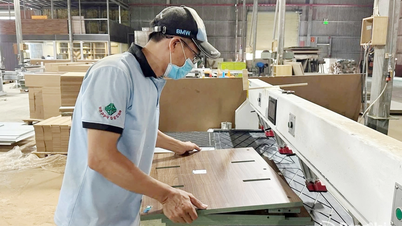
Cutting the rice noodles is the final step in making them. In the past, the strongest person in the household would handle this task, as the cutter had to operate the machine manually, which required a lot of strength. But nowadays, in just a few minutes of machine operation, hundreds of rice noodles are cut into thin, long, and uniform strands.
Beside the smoky stove, Ms. Giang diligently makes each rice noodle, carefully handling every product she creates. Although the work is arduous and the income isn't high, it's a traditional craft that has helped her support her family. On average, Ms. Giang's family produces 80-100 kg of rice noodles per day.
Many people comment that the rice noodles made traditionally, like those made by Ms. Giang's family, taste better than those made by machine, making them popular with restaurants and food stalls. Because of the manual method, Ms. Giang's family only produces enough rice noodles to supply their regular customers for the day. But every restaurant and food stall that tries her noodles praises them highly.
Ms. Giang shared: "Tay Ninh rice noodles have a distinctive flavor and a soft, chewy texture, quite different from rice noodles made from rice flour. I've eaten rice noodles from my hometown since I was a child, so I'm used to the taste; you'll find it quite different when you go to other regions."
A delicious bowl of rice noodle soup with soft and chewy noodles.
If you've come to Tay Ninh, don't forget to enjoy the delicious and appealing noodle soup. When cooking noodle soup, besides the broth, the main ingredient, the noodles themselves, determines the unique deliciousness of noodle soup from each region. The combination of rice and wheat flour creates the distinctive chewy texture and aroma of Tay Ninh noodle soup.
Hoa Khang - Ngoc Dieu




![[Photo] The heat at the fireworks display site on the opening night of the Da Nang International Fireworks Festival 2026](https://vphoto.vietnam.vn/thumb/1200x675/vietnam/resource/IMAGE/2026/05/27/1779889741485_ndo_br_z7872039145157-fecaba5112f39e8352544099d7ef4738-5140-jpg.webp)


![[Photo] Life on both banks of the river returns to its bustling pace on the day the Long Bien Bridge opens to traffic.](https://vphoto.vietnam.vn/thumb/1200x675/vietnam/resource/IMAGE/2026/05/28/1779949763708_cau-long-bien-minh-duy-7-3610-jpg.webp)



















































































Comment (0)