

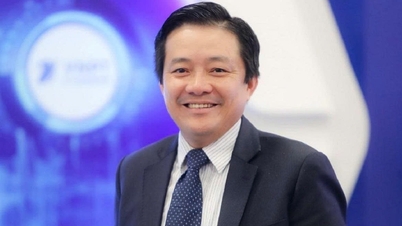
At the beginning of the new year, a reporter from Thanh Nien newspaper had an interview with Associate Professor Dr. Nguyen Van Vu, Deputy Head of the Faculty of Information Technology and Head of the Software Engineering Department at the University of Science (Vietnam National University Ho Chi Minh City), about the development trends of artificial intelligence in 2025.

Associate Professor Dr. Nguyen Van Vu, Deputy Head of the Faculty of Information Technology and Head of the Software Engineering Department, University of Science (Vietnam National University Ho Chi Minh City)
PHOTO: UNIVERSITY OF SCIENCE
DEVELOPMENT AND APPLICATION OF AI IN MEDICINE AND HEALTHCARE
How would you assess the development trends of artificial intelligence (AI) in 2025, in the context of the world in general and Vietnam in particular, sir?
The most prominent trend in AI development in 2025 will continue to be the development of large-scale language-based models and foundational AI models, and their applications. Researchers from universities and major companies will continue to research, build, and release new versions and foundational models with higher capabilities, accuracy, speed, and security.
Another prominent trend is the development and application of AI in medicine and healthcare, particularly in assisting doctors in diagnosing diseases and monitoring and evaluating the effectiveness of medications.
In Vietnam, the main trend is the continued application of AI into business processes at companies and agencies to improve labor productivity, increase revenue, and reduce costs.
Many companies will build AI solutions based on popular platform models to serve specific industry and business process needs, including virtual assistants and AI agents. AI applications will become more widespread in government agencies once large language models are trained with data and administrative processes.
CHANGES IN INDUSTRY STRUCTURE
According to him, what are the opportunities and challenges for Vietnam in the face of the current rapid development of AI?
Vietnam's opportunities can be seen in many aspects. For example, the development and application of AI solutions in various fields such as: public services, healthcare (healthcare, disease diagnosis), transportation, etc.
Developing AI solutions for overseas markets and increasing foreign investment, especially in domestic technology companies, is crucial. With a high-quality AI workforce and software expertise, Vietnam can accelerate the development and operation of products (startups). Vietnam has the opportunity to become an attractive destination for AI technology businesses.
It also involves developing AI human resources. The rapid development of AI creates opportunities for Vietnam to invest in training high-quality AI human resources.
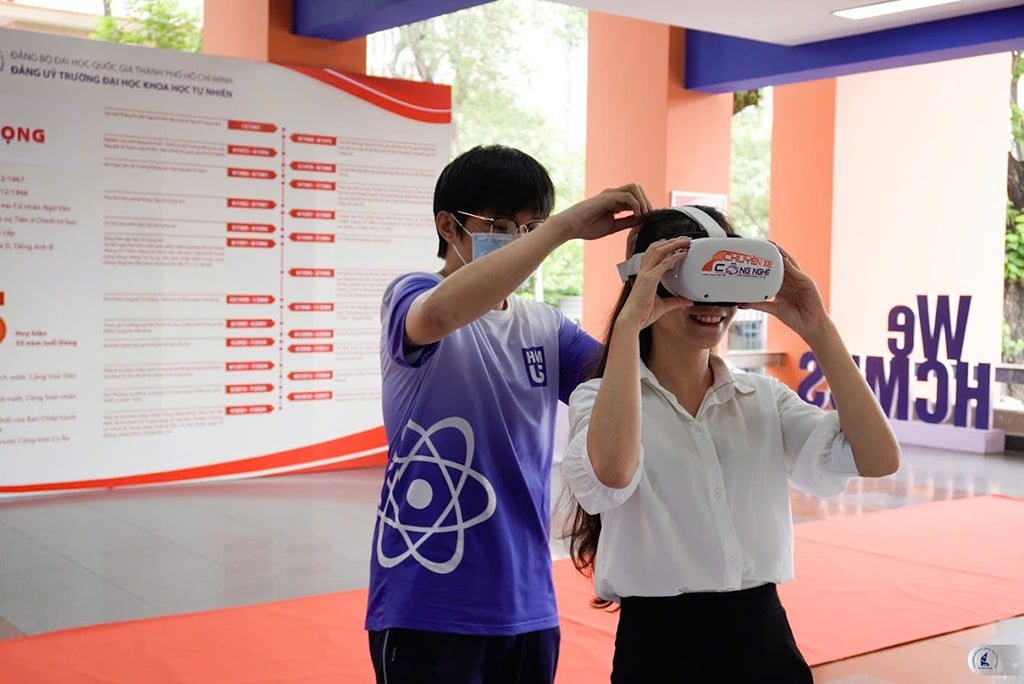
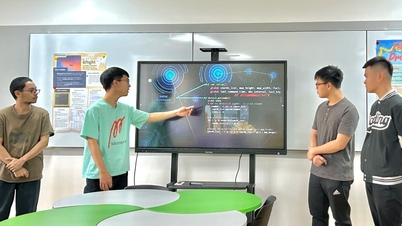
Students from the University of Science (Vietnam National University Ho Chi Minh City) experience activities applying AI.
Simultaneously, Vietnam also faces many challenges in the face of the rapid development of AI. Among these, the shortage of high-quality AI human resources is a major challenge. According to a survey we conducted in 2023 in Ho Chi Minh City (within the framework of the Ho Chi Minh City People's Committee's project on training internationally qualified AI human resources), up to 75% of businesses believe that the current AI workforce does not meet the quantitative requirements, while 65% believe that the quality of AI human resources also falls short of expectations. This survey also shows that the demand for AI human resources is growing, with an increase of 10% to 25% annually.
AI has a far-reaching impact on many industries, both increasing labor productivity and leading to the replacement of some jobs or a decrease in labor demand. This causes a shift in the occupational structure and can lead to unemployment for those who fail to adapt or lack the appropriate skills to transition.
Vietnam's level of digital transformation is still limited. To develop and apply AI effectively, the first step is to undergo digital transformation through the development of software solutions that serve the requirements of data collection, management, and operation of business processes in agencies and enterprises. The slow pace of digital transformation, especially in government agencies, reduces the potential and effectiveness of AI application.
What are the predicted impacts of AI on Vietnam's labor market, industry structure, and job positions, sir?
Currently in Vietnam, the application of AI is still low, mainly focused on using tools like ChatGPT for digital content creation. Job positions related to digital content, such as advertising, scriptwriting, and office assistant roles, are declining. In the near future, as AI solutions are developed and applied more widely, the structure of industries and job positions will change significantly. Repetitive or simple tasks such as data entry, customer service, and basic data analysis will gradually be replaced by AI agents. For example, in the software field, the need for engineers specializing in simple programming and testing will gradually be replaced by AI tools like GitHub Copilot.
DeepSeek is shaking up the field of AI.
In late December 2024, DeepSeek, a Chinese technology company, surprised everyone by announcing the release of its free DeepSeek V3 large language model (LLM), which took only two months to build at a cost of less than $6 million.
Built on a low budget but with features comparable to top-tier Western models, these are two of the reasons why China's DeepSeek AI has been a surprise.
Experts believe the AI race, with DeepSeek's success, is no longer a one-sided "game." According to Business Today , just as the Soviet Union's Sputnik launch spurred the US and other nations to invest in space technology, DeepSeek could inspire a wave of innovation in AI.
CONDITIONS FOR TRAINING HIGH-QUALITY AI HUMAN RESOURCES
Many universities are opening AI training programs; what are the opportunities for students in this field, in your opinion?
As mentioned above, the AI workforce has not met the needs of businesses and organizations in terms of both quantity and quality. According to our survey, demand increases annually by 10-25%, while the AI training quotas of universities in Ho Chi Minh City only increase by 5-10% per year. Although many universities are opening AI training programs and increasing training quotas, it is important to note that the quality of graduates is the decisive factor in determining opportunities for students in the AI field; because to develop and operate AI solutions, we need a highly capable and specialized workforce.
AI training requires significant investment in both infrastructure and human resources, so have domestic universities met these requirements yet?
The infrastructure, especially computing infrastructure with supercomputers, has not yet met the training requirements of universities. Furthermore, to train high-quality AI human resources, we need a good learning environment that provides students with opportunities for international integration. We also need an ecosystem for AI research, development, and application with the participation of students, researchers, and businesses.
Learners need to be taught how to use AI effectively.
We should view AI as a supporting tool to achieve learning goals; therefore, learners should not be prohibited from using AI in their studies and research if such use does not affect the training objectives of the program and course. Furthermore, learners need to be trained in the skills to use AI tools and solutions effectively.
Whether students are allowed or restricted from using AI should be specifically defined within each subject, rather than simply prohibiting or not prohibiting its use.
For learners, the use of AI (if permitted) should be seen as a means, a tool to support the acquisition of necessary skills, knowledge, and experience. Abusing AI solely to achieve high scores will have serious consequences for learning goals and long-term personal development.
Source: https://thanhnien.vn/dao-tao-nhan-luc-ai-trong-xu-the-moi-18525020319580616.htm

![[Image] Central Party Office summarizes work in 2025](/_next/image?url=https%3A%2F%2Fvphoto.vietnam.vn%2Fthumb%2F1200x675%2Fvietnam%2Fresource%2FIMAGE%2F2025%2F12%2F18%2F1766065572073_vptw-hoi-nghi-tong-ket-89-1204-jpg.webp&w=3840&q=75)


















































































Comment (0)