

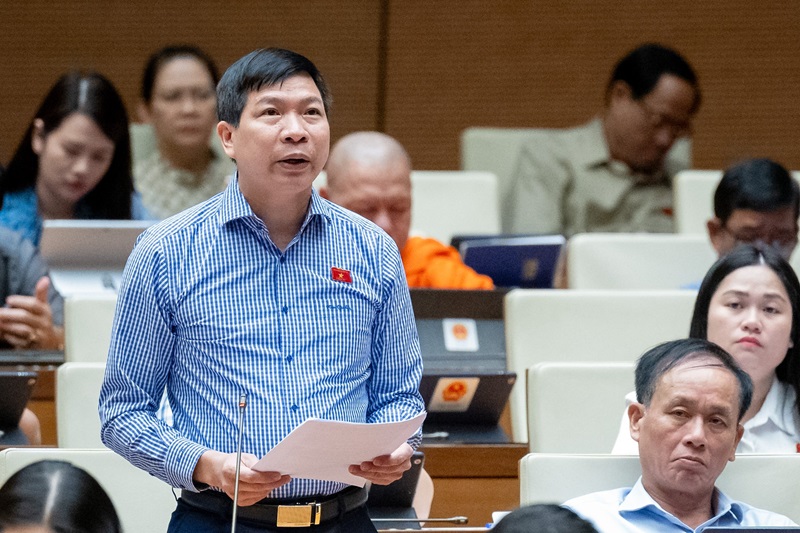
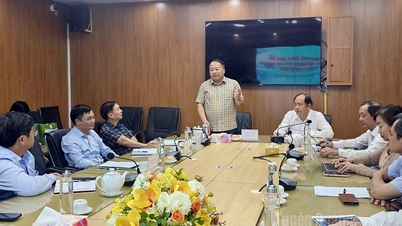
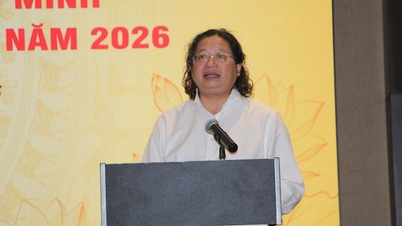
National Assembly Deputy Tran Van Thuc, Provincial Party Committee member, Deputy Head of the Propaganda and Mass Mobilization Department of the Thanh Hoa Provincial Party Committee.
Participating in the discussion, National Assembly Deputy Tran Van Thuc, Provincial Party Committee member and Deputy Head of the Propaganda and Mass Mobilization Department of Thanh Hoa Provincial Party Committee, stated that the draft Law on Teachers has been meticulously and thoroughly prepared by the drafting agency; it has undergone numerous consultations, revisions, and amendments, and is now basically complete for submission to the National Assembly for final consideration, discussion, and approval as prescribed.
After studying the draft Law on Teachers dated April 16, 2025, the delegates unanimously agreed with the draft law, particularly on the following fundamental points:
The draft law's scope and target audience are quite broad and comprehensive, encompassing teachers on the payroll, those under labor contracts, and foreign teachers in public, private, and non-public educational institutions within the national education system. Teachers in non-public educational institutions are treated equally with teachers in public institutions in terms of identification, professional standards, basic rights and obligations, and certain policies such as training, professional development, recognition, rewards, and handling of violations.
The authority to advise on the overall staffing of the teaching staff under its management is delegated to the Ministry of Education and Training (MOET); the authority to recruit and accept teachers is delegated to educational management agencies or the heads of educational institutions. Regulations stipulate that teacher recruitment must include pedagogical practice to select individuals with sufficient competence aligned with the professional standards for teachers, meeting the professional needs of teachers at each educational level and training qualification. These regulations will help the MOET sector proactively prepare a teaching staff to meet the actual needs of educational institutions.
Specific regulations regarding the deployment, secondment, and transfer of teachers, with attention to preserving and implementing policies and benefits for teachers subject to deployment, secondment, and transfer, as well as policies aimed at strengthening and maintaining the stability of the teaching staff in ethnic minority areas, mountainous regions, border areas, islands, and areas with particularly difficult socio-economic conditions.
The specific regulations on inter-school and inter-level teaching are consistent with the practical implementation of inter-school and inter-level teaching in localities over the past period, and are also in line with the dissolution of district-level administrations and the merger of commune-level administrations in the near future.
The Central Committee's policy outlined in Resolution 27-NQ/TW has been concretized: "Teachers' salaries shall be ranked highest in the administrative and public service salary scale"; and specific regulations have been established regarding support policies and policies for valuing teachers, with particular attention paid to policies for teachers working in ethnic minority areas, mountainous regions, border areas, islands, and areas with particularly difficult socio-economic conditions.
The regulations stipulate a lower retirement age (compared to the retirement age of workers under normal conditions) for preschool teachers and a higher one for highly qualified teachers, ensuring suitability with the specific professional characteristics of preschool teachers and encouraging high-quality human resources to work in specialized fields and industries.
Furthermore, with the hope that the Law on Teachers, once enacted, will increasingly enhance the effectiveness of managing and utilizing the teaching staff in educational institutions, in line with the practical development of the education sector, the delegates offered the following suggestions:
Clause 6 of Article 4 of the draft law on the interpretation of terms stipulates: “6. The head of an educational institution is the principal or director of the educational institution, responsible for managing and operating the activities of the educational institution.” It is suggested that this be reviewed to ensure that the concept of the head of an educational institution does not only include the principal and director. In practice, the head of an educational institution can also be the owner of a private institution, the owner of an individual business, etc. Strict regulations regarding the head of an educational institution are essential for the smooth implementation of related regulations; and at the same time, ensure the identification of the legal obligations to which that individual is accountable to the community, society, and the law.
Regarding Article 7 on the professional activities of teachers: Clause 3 stipulates: "The professional activities of teachers as stipulated in points a and b of Clause 2 of this Article shall be carried out according to the school year or course." It is suggested that the provision in Clause 3 be omitted, because logically, if it were included, the remaining points of Clause 2, besides points a and b, would also need to specify the time of implementation. Furthermore, the content as stipulated in Clause 3 is unnecessary and meaningless; in practice, activities as stipulated in points a and b are always included in the work plans of educational institutions. If specific regulations on the implementation time of these activities are needed, this is a matter within the authority of government agencies.
The draft law stipulates that the recruitment and appointment of teachers is assigned to the education management agency to preside over or to the head of the public educational institution according to the decentralization of authority. It is proposed that other provisions regarding the transfer and appointment of teachers to management positions in educational institutions should also be adjusted in this direction, whereby the education management agency takes the lead in advising the competent authority on the transfer and appointment of teachers to management positions in educational institutions.
Regarding the reasons, the delegates proposed that it is necessary to give the Education sector the autonomy to lead or advise on the recruitment and employment of teachers in order to address the shortcomings in the use and management of the teaching staff in the past, such as the localized surplus and shortage of teachers between educational institutions and between commune-level administrative units, while simultaneously improving the efficiency of the teaching staff and enhancing the quality of education.
The delegates also proposed unifying the policy of decentralization and granting autonomy to the education sector in the recruitment and employment of teachers in the Law on Teachers with the amendments to the Law on Public Employees, the Law on Organization of Local Government, and other subordinate legal documents to create a synchronized and unified legal framework for the development of the teaching staff.
The reason is that currently, parallel to the drafting and promulgation of the Law on Teachers, the competent authorities are simultaneously amending several laws such as the Law on Public Employees, the Law on Organization of Local Government, etc., to ensure consistency with the restructured two-tiered local government system. The delegates suggested that a comprehensive and unified solution is needed to avoid duplication in the management and utilization of the teaching staff.
Quoc Huong
Source: https://baothanhhoa.vn/dbqh-tran-van-thuc-doan-dbqh-tinh-thanh-hoa-de-xuat-giao-quyen-chu-dong-cho-nganh-gd-amp-dt-trong-tuyen-dung-su-dung-giao-vien-247850.htm

![[Photo] Prime Minister Pham Minh Chinh presides over a meeting on private sector economic development.](/_next/image?url=https%3A%2F%2Fvphoto.vietnam.vn%2Fthumb%2F1200x675%2Fvietnam%2Fresource%2FIMAGE%2F2025%2F12%2F20%2F1766237501876_thiet-ke-chua-co-ten-40-png.webp&w=3840&q=75)


![[Photo] Prime Minister Pham Minh Chinh presides over the conference announcing the establishment of the International Finance Centre in Vietnam.](/_next/image?url=https%3A%2F%2Fvphoto.vietnam.vn%2Fthumb%2F1200x675%2Fvietnam%2Fresource%2FIMAGE%2F2025%2F12%2F21%2F1766309817714_ndo_br_dsc-3400-jpg.webp&w=3840&q=75)






































































Comment (0)