

The salt industry development plan for the period 2021-2030, approved by the Prime Minister in Decision 1325/QD-TTg, aims to promote the development of the salt industry. The plan's objectives for 2025 are to maintain a total salt production area of 14,500 hectares, with an output of 1.5 million tons per year. This includes 5,000 hectares of salt crystallization on tarpaulin-lined surfaces, producing 650,000 tons (43%), and 500,000 tons of processed salt. The plan also aims to ensure 4,805 hectares of industrial-scale salt production, with an output of 640,000 tons per year (42%); and to apply science and technology to increase salt production productivity by at least 20%.
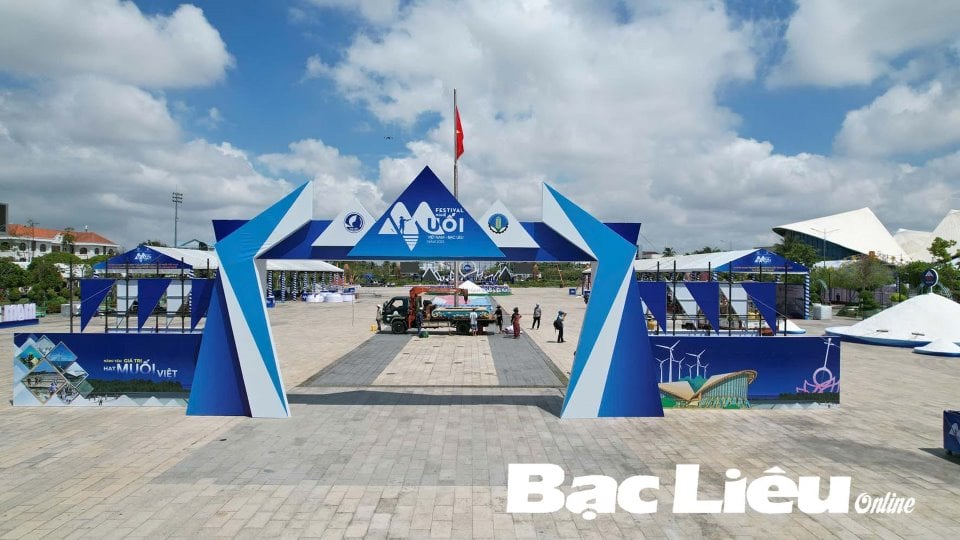
Many activities within the framework of the Salt Production Festival were held at Hung Vuong Square (Bac Lieu City). Photo: KK
PROMOTING THE DEVELOPMENT OF THE SALT INDUSTRY
One of the objectives of the Project is to invest in the development of salt production linked to processing and marketing. Accordingly, investment in the synchronized development of salt production, processing, and marketing will be included in the medium-term public investment plan for the period 2021-2025 and beyond. The project aims to develop the production of various types of salt to meet domestic demand, with a focus on supporting the synchronized development of salt production containing abundant natural minerals and micronutrients with low NaCl content, which is beneficial to health.
For artisanal salt production, investment in renovating and upgrading infrastructure, and strengthening the irrigation system in salt fields for salt producers, along with support for building processing models and diversifying salt products to increase added value, is crucial in the provinces and cities of Thai Binh, Nam Dinh, Thanh Hoa, Nghe An, Ha Tinh , Quang Ngai, Phu Yen, Binh Dinh, Ba Ria - Vung Tau, Ho Chi Minh City, Ben Tre, Tra Vinh, Soc Trang, Bac Lieu, and Ca Mau.
Support investment in equipment systems for processing and analyzing salt quality, design, and packaging for small and medium-sized salt processing facilities to meet market demands; invest in and support the development and replication of salt production linkage models along the value chain from production and processing to consumption; pilot models of salt production combined with rural tourism and resort tourism; models applying advanced techniques in clean salt production; and models of salt production containing many natural minerals and micronutrients with low NaCl content, beneficial to health. Encourage and support organizations and individuals to invest in and upgrade salt storage systems, ensuring salt reserves for production and business, and purchasing salt for temporary storage.
ENHANCE THE VALUE OF SALT
Another task of the Project is to strengthen research and application of science and technology in salt production and processing to improve productivity, quality, and diversify salt products. Specifically, for salt production using sand-drying and dispersed water-drying technologies (manual salt production), research and improve the technology and equipment for producing crystallized salt on new materials; build a model of salt production linkage along the value chain between enterprises, cooperatives, and salt farmers; research and apply technology and build a model for salt crystallization using the greenhouse effect to minimize risks from climate change; research and support the pilot construction of a model combining salt production with tourism and recreation in salt-producing villages to promote and sell salt.
The long-term goal by 2030 is to focus on improving productivity and product quality, with a total salt production area of 14,200 hectares but a production volume of 2 million tons per year, meeting domestic demand, especially supporting the development of salt products and other processed salt products to serve export, tourism, and healthcare needs.
Furthermore, the Ministry of Agriculture and Environment has also piloted the Project to Improve the Quality and Value Chain of Vietnam's Salt Industry for the period 2021-2025 in eight provinces: Nam Dinh, Thai Binh, Nghe An, Phu Yen, Khanh Hoa, Ninh Thuan, Ben Tre, and Bac Lieu. Notably, from March 6-8, 2025, the first Vietnam Salt Festival will be held in Bac Lieu province to honor, preserve, and develop the traditional salt-making craft and enhance the value of Vietnamese salt.
KIM KIM
Source: https://baocamau.vn/de-an-phat-trien-nganh-muoi-giai-doan-2021-2030-a41820.html







![When forestry is a 'weakness' for Nghe An?: [Part 3] Forest owners worry about the challenge of financial self-sufficiency](https://vphoto.vietnam.vn/thumb/402x226/vietnam/resource/IMAGE/2026/06/01/1780328200116_pu-hoat-014846_425-223223.jpeg)



![Transforming from Resolution 57: [Part 1] 'Digital Field' in the Heart of the City](https://vphoto.vietnam.vn/thumb/402x226/vietnam/resource/IMAGE/2026/06/01/1780313803412_2848-htx-nong-nghiep-tuan-ngoc-8-173833_249-173836.jpeg)









![[Photo] Reception to welcome General Secretary and President To Lam and his wife on their State visit to the Philippines](https://vphoto.vietnam.vn/thumb/1200x675/vietnam/resource/IMAGE/2026/06/01/1780295488620_vna-potal-chieu-dai-chao-mung-tong-bi-thu-chu-tich-nuoc-to-lam-va-phu-nhan-tham-cap-nha-nuoc-toi-philippines-8798060-7855-jpg.webp)


























































Comment (0)