

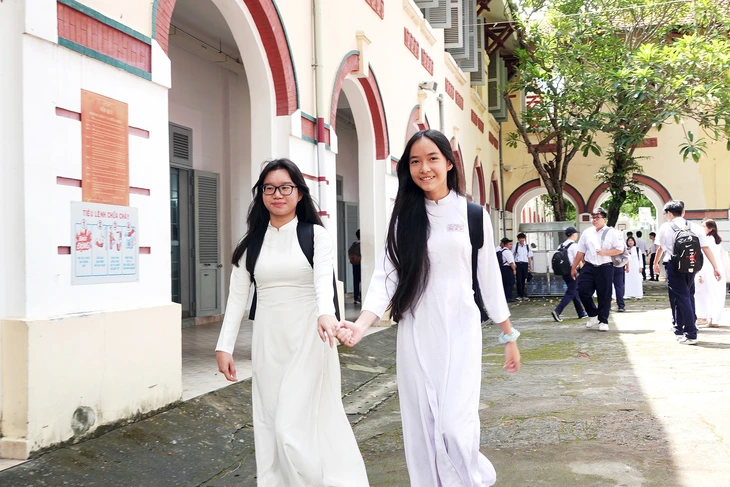
Tenth-grade students at Marie Curie High School (Ho Chi Minh City) arrived at school on the afternoon of August 27th to hear about school regulations and have their photos taken for their application files - Photo: TTD
Speaking to Tuoi Tre newspaper, delegate Nguyen Thi Viet Nga (member of the Committee on Culture and Society, deputy head of the National Assembly delegation of Hai Phong City ) said that this viewpoint is very noteworthy, reflecting a completely new understanding, unprecedented in previous resolutions.
This perspective clearly demonstrates a new level of engagement, emphasizing that awareness of education and training should not be merely a slogan but should be realized through concrete actions.
Removing cost barriers and creating equal opportunities for all children.
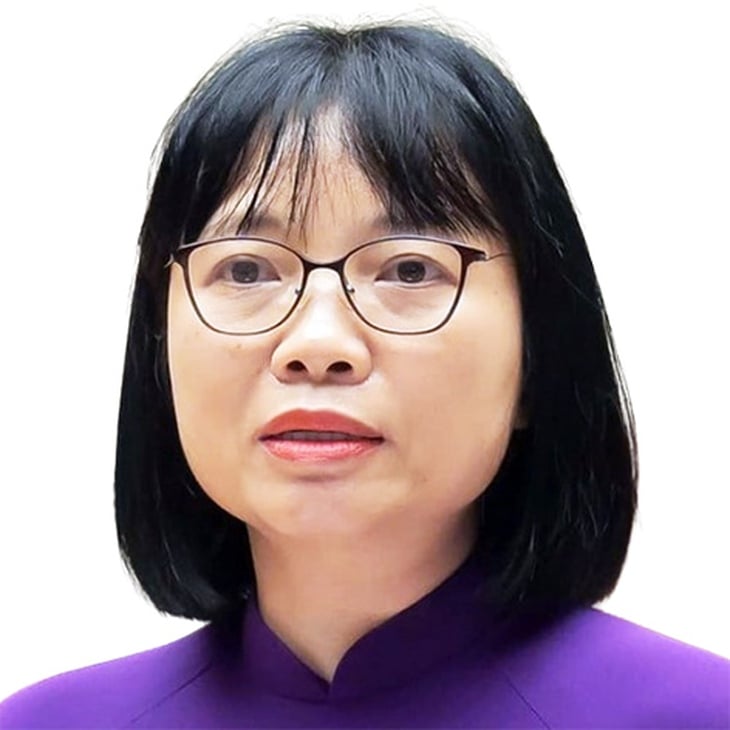
Representative NGUYEN THI VIET NGA
* In your opinion, what needs to be done in the future, and how should resources be prepared, to clearly demonstrate that education and training will determine the future of the nation?
- To effectively implement this new perspective, there are three key task groups that need to be deployed urgently and efficiently.
Firstly, regarding financial resources, priority should be given to the education budget, while also strongly mobilizing social resources, combining state resources with other legitimate sources of social funding.
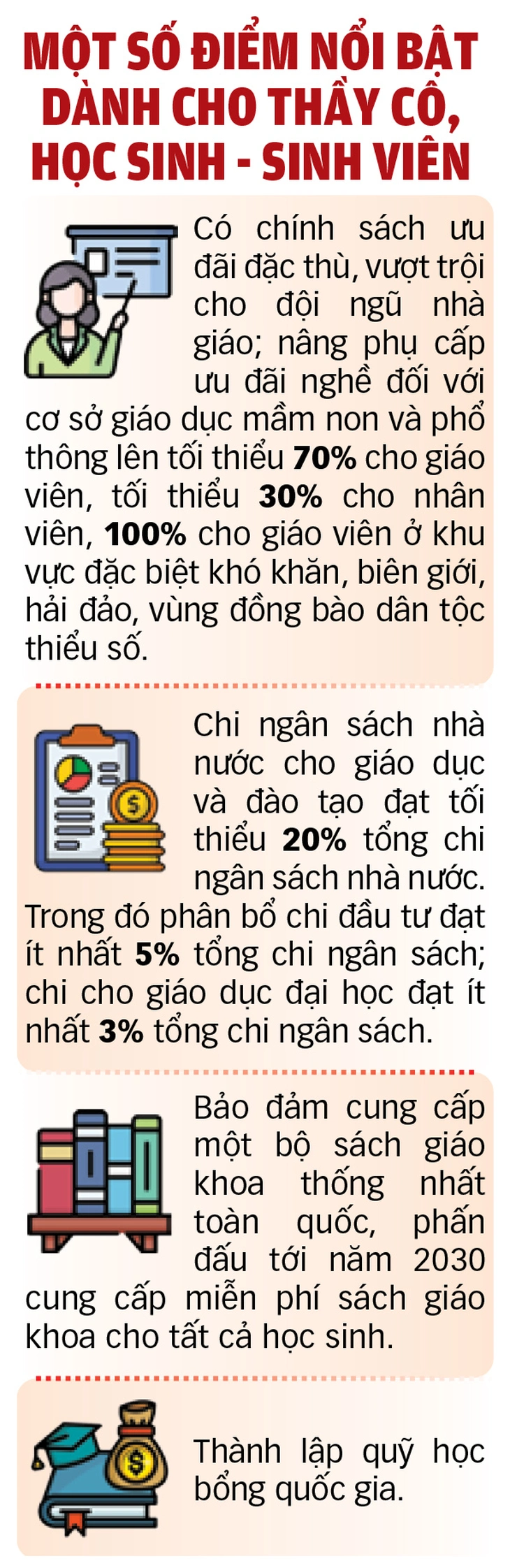
The resolution clearly states that 20% of the total budget revenue should be allocated to education.
However, this 20% figure is not simply about allocating that amount of funding to the education sector each year, but requires meticulous calculation by relevant authorities ( Ministry of Finance ) regarding the overall education budget from various ministries and national target programs.
With limited national resources, careful and precise planning is needed to ensure that investments are both highly effective and avoid waste.
Secondly, regarding human resources, it is necessary to improve the quality of teachers and lecturers, and to have policies to attract talented individuals and experts from both within and outside the country in a truly outstanding and attractive way.
Only in this way can we improve the quality of education as expected. A developed education system is impossible without a team of excellent teachers and education experts.
Thirdly, it's about system governance. We must innovate management, ensure transparency, and put the learner at the center. This is an element that is often overlooked, but it is one of the key factors for our development and innovation in education during this period of rapid scientific and technological advancement.
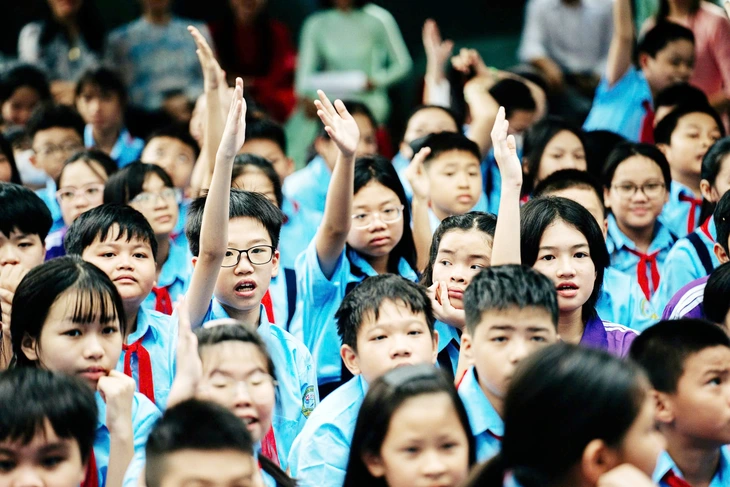
Sixth-grade students at Go Vap Secondary School (Ho Chi Minh City) excitedly enter their new school - Photo: THANH HIEP
A set of free textbooks: humane and fair.
* One aspect that has received much attention is the resolution's task-solution statement regarding ensuring the provision of a unified set of textbooks nationwide, striving to provide textbooks free of charge to all students by 2030. How do you view this content?
- The policy of providing free textbooks to all students by 2030 is very humane, ensuring uniformity and fairness in access to education, helping to remove cost barriers, and creating equal opportunities for all children.
To achieve this, it requires an optimized production and printing mechanism, the application of digital technology to reduce costs; a fair distribution system; and a reasonable budget, combined with social mobilization to ensure financial sustainability.
In order for the policy on textbooks outlined in the resolution to be effectively implemented in practice, several key aspects need to be given special attention.
The compilation process must be open and transparent, with broad participation from scientists and teachers, and subject to thorough social review. This helps the textbooks avoid errors, ensure scientific accuracy, and maintain practical relevance.
Furthermore, it is necessary to establish an independent and objective evaluation mechanism, avoiding formality or rigid "framework." The evaluation process must focus on quality, not just "legalizing procedures."
Furthermore, the implementation process must be synchronized, from training teachers and ensuring adequate facilities to supporting disadvantaged localities. Only then will the textbooks truly become a part of everyday life, without adding further pressure on parents, students, and teachers.
Regarding the roadmap, it needs to be implemented step by step, with pilot programs and evaluations before being scaled up.
Regarding evaluation criteria, in addition to the quality of knowledge, attention should be paid to its suitability to students' learning abilities, its feasibility in teaching, and especially its level of social consensus. When these criteria are met, the unified set of textbooks will become an effective tool contributing to improving the quality of education, in line with the spirit of Resolution 71 of the Politburo.
Early childhood and primary education are the "roots" of the national education system.
* The guiding principles state that early childhood and general education are the foundation for shaping personality and developing students' qualities and abilities. In your opinion, what additional solutions does the education sector need to implement to achieve this?
- Early childhood and primary education are the "roots" of the entire national education system.
This is a stage not only for acquiring knowledge but, more importantly, for shaping character, cultivating qualities, honing life skills, and laying the foundation for the holistic development of a person.
To achieve this, the education sector needs to innovate its educational content and methods.
Therefore, we need to continue shifting from a teaching style that heavily emphasizes memorization to one that teaches critical thinking and problem-solving skills.
The curriculum must be closely linked to practical applications, helping students apply their knowledge to real life, while simultaneously fostering love for their homeland, civic awareness, and a spirit of international integration.
At the same time, strong investment in the teaching staff is necessary, and preschool and primary school teachers must truly be considered the core workforce.
In addition to improving professional qualifications, we need to focus on cultivating pedagogical skills and psychological-educational skills so that they are capable of nurturing and guiding students from their early years.
In addition, there must be adequate incentive policies, especially for teachers in remote areas, so that they can feel secure and committed to the profession.
Another solution is to strengthen coordination between schools, families, and society. The formation of students' character and qualities cannot be solely the responsibility of the school; it requires close collaboration with parents and society.
Schools need to regularly communicate with parents, listen to their concerns, and cooperate in educating their children. At the same time, the community and organizations also need to participate in creating a healthy and safe environment that helps children develop harmoniously in terms of intellect, physical health, and emotional well-being.
If these things are achieved, early childhood and primary education will become a solid foundation for shaping a generation of Vietnamese citizens who are knowledgeable, ethical, and socially responsible.
Some specific objectives of the resolution
By 2030
- Expand equitable access and improve the quality of early childhood and primary education to reach advanced levels in the Asian region.
- Complete universal preschool education for children aged 3-5 and compulsory education up to lower secondary school.
- The percentage of workers with college degrees or higher reached 24%.
- The proportion of students studying basic sciences, engineering, and technology must reach at least 35%, including at least 6,000 postgraduate students and 20,000 students in talent programs.
- Recruit at least 2,000 excellent lecturers from abroad.
- Strive to have at least 8 higher education institutions among the top 200 universities in Asia, and at least 1 higher education institution among the top 100 universities in the world in certain fields according to reputable international rankings...
By 2035
- Complete the universalization of high school education and equivalent qualifications.
- Strive to have at least two higher education institutions ranked among the top 100 universities in the world in certain fields according to reputable international rankings...
Vision 2045
- Vietnam has a modern, equitable, and high-quality national education system, ranking among the top 20 countries in the world.
- All citizens have the opportunity for lifelong learning, to improve their skills and knowledge, and to develop their full personal potential.
- Strive to have at least 5 higher education institutions among the top 100 universities in the world in certain fields according to reputable international rankings...
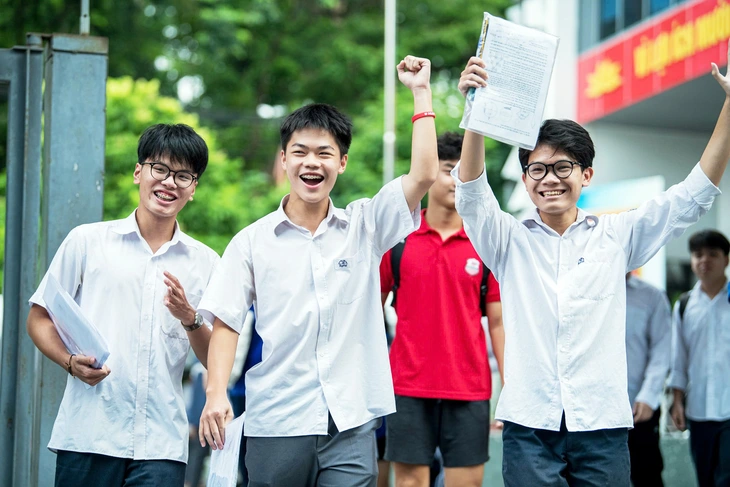
Students are excited after taking the 2025 high school graduation exam - Photo: NAM TRAN
* Delegate TRAN KHANH THU (Hung Yen):
Create new mechanisms to encourage learning and support students.
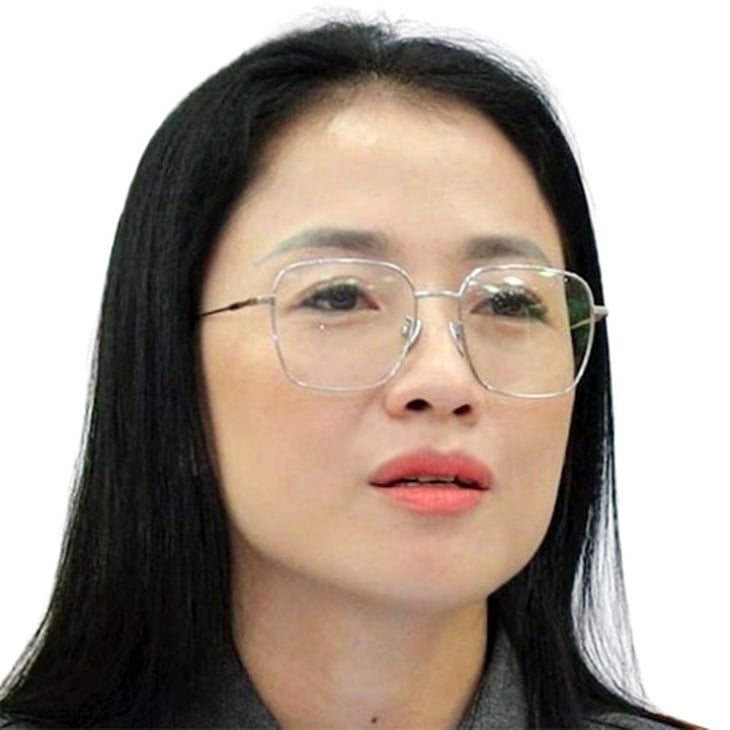
I was particularly impressed that the resolution expressed a unified approach to building and implementing a new National Target Program on modernization and improving the quality of education and training for the period 2026-2035; prioritizing investment in higher education.
This most clearly demonstrates the Party's guiding viewpoint on the role and responsibilities of education and training; considering education and training as a top national priority, an extremely important driving force and foundation for development, and a determinant of the country's and nation's future in the new era.
Secondly, establishing a national scholarship fund, while effectively utilizing other talent and education promotion funds from the state budget and other legitimate sources, is a new mechanism to encourage learning and support students, especially those from remote areas.
In addition, the resolution also sets long-term strategic goals such as building a modern education system that is deeply integrated with the world.
The emphasis on holistic education—combining knowledge, skills, ethics, and physical development—reflects a deep concern for training Vietnamese people to be harmoniously developed, creative, and resilient.
Policies aimed at improving the living standards and income of teachers, focusing on education in disadvantaged areas, and universalizing education to all age groups demonstrate fairness and humanity in the approach to education.
The resolution promotes autonomy, innovation, and proactive creativity in each school and for each teacher, and encourages the application of new scientific and technological achievements in teaching to improve quality.
For the resolution to truly come to life, it requires strong determination from the entire society, synchronized involvement from all sectors and levels, and a significant shift in mindset from administrators to teachers and students.
Organizing, inspecting, monitoring, and ensuring sufficient resources also presents a significant challenge.
However, if Resolution 71 is implemented seriously, it will contribute to a breakthrough for Vietnamese education, bringing the country closer to advanced education systems in the world, as desired by the entire population and decided by the Party and the State.
* Representative NGUYEN THI MAI HOA (Deputy Chairperson of the Committee on Culture and Social Affairs):
Good news regarding teachers' income.
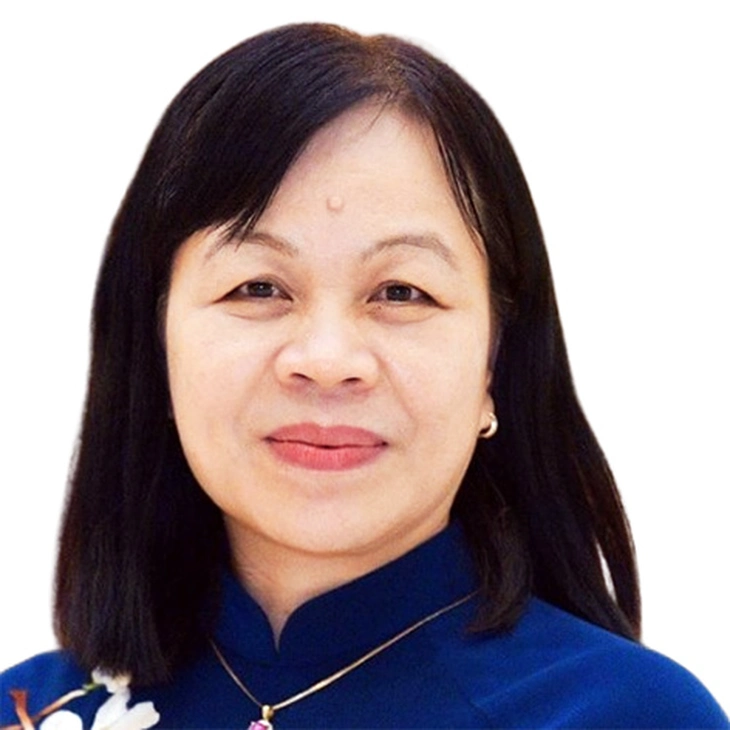
I believe the most significant breakthrough in this resolution lies in its guiding principles, understanding, and overall thinking regarding education.
While consistently considering "education as a top national priority," it has added a guiding principle that education is crucial in "determining the future of the country."
At the same time, another breakthrough lies in defining autonomy for higher education and vocational education regardless of the level of autonomy.
Also in the resolution, the Politburo emphasized the need for special, superior preferential policies for the teaching staff, and the development of appropriate policies to mobilize talented individuals from outside the field to participate in teaching and training... This is good news for teachers and the education sector.
In fact, when the Law on Teachers was drafted and passed, the provision that teachers' salaries should be ranked highest in the administrative and public service salary scale received considerable criticism regarding its feasibility.
However, with the requirements and solutions outlined in Resolution 71 of the Politburo, this issue has been resolved.
Therefore, it is necessary to quickly put the Law on Teachers into practice, realizing it through a specific salary scale system so that the policy takes effect immediately. At the same time, it is necessary to review and build a team of qualified teachers and school staff.
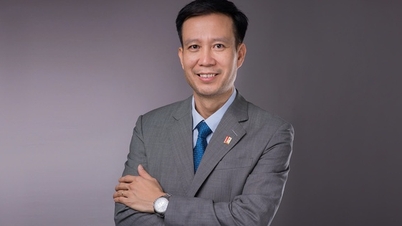
* Dr. Tran Thanh Hai (Principal of Vien Dong College):
Vocational schools have the opportunity to make a breakthrough.
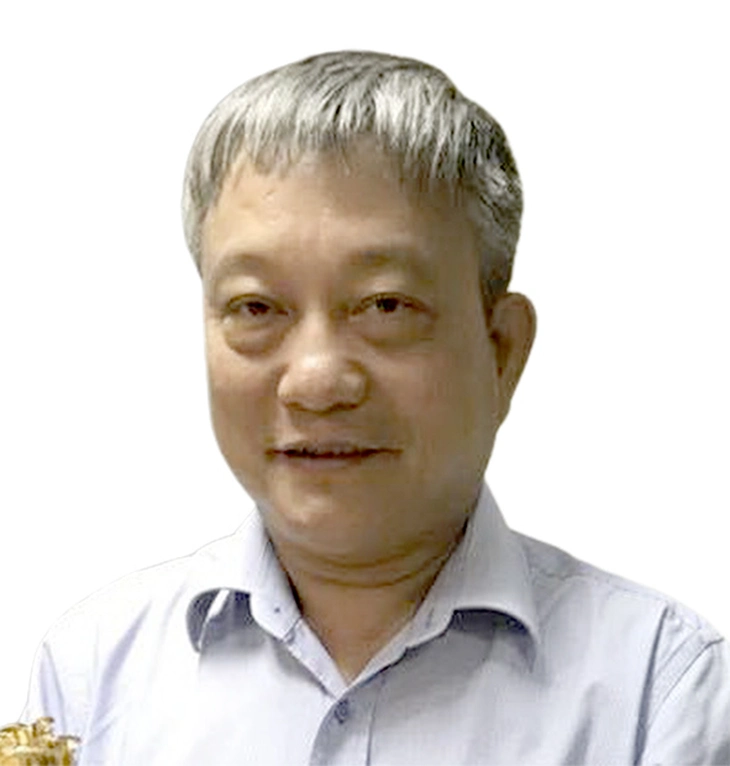
This Politburo Resolution 71 represents a very strong shift in thinking regarding vocational education.
For the first time, the solutions were clearly outlined: restructuring the vocational school system towards a streamlined and efficient model; developing facilities that meet international standards; and, most importantly, emphasizing the close link between schools, businesses, and local communities.
I believe this addresses the biggest long-standing "bottleneck": training hasn't been truly aligned with the needs of the labor market.
What I found particularly striking was that the resolution clearly defined the role of vocational education alongside higher education, rather than viewing it as a "subordinate" or "secondary option".
Equating vocational high schools with regular high schools and developing streaming programs right after lower secondary school will give students more practical choices that suit their abilities, meaning not everyone has to go to university. This is a progressive viewpoint, aligning with the trends of developed countries.
I also strongly agree with the specific mechanisms and policies for developing vocational teachers and attracting experts and highly skilled workers to participate in teaching.
If there were mechanisms in place to involve engineers and experts from businesses in vocational training, the quality of training would undoubtedly improve significantly. Investment in education is also a crucial factor in ensuring vocational schools can confidently develop in a modern direction.
I believe that the goals for 2030, 2035, and the vision for 2045 of building an internationally standardized vocational education system and creating a highly skilled workforce are entirely feasible if the solutions in the resolution are implemented synchronously.
Source: https://tuoitre.vn/de-giao-duc-va-dao-tao-quyet-dinh-tuong-lai-dan-toc-20250828084537962.htm



![[Image] Hanoi's urban life under the challenge of a "scorching hot" environment](https://vphoto.vietnam.vn/thumb/1200x675/vietnam/resource/IMAGE/2026/05/25/1779706979265_nang-nong-t5-2026-minh-duy-7-4636-jpg.webp)
![[Image] Close-up view of the interchange connecting the two expressways and Long Thanh Airport.](https://vphoto.vietnam.vn/thumb/1200x675/vietnam/resource/IMAGE/2026/05/25/1779703378210_ndo_br_z7863716673926-224453a31600126cce10622af6290afd-4549-jpg.webp)







































































Comment (0)