

Hanoi's Dong Da District has proposed increasing the height of the Trung Tu apartment complex to 48 floors without changing the population density.
Dong Da District is currently seeking public opinion on the detailed planning task for the renovation and reconstruction of the Trung Tu residential area, at a scale of 1/500.
According to the explanatory document, the Trung Tu residential area is expected to have a population of 8,200 people, with over 4,000 people in the surrounding area. The overall building density of the area remains the same as the 1/2,000 scale urban zoning plan approved by the city in 2012, at 30-60%. The minimum height remains at 2 stories, but the maximum height, as proposed in this project, is double the number of stories previously suggested in the zoning plan, from 24 to 48 stories.
The planned items in the planning area include: apartment buildings; townhouses; villas and social infrastructure facilities such as kindergartens, primary schools, high schools; parks, gardens, sports training grounds; office buildings; roads, parking lots and other urban technical infrastructure.

Two buildings belonging to the Trung Tu residential complex on Pham Ngoc Thach street. Photo: Vo Hai
The Trung Tu residential complex, spanning nearly 12 hectares, is located in Trung Tu ward, Dong Da district. This model complex, built between 1972 and 1975, comprises 29 four- to five-story apartment buildings without elevators, each containing an average of 60-120 apartments, and 119 villas and townhouses.
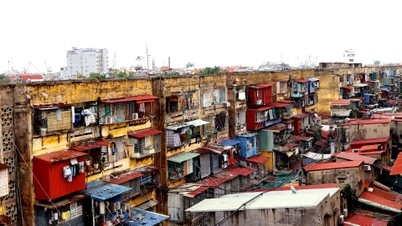
The apartments in the housing complex are in serious disrepair. Most households have expanded their living space, causing the exterior surfaces of the buildings to be deformed, with many walls and floors peeling and cracking. Some sections of the corridors have been demolished to make way for water and electrical pipes, leaving exposed internal wall structures and posing a safety hazard.
Furthermore, due to the buildings' age, many apartments frequently suffer from dampness and leaks during the rainy season. Public areas and shared spaces have been encroached upon and converted into residential units combined with shops. The ground floor of buildings in the complex and surrounding areas is used for commercial and service businesses.

Most households have expanded their living space, causing the exterior of these buildings to become distorted. Photo: Vo Hai
Along with Trung Tu, two other apartment complexes in Dong Da district are also undergoing public consultation for renovation planning: Kim Lien and Khuong Thuong. Kim Lien is also a model apartment complex, one of the first in the country and in Hanoi, built between 1965 and 1970. The complex consists of 44 apartment buildings ranging from 2 to 6 stories high, located adjacent to Pham Ngoc Thach street with many key service and public facilities.
The Khuong Thuong residential complex comprises 38 buildings with 1,104 apartments and over 3,500 residents, averaging 3.2 people per household. The group of individual houses (alley 1 Ton That Tung and alley 43 Dong Tac) has a total of 45 households with 180 residents, averaging 4 people per household.

Location of the Trung Tu apartment complex renovation plan. Source: Dong Da District People's Committee
Dong Da District currently has 507 apartment buildings, concentrated in 12 large residential complexes covering over 2 hectares, accounting for 30% of the total number of apartment buildings in the city. In Phase 1, the district will develop a detailed plan for the Khuong Thuong residential complex and a master plan for three other complexes: Trung Tu, Kim Lien, and Khuong Thuong. Phase 2 will involve developing detailed plans for five more complexes: Vinh Ho, Van Chuong, Thuy Loi, Nam Dong, and Hao Nam. Phase 3 will include the Phuong Mai and Nam Thanh Cong apartment complexes, and Phase 4 will encompass the remaining old apartment buildings.
According to statistics from 2020, Hanoi has over 1,500 old apartment buildings, including nearly 1,300 in 76 apartment complexes. In addition, the city also has 306 independent old apartment buildings, constructed between 1960 and 1994 and before 1954. Since 2005, Hanoi has begun renovating these old apartment complexes. However, due to some shortcomings and policy changes, only 19 projects have been completed and put into use (accounting for 1.2% of the total number of old apartment buildings), and 14 projects are currently underway.
During the period 2021-2025, the city plans to renovate 10 old apartment complexes, including four Category D complexes – dangerous buildings at risk of collapse requiring urgent relocation of residents, namely: Giang Vo, Thanh Cong, Ngoc Khanh, and the Ministry of Justice building; and six complexes deemed feasible for renovation: Kim Lien, Trung Tu, Khuong Thuong, Thanh Xuan Bac, Thanh Xuan Nam, and Nghia Tan.
Vo Hai
Source link
![[Photo] Ba Lang An Lighthouse - the "eye of the sea" amidst the "rock museum" of Quang Ngai province.](https://vphoto.vietnam.vn/thumb/1200x675/vietnam/resource/IMAGE/2026/05/29/1780038698840_anh-man-hinh-2026-05-29-luc-14-10-42.png)



![[Image] Pleasant weather helps students enter the 10th grade entrance exam with confidence.](https://vphoto.vietnam.vn/thumb/1200x675/vietnam/resource/IMAGE/2026/05/29/1780034401612_ngay-1-thi-lop-10-minh-duy-8-5009-jpg.webp)

































































































Comment (0)