


The story goes that, during a sea patrol, Admiral Giap Van Cuong, then Commander of the Navy, saw the soldiers shirtless, their shoulders marked with cuts from coral rocks that had turned into shiny red scars under the sea sun. The soldiers laughed innocently and said, “Dad, you know? We use our shoulders to carry coral rocks, so it’s normal for our shoulders to get torn. A few minor scars are even more ‘trophies’ for us to impress girls on the mainland, Dad. We’ve written letters to our girlfriends, telling them we’re using our shoulders to support the Fatherland. Don’t you think so?”
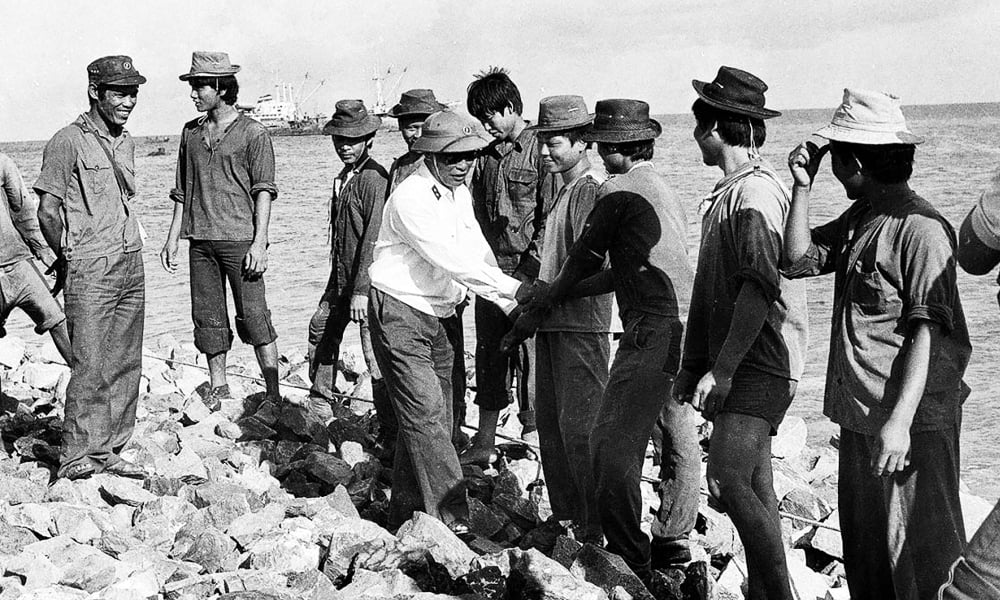 |
Admiral Giap Van Cuong meets with engineering soldiers building Tien Nu Island. (Archival photo) |
The renowned commander playfully scolded his soldiers, tears welling up in his eyes. "Well, the country is still poor. You soldiers, guarding the islands in the vast, stormy seas, your uniforms can't possibly withstand the strain, so carrying stones on your bare shoulders is only right. And you even managed to include such imagery in a letter to your loved one on the mainland—what more can I ask for? Anyway, it's almost dark now, so you can all go to bed early. I'll be on guard duty tonight!"
And Admiral Giap Van Cuong stood guard with his rifle, much to the utter surprise of the island soldiers.
Admiral Giáp Văn Cương was born in 1921 in Bảo Đài commune, Lục Nam district, Bắc Giang province. Bắc Giang is a revolutionary land steeped in legends from the wars against the invaders from the North. Giáp Văn Cương was born into a prestigious family. He received a good education from a young age, but his adventurous and sociable nature led him to travel early. In 1942, at the young age of 21, he went to Bình Định, a region known for its martial arts, to work as a civil servant in the railway industry. During the August Revolution of 1945, Giáp Văn Cương joined the Viet Minh. He then served as Battalion Commander of the 19th Ba Tơ Battalion; Regiment Commander of the 96th Regiment, before relocating to the North.
In 1964, he returned to the battlefield, assuming the positions of Commander of the 324th Division, the 3rd Division, the 2nd Division, and Deputy Commander and Chief of Staff of the Quang-Da Front; in early 1974, he was appointed Deputy Chief of the General Staff of the Vietnam People's Army. In March 1977, he was appointed Commander of the Navy; in February 1980, he returned to the Ministry of National Defense . In early 1984, due to the complex situation in the East Sea, he was reassigned to the position of Commander of the Navy for the second time. In 1988, he was promoted from Vice Admiral to Admiral (rank of General). General Giap Van Cuong was also the first Admiral of the Vietnamese Army.
As a native of Bao Dai, he held many important positions in the wars of national defense, especially serving as Commander of the Navy during the period after the reunification of North and South Vietnam, a time when the country was overwhelmed with work and the situation in the East Sea was extremely complex. This further demonstrates the great trust that the Party, State, and Army placed in Admiral Giap Van Cuong.
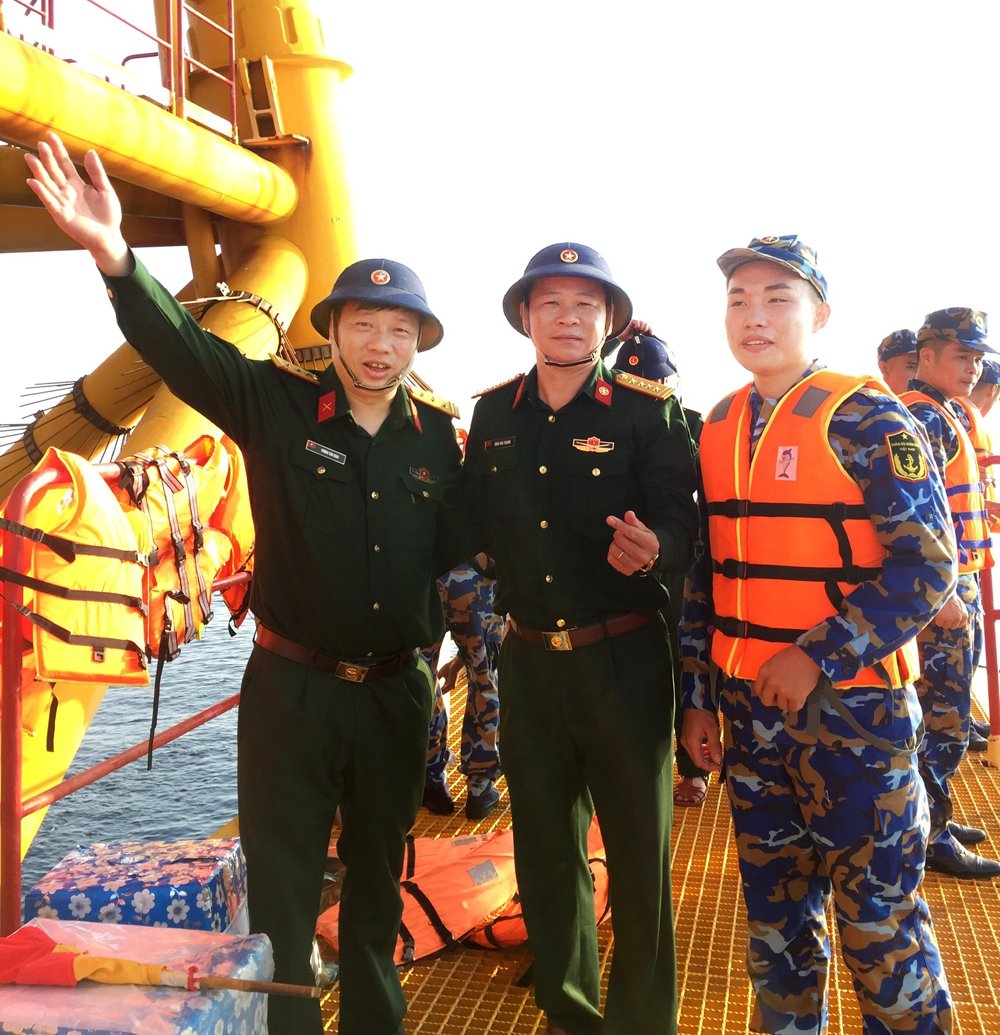 |
Author Phung Van Khai (far left) during a business trip to Truong Sa. |
I vividly remember that while working on the memoir of Lieutenant General Lu Giang – former Commander of the Capital Military Region – an outstanding son of Luc Nam (Bac Giang province), he repeatedly mentioned Admiral Giap Van Cuong with rare respect. Both men commanded troops advancing south after the August Revolution and fought valiantly on the Quang-Da front. After the liberation of South Vietnam in 1975, both generals received important responsibilities from the Party and the Army. As outstanding sons of Bac Giang, both dedicated their lives to the revolutionary cause, serving as humble yet noble role models.
During our recent historic April trip to Truong Sa, our 10 working groups were named after the islands, both above and below water, like a harmonious symphony: Song Tu Tay Group; Da Nam Group; Son Ca Group; Da Thi Group; Sinh Ton Dong Group; Len Dao Group; Tien Nu Group; Nui Le A Group; Da Tay B Group; and Truong Sa Group, traversing a vast expanse of sea, sky, clouds, and water. The song sung on the ship , "...This sea is ours, this island is ours - Truong Sa - Though storms, though tempests, though hardships, we will overcome them / Truong Sa soldiers, continue to sing the song about the exemplary soldiers of Uncle Ho's army / With manly spirit, we will firmly uphold the sovereignty of our Vietnamese Fatherland..." deeply moved everyone in the working group.
In the stories we told from the cramped ship's cabins, where we'd spread mattresses on the salty sea floor and lie head to toe, we often remembered Admiral Giap Van Cuong. The ships are now larger, the waves and winds are still as rough as before, but the amenities are far more complete. In the past, Admiral Giap Van Cuong spent weeks at sea with his soldiers on small boats, traveling thousands of miles. And now, with the islands so well-maintained, he's gone. He's gone, yet he remains so close, his image of an impenetrable fortress on the shoulders and in the minds of each soldier.
At the islands, both above and below sea level, boats started arriving at 6 a.m., one after another, carrying the delegation to the islands. Everyone wanted to be on the first trip. Everything in Truong Sa today is new. Everything in Truong Sa is youthful. The faces of the soldiers are unusually bright. The soldiers of Truong Sa today are steadfast, their lives are fulfilling in every aspect. The heartfelt affection of people from all over the country for Truong Sa is evident. A majestic statue of Hung Dao Dai Vuong Tran Quoc Tuan stands tall amidst the sea and sky of Song Tu Tay Island. A statue of President Ho Chi Minh stands proudly under the national flag. Statues of the heroic martyrs who sacrificed their lives for the sacred sovereignty of the sea and islands evoke profound and complete feelings in each member of the delegation. Everyone wants to do something truly good for the nation. That is also the aspiration that Admiral Giap Van Cuong had, decades ago, to fulfill.
According to naval soldiers, during patrols, Admiral Giap Van Cuong would always gather the troops on the island and ask: "I'll give you a question: If the enemy wants to seize the island, how will they fight?" The officers and soldiers on the island, as well as the accompanying combat officers, would frankly present their options based on their own thinking. Usually, the general would listen, nod, and then ask: "So, if the enemy lands on the island, how will you fight to defend it?"
Everyone enthusiastically offered various strategies for fighting the enemy. The white-haired general questioned each person and their chosen approach, sometimes offering counterarguments, other times adding to their combat ideas. Once everything was more or less settled, he emotionally asked, "How difficult is life for you all here? It must be very difficult, isn't it? Even as the Commander, I haven't been able to help much; I feel guilty towards you all. Let's work together to overcome these difficulties."
That's Admiral Giap Van Cuong for you. Before leaving the island, he reminded his crew to write down all the plans, including everyday stories. After the ship had departed, in the pitch-black night, the old general sat silently on the deck like a statue.
Admiral Giap Van Cuong, along with relevant ministries and agencies, proposed the construction of the DK1 offshore platform system on submerged coral reefs in Vietnam's continental shelf waters very early on. This proposal was supported by the Central Military Commission, the Ministry of National Defense, and the Party and State leadership. To date, the DK1 offshore platform system has become one of the symbols affirming sovereignty and has made significant socio-economic contributions to the exploitation of marine resources.
During our field trips to Luc Nam and our trips to Truong Sa, we artists, writers, and journalists frequently mentioned our ancestors who contributed to the nation, the people, the revolution, and the Army, including Admiral Giap Van Cuong. He himself never rested for a single moment. He passed away suddenly in 1990, with many plans still awaiting him. Admiral Giap Van Cuong received many prestigious awards from the Party, the State, and the Army. On May 7, 2010, Admiral Giap Van Cuong was posthumously awarded the title of Hero of the People's Armed Forces.
A life has ended, but it has opened new, brighter chapters. The name Giap Van Cuong has become the name of streets and avenues in Da Nang, Khanh Hoa, Bac Giang, Kon Tum… This is also a tribute and recognition to Admiral Giap Van Cuong - the legendary Commander of the Navy.
Source: https://baobacgiang.vn/den-truong-sa-nho-do-doc-giap-van-cuong-postid416943.bbg
![[Image] A dreamy "livable city" under pink clouds](https://vphoto.vietnam.vn/thumb/1200x675/vietnam/resource/IMAGE/2026/02/24/1771930060937_tp4-jpg.webp)
![[Photo] White pear blossoms bloom across the border of Pho Bang](https://vphoto.vietnam.vn/thumb/1200x675/vietnam/resource/IMAGE/2026/02/24/1771927665653_a8-8280-jpg.webp)

![[Photo] Head of the Central Propaganda and Mass Mobilization Department visits and congratulates the Ministry of Health and the Military Traditional Medicine Institute.](https://vphoto.vietnam.vn/thumb/1200x675/vietnam/resource/IMAGE/2026/02/24/1771938483290_img-2682-3562-jpg.webp)











































Comment (0)