

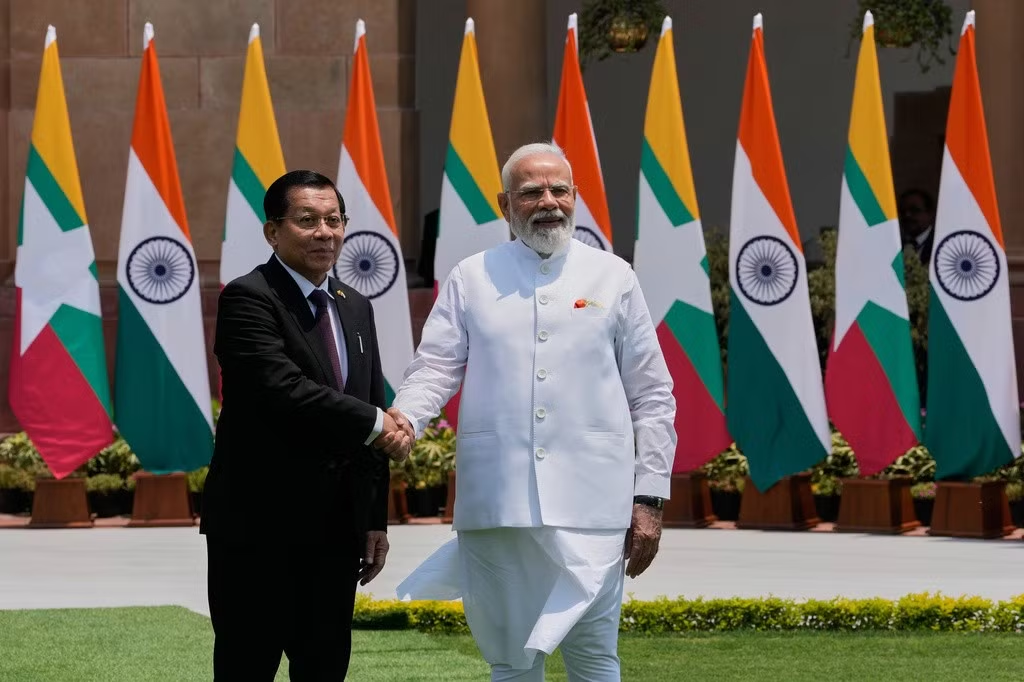
Min Aung Hlaing's five-day visit, which began on June 30 at the invitation of Indian Prime Minister Narendra Modi, aims to strengthen relations with one of Myanmar's key partners in the region.
Despite Western sanctions imposed on Myanmar since the February 2021 coup, India has maintained working relations with Myanmar's military leaders due to the country's strategic importance to New Delhi's security.
Hunter Marston, Southeast Asia director at the Lowy Institute in Sydney, said the invitation amounted to “de facto recognition of the military leader’s political standing,” recalling the meeting between the two leaders on the sidelines of the BIMSTEC summit in Bangkok in April.
Min Aung Hlaing, who served as the army chief and leader of Myanmar 's military government since the 2021 coup, was appointed president last April.
His last visit to India was in 2019, as the army chief, before staging a coup in 2021 and suppressing the opposition. The coup triggered nationwide armed conflict and a humanitarian crisis that continues to this day.
Min Aung Hlaing met with Prime Minister Narendra Modi on June 1st, along with government officials and business representatives, to discuss measures to boost bilateral relations.
The visit takes place against the backdrop of India's desire to promote the Kaladan Multimodal Transport Project (KMMT) – a 109-kilometer corridor connecting the town of Paletwa in Chin State with the Zorinpui border crossing in Mizoram State, India.
This project has been stalled for many years due to fighting between the Myanmar military and the Arakan forces and allied resistance groups. According to Marston, to implement the project, an increased military presence in Chin State is needed to stabilize the corridor.
The director for Southeast Asia at the Lowy Institute in Sydney also stated that naval cooperation is one of New Delhi's top priorities. According to Marston, India views Myanmar as a "crucial partner in expanding its maritime military power and countering the risk of Chinese dominance in the maritime periphery," particularly in the Bay of Bengal.
Inevitably
Sreeparna Banerjee, a research fellow in the Observer Research Foundation's strategic research program, believes the visit reflects a trend toward resuming exchanges with Myanmar's military leadership, as this is inevitable.
According to Ms. Banerjee, the timing of the visit was significant because Chinese Foreign Minister Wang Yi had previously visited Naypyidaw to discuss border stability with Mr. Min Aung Hlaing. UN Special Envoy Julie Bishop had also visited the area.
Ms. Banerjee stated that New Delhi's invitation to Mr. Min Aung Hlaing for a state visit brought "symbolic value to the Myanmar military government, demonstrating a certain degree of acceptance from the international community, although this does not equate to political support."
Although many of India's security issues, such as armed insurgency, arms and drug trafficking, refugee flows, and fraud centers along the border, could be handled through lower-level channels, Banerjee suggested that New Delhi believed direct contact with Min Aung Hlaing was unavoidable.
Professor Htwe Htwe Thein, associate professor of international business at Curtin University, also argued that the visit was more pragmatic than politically motivated.
According to her, Myanmar is strategically important and therefore cannot be ignored, while emphasizing that the escalating instability in the country has become a regional crisis that "neighboring countries cannot simply sit and wait for it to end on its own."
"Choosing India as his first destination as president has immense symbolic significance. Min Aung Hlaing wants to show that he has support not only from China," she said.
According to Ms. Htwe, the visit reflects realities, including India's investments in Myanmar's infrastructure and New Delhi's deep concerns that Chinese influence would fill the void if India withdrew.
“India cannot allow this entire relationship to fall into China’s hands. Welcoming President Min Aung Hlaing is India’s way of asserting to the region that it remains present here,” Htwe said.
Besides the Kaladan project, other important projects being promoted include the trilateral highway between Myanmar, India, and Thailand, along with numerous border infrastructure and energy network projects.
Source: https://tienphong.vn/dieu-gi-khien-an-do-trai-tham-do-don-lanh-dao-myanmar-post1848323.tpo
![[Photo] First session of the 14th Congress of the Vietnam Trade Union](https://vphoto.vietnam.vn/thumb/1200x675/vietnam/resource/IMAGE/2026/06/03/1780465947883_ndo_br_img-3852-jpg.webp)




















![[Photo] Delegation attending the 14th Congress of the Vietnam Trade Union visits the Mausoleum of President Ho Chi Minh.](https://vphoto.vietnam.vn/thumb/1200x675/vietnam/resource/IMAGE/2026/06/03/1780451842301_ndo_br_img-3824-jpg.webp)









































Comment (0)