

Over the years, along with rapid urbanization and ever-increasing housing demand, the real estate market has experienced strong growth, making a significant contribution to economic growth. However, behind this dynamism, the market also shows signs of unsustainable development. House prices in major cities continue to remain high, far exceeding the affordability of most people. In Hanoi, it is not uncommon to find apartments priced at hundreds of millions of dong per square meter.
A worrying reality is that housing in many areas is being turned into a tool for speculation, asset accumulation, and short-term profit. In some areas, land and house prices are artificially inflated in a short period due to rumors of urban planning, the bandwagon effect, or price manipulation tactics, creating an artificial price level. Many projects are bought and sold multiple times even before the product is completed, causing the value of real estate to increasingly diverge from its actual use value.
Excessive capital flow into real estate speculation instead of production and business poses significant risks to the economy. Rising housing prices not only increase the cost of living for urban residents but also negatively impact the economy's competitiveness, as rent, commercial space, and living expenses are all driven up.
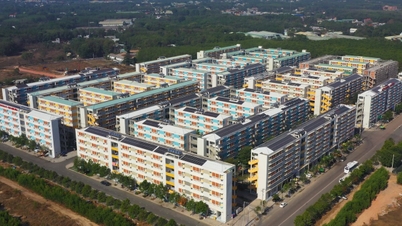
More notably, even in the social housing sector, which has profound social welfare significance, there have been instances of exploiting the policy for personal gain. In fact, there have been cases of people buying social housing not for the purpose of living in it, but for the purpose of reselling or renting it out. Meanwhile, many genuinely needy people cannot access the policy due to complicated procedures and limited supply.
The message "a home is for living in" should therefore be seen as a guiding principle for a healthier, more sustainable, and balanced real estate market. A properly developed market cannot rely solely on rising property prices, but must ensure the actual housing needs of the majority of the population. Housing must first and foremost be defined as an essential need of life, linked to social welfare and the quality of urban development.
To realize that goal, the first priority is to continue improving institutions and policies aimed at controlling speculation and encouraging investment to meet real housing needs; to research appropriate tax tools for owning multiple properties that are not in use; to impose higher taxes on short-term speculative transfers; and to increase transparency in transaction data, land prices, and planning to limit the creation of artificial price surges in the market.
Furthermore, it is necessary to strongly develop the supply of housing that is affordable for the people. The current reality shows that there is still a serious shortage of mid-range, affordable, and social housing in major cities. Meanwhile, many high-end projects are in surplus, creating an imbalance with actual demand.
For social housing, the management agency needs to continue removing bottlenecks in investment procedures, land allocation, credit, and investor selection mechanisms to accelerate project implementation; and strongly develop rental housing alongside housing for sale.
Another crucial solution is to build a synchronized national database on housing and the real estate market, connecting taxes, land, population, and real estate transactions. When all transactions are transparent and effectively monitored, speculation, price manipulation, or loopholes will have little chance of existing.
In the long term, there needs to be a shift in mindset regarding real estate market development towards a more substantive approach. Continuously rising house prices cannot be considered a sign of success. A healthy market must be one that allows people to access housing that suits their income.
Housing is not simply an asset to accumulate or speculate for profit. For each family, it is also a place to live, the foundation of social stability and quality of life. When the real estate market operates according to its true nature of "houses are for living in," that is also when social welfare policies become more substantive and urban development becomes more sustainable.
Source: https://hanoimoi.vn/dua-nha-o-tro-ve-dung-gia-tri-972259.html




![[Photo] General Secretary and President To Lam presides over the meeting to approve the draft report on the results of the second inspection by the Politburo of the Standing Committee of the Hanoi City Party Committee.](https://vphoto.vietnam.vn/thumb/1200x675/vietnam/resource/IMAGE/2026/05/26/1779789811432_a2-bnd-4430-9620-jpg.webp)


































































Comment (0)