

In 2022, the number of immigrants entering Germany increased sharply compared to the previous year, mainly due to the influx of refugees from unstable regions such as Ukraine, Syria and Afghanistan. This figure is 6.5% higher than the previous year 2021, equivalent to 1.2 million people.
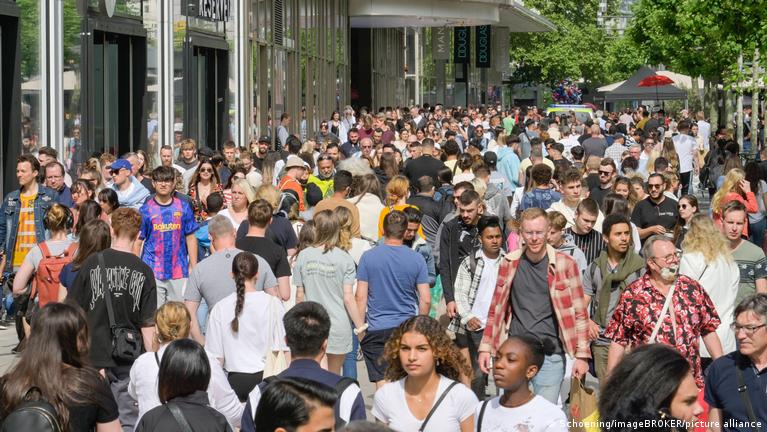
Crowds of people in the capital Berlin, Federal Republic of Germany. Photo: DW.
People considered to have immigrant background include those who have immigrated to Germany from 1950 to the present (first generation) and their biological children (second generation) - that is, those born in Germany and whose parents both immigrated to Germany from 1950 to the present.
Of the 20.2 million people with immigrant background, 15.3 million have directly immigrated to Germany since 1950 (18.4% of the population) and 4.9 million are their biological children (5.9% of the population).
The proportion of men with an immigrant background is 24.8%, higher than the 23.8% of women. It is known that Germany's population reached a record high in 2019 thanks to immigration.
In addition, there are more than 3.9 million people who were born in Germany but only have one immigrant parent. These people are not considered to have an immigrant background.
Of the 15.3 million immigrants living in Germany in 2022, those who arrived in 2013 accounted for almost 40% (6.1 million). Their average age was 29.9 years, significantly younger than those without an immigrant background (average age 47 years).
The three main countries of origin for immigrants to Germany since 2013 have been Syria (16%), Romania (7%) and Poland (6%). Ukraine ranked fourth with 5%. Destatis said the statistics have not yet fully captured the number of immigrants from Ukraine to Germany in 2022.
According to Destatis estimates, the total population living in Germany at the end of 2022 was about 84.3 million people, an increase of about 1.1 million people compared to the end of 2021.
The main reasons for foreigners immigrating to Germany since 2013 were asylum (27.9%), work (24.2%) and family reunification (23.9%). In addition, 8.2% of immigrants since 2013 said that they came to Germany mainly for study (university, postgraduate studies, vocational training...).
Ngoc Anh (according to DW)
Source


















![[Photo] General Secretary and Prime Minister visit the National Exhibition and Fair Center](https://vphoto.vietnam.vn/thumb/1200x675/vietnam/resource/IMAGE/2025/8/19/f4503ad032d24a90beb39eb71c2a583f)

![[Photo] Politburo works with the Standing Committee of Da Nang City Party Committee and Quang Ninh Provincial Party Committee](https://vphoto.vietnam.vn/thumb/1200x675/vietnam/resource/IMAGE/2025/8/19/b1678391898c4d32a05132bec02dd6e1)
![[Photo] Close-up of the first International Financial Center building in Ho Chi Minh City](https://vphoto.vietnam.vn/thumb/1200x675/vietnam/resource/IMAGE/2025/8/19/3f06082e1b534742a13b7029b76c69b6)

![[Photo] President Luong Cuong's wife and Queen of Bhutan visit Tran Quoc Pagoda](https://vphoto.vietnam.vn/thumb/1200x675/vietnam/resource/IMAGE/2025/8/19/62696af3852a44c8823ec52b03c3beb0)


![[Photo] General Secretary To Lam attends the inauguration and groundbreaking ceremony of 250 projects to celebrate National Day](https://vphoto.vietnam.vn/thumb/1200x675/vietnam/resource/IMAGE/2025/8/19/3aa7478438a8470e9c63f4951a16248b)


























































Comment (0)