

World coffee prices have slightly adjusted, with low fluctuations. Robusta coffee futures for the nearest delivery date reversed to increase due to concerns about supply shortages, while the January 2024 delivery date continued to decrease.
The ICE-London inventory report surged earlier this week, ending a nearly three-month decline that had dragged robusta prices lower. However, the uptick was short-lived as the daily inventory report quickly fell again, causing robusta prices to rebound. The September 5 inventory report showed a further decline of 620 tonnes, or 1.77%, to 34,370 tonnes, continuing to raise concerns about a supply shortage.
Meanwhile, as of September 5, Arabica standard inventory was 28,075 tons, down more than 1,000 tons compared to the end of August 2023.
The reason for the continued recovery of the two exchanges was low inventories in London and heavy rains in Brazil. Arabica increased due to excessive rains in the main coffee growing regions in Southeast Brazil, hindering the harvest of the crop in the final stages.
 |
| Domestic coffee prices today, September 7, increased by 100 VND/kg in some key purchasing localities. (Source: YouTube) |
At the end of the trading session on September 6 on the international futures exchange, the price of robusta coffee on the ICE Futures Europe London exchange for November 2023 delivery increased by 3 USD, trading at 2,456 USD/ton. The January 2024 delivery decreased by 7 USD, trading at 2,360 USD/ton. Trading volume was low.
Arabica coffee prices on the ICE Futures US New York exchange for December 2023 delivery increased by 0.35 cents, trading at 153.8 cents/lb. Meanwhile, for March 2024 delivery increased by 0.45 cents, trading at 154.8 cents/lb. Average trading volume.
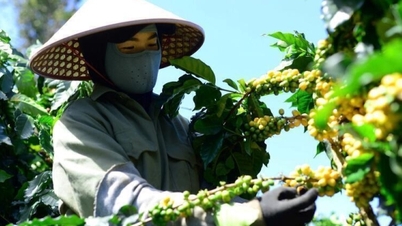
Domestic coffee prices today, September 7, increased by 100 VND/kg in some key purchasing localities.
Unit: VND/kg. (Source: Giacaphe.com) |
Rabobank's outlook for the upcoming market shows that the supply-demand balance is expected to be balanced next season due to lower demand in consuming countries, while production is also forecast to decline in Vietnam (29 million bags) and Colombia (12.6 million bags).
Concerns about supply shortages continue to haunt the market. The news that Brazil exported a total of 3.29 million bags of all kinds of coffee in August, including 700,000 bags of Conilon robusta, has not helped the market ease supply concerns, as the El Nino weather phenomenon is forecast to appear later this year and will cause partial drought in major coffee-producing countries around the Pacific Rim.
In 2023, Vietnam's coffee exports are forecast to reach a new record of 4.2 billion USD. The Vietnamese coffee industry is aiming for an export turnover of 6 billion USD by 2030. Besides advantages, this item also faces difficulties when domestic supply decreases. The Ministry of Agriculture and Rural Development said that Vietnam's coffee output in the 2022-2023 crop year decreased by 6% compared to the previous crop year, down to 29.7 million bags (60kg/bag). This is the lowest output level in the past 4 years, due to higher production costs (labor, fertilizer), farmers tend to switch to more profitable crops.
Indonesia is forecast to have completed the harvest of the current coffee crop year, from April 2023 to March 2024, with an estimated output of 10.3 million bags, lower than the average output of the last 3 years of 11.8 million bags, not as severe a crop failure as some forecasts made at the beginning of the harvest.
Source



![[Photo] Parade to celebrate the 50th anniversary of Laos' National Day](/_next/image?url=https%3A%2F%2Fvphoto.vietnam.vn%2Fthumb%2F1200x675%2Fvietnam%2Fresource%2FIMAGE%2F2025%2F12%2F02%2F1764691918289_ndo_br_0-jpg.webp&w=3840&q=75)
![[Photo] Worshiping the Tuyet Son statue - a nearly 400-year-old treasure at Keo Pagoda](/_next/image?url=https%3A%2F%2Fvphoto.vietnam.vn%2Fthumb%2F1200x675%2Fvietnam%2Fresource%2FIMAGE%2F2025%2F12%2F02%2F1764679323086_ndo_br_tempimageomw0hi-4884-jpg.webp&w=3840&q=75)



















































































Comment (0)