


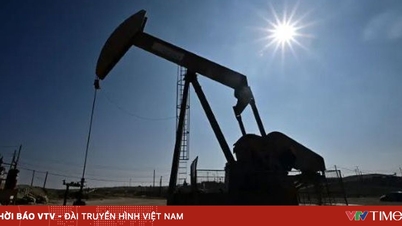
On January 29th, Brent crude oil prices on the international market officially surpassed the $70/barrel mark for the first time since September 2025, amid escalating tensions between the US and Iran. At the start of trading in London on January 29th, Brent crude oil prices rose 2.4% to $70.06/barrel; while West Texas Intermediate (WTI) crude oil also increased 2.6% to $64.82/barrel.
On January 28, Iran declared its readiness to confront and would respond "appropriately" to any military action against it. At a meeting with foreign media representatives, Iran's Vice Foreign Minister for Legal Affairs and International Relations, Kazem Gharibabadi, affirmed its determination to counter threats in the Middle East, including the US military buildup in the region.
Iran's warning came after President Trump declared a "massive US naval fleet" was heading to waters near Iran and ready to act if necessary. Meanwhile, France and Germany supported the European Union's (EU) consideration of adding Iran's Islamic Revolutionary Guard Corps (IRGC) to its list of terrorist organizations. The US and Canada have already added the IRGC, but the EU and the UK have yet to make a similar decision.
The US-Iran tensions are posing significant challenges to regional energy security. Derren Nathan, head of equity research at financial services firm Hargreaves Lansdown, believes that a conflict, if it occurs, risks directly impacting Iran's crude oil production of three million barrels per day.
At the same time, Nathan also warned of the risk of disruption to oil and gas tankers transiting the Strait of Hormuz, which is considered a key transit hub for global energy supplies. In this context, future oil price fluctuations will depend heavily on the ability of all parties to exercise restraint and the outcome of diplomatic efforts to de-escalate tensions.
Source: https://vtv.vn/gia-dau-vuot-moc-70-usd-thung-100260129181057833.htm

![[Photo] General Secretary To Lam attends the opening session of the Peace Council on Gaza.](https://vphoto.vietnam.vn/thumb/1200x675/vietnam/resource/IMAGE/2026/02/19/1771516865192_tbttolam5-jpg.webp)


























































































Comment (0)