

.jpg)
Culture derived from commodities
Once, I spent a long time at the Hoi An Trade Ceramics Museum (Da Nang), admiring hundreds of Chu Dau artifacts salvaged from shipwrecks in the waters off Cu Lao Cham nearly 30 years ago.
Standing before the bowls, plates, gourds, lime containers, and jars... in shades of yellow, eel-skin, bluish-purple, and green, adorned with intricate patterns, I wondered how, about 500-600 years ago, handcrafted items from the skilled hands of the Eastern region had arrived at the Hoi An trading port? And how did these products manage to travel on merchant ships on their long voyages to distant overseas regions?
.jpg)
"That is the core value of Chu Dau pottery. Although it was lost to history, it flourished and stood strong, thanks to its tradition," artisan Nguyen Van Luu, one of the key figures in successfully restoring this ancient pottery style, told me.
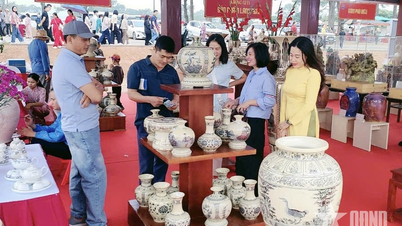
Chu Dau village, formerly part of Thai Tan commune, Nam Sach district, Hai Duong province, is now Thai Tan commune (Hai Phong). Throughout its centuries-long history, Chu Dau pottery has spread throughout the world . From priceless, unique artifacts in museums to products catering to contemporary tastes, visitors, both Vietnamese and foreign, come to Chu Dau. Some buy pottery to display, others simply to admire it before leaving. Chu Dau pottery is not just a commodity; it is a cultural heritage.
Not many traditional craft villages clearly identify their patron saint. However, Chu Dau pottery has sufficient evidence to confirm that female artisan Bui Thi Hy is the patron saint. During the salvage operation of a shipwreck at the bottom of the sea off Cu Lao Cham in 1997, a portrait statue of Bui Thi Hy was found and is currently on display at the National Museum of History.
.jpg)
According to the Bui family genealogy, Bui Thi Hy (1420 - 1499) married Dang Sy, a resident of Chu Dau village. Later, she and her husband established a pottery workshop, and their products were traded throughout the country. Evidence of this is the ancient blue and white porcelain vase currently on display at the Topkapi Saray Museum (Istanbul, Türkiye). The vase bears 13 Chinese characters, which translate to: "In the 8th year of Thai Hoa (1450), in Nam Sach district, artisan Bui Thi Hy wrote/painted/created."
By the 17th century, Chu Dau pottery had been lost but was gradually restored quite by chance. In 1980, Mr. Makato Anabuki, former Secretary of the Japanese Embassy in Vietnam, discovered the aforementioned blue and white porcelain vase on display at the Takapisaray Museum and wrote to Mr. Ngo Duy Dong, then Secretary of the Hai Duong Provincial Party Committee, requesting his assistance in verifying its authenticity. Based on this information, relevant authorities conducted fieldwork and collected evidence of the ancient pottery village.
Around 1990, fishermen in the Quang Nam coastal area recovered many pottery artifacts and discovered the shipwreck. In 1997, excavation began by the Vietnam National Museum of History, the Vietnam Salvage and Rescue Company, and Saga Horizon Company (Malaysia).
At that time, the ship lay at a depth of about 80 meters, containing a large quantity of Chu Dau pottery – evidence of the glorious era of this ancient pottery style being exported abroad.
Sacred earth, sacred fire give birth to precious pottery.
Mr. Nguyen Van Luu, a native of Chu Dau, once admitted that he knew nothing about pottery before getting involved. However, the responsibility, love, and passion of someone born and raised in this land always motivated him to learn more. Accompanying Mr. Luu at that time was Mr. Nguyen Huu Thang, former Chairman of the Board of Members of Hanoi Trade Corporation (Hapro).
.jpg)
In the early days, in 2001, when he began rebuilding the ancient pottery tradition, everything was new, from the raw materials, mixing, methods of reviving ancient designs, patterns and motifs, firing and glazing techniques... to the people involved.
Starting as a small workshop, then expanding into a factory, and finally establishing a company, Chu Dau pottery became more widely known and attracted the attention of artisans from all over the country.
These craftsmen, originally farmers, put aside their hoes and plows to work in the workshop. They received technical training from artisans from various places and are now highly skilled. From selecting raw materials from the Chi Linh region, mixing additives, molding shapes, painting patterns, and glazing... they are proficient in every step.
.jpg)
It's impossible to recount all the hardships of those early days, but "sacred earth and sacred fire give birth to precious pottery," and the first products were finally produced. Everyone was overjoyed, knowing that the lost tradition of ancient pottery was gradually being revived.
Less than three years later, the first shipments of Chu Dau pottery were exported to Europe, and today it is present in approximately 70 countries and territories. Chu Dau pottery products are housed in 46 prestigious museums in 32 countries.
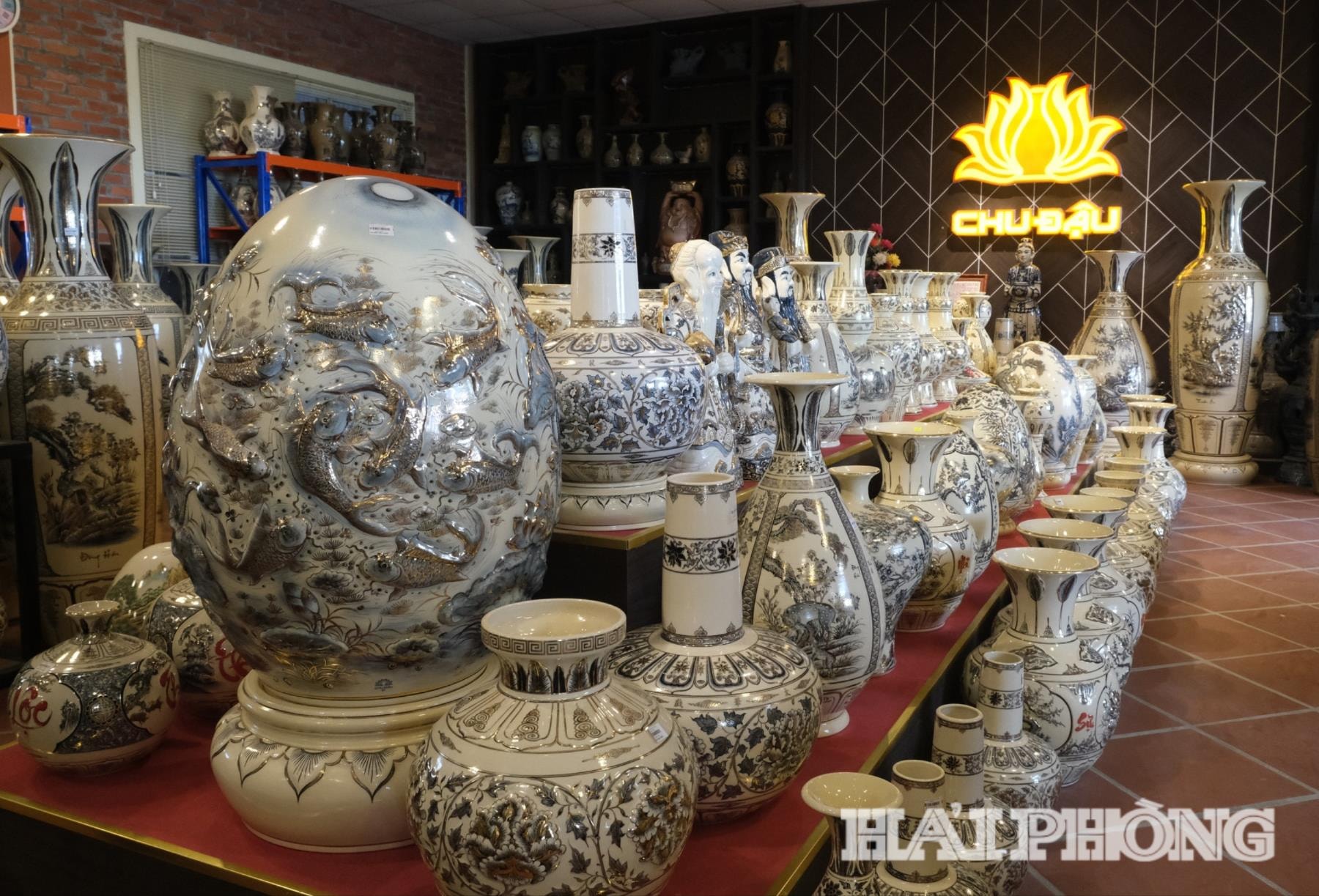
Currently, there are five ceramic production facilities in the Chu Dau area. Mr. Luu's Chu Dau Ceramic Joint Stock Company, despite constantly innovating its designs, remains absolutely faithful to the essence of this ancient ceramic style and always strives to achieve the highest level of technical and artistic excellence: thin as paper, bright as a mirror, transparent as jade, white as ivory, and resonant like a bell.
Mr. Luu said that in the past, ceramics had three product lines: for everyday use, for official use, and for imperial use. Nowadays, in the production process, based on revived ancient designs, artisans will flexibly decorate with contemporary motifs to suit the tastes of consumers.
The Chu Dau pottery village proudly displays a vase bearing nine characters gifted by General Vo Nguyen Giap: "Chu Dau pottery, the essence of Vietnamese culture." Mr. Luu always believes that receiving the General's inscription is both an honor and a heavy responsibility, that the craft must not be allowed to fade away again, but must always be preserved and promoted!
TIEN HUYSource: https://baohaiphong.vn/gin-giu-dong-gom-co-tinh-hoa-chu-dau-544127.html

![[Photo] Ba Lang An Lighthouse - the "eye of the sea" amidst the "rock museum" of Quang Ngai province.](https://vphoto.vietnam.vn/thumb/1200x675/vietnam/resource/IMAGE/2026/05/29/1780038698840_anh-man-hinh-2026-05-29-luc-14-10-42.png)
![[Image] Pleasant weather helps students enter the 10th grade entrance exam with confidence.](https://vphoto.vietnam.vn/thumb/1200x675/vietnam/resource/IMAGE/2026/05/29/1780034401612_ngay-1-thi-lop-10-minh-duy-8-5009-jpg.webp)





















































































Comment (0)