

- Táo Quân 2019 program: The Jade Emperor makes a secret visit to Bac Lieu.
- When the Kitchen Gods… fight the COVID-19 pandemic
- Filming begins for the Táo Quân Bạc Liêu 2016 program.
From the 23rd day of the 12th lunar month until Tet (Lunar New Year), generations of viewers eagerly await the Táo Quân (Kitchen Gods) show, whether watching it on television, radio, or live on stage. For the artists, participating in the show is a particularly exciting experience. Receiving a role and holding the script in their hands fills their hearts with the festive atmosphere of Tet.
Táo Quân - It's that time again!
In the Vietnamese psyche, the Kitchen God is both a familiar and sacred figure. The family kitchen, where the Kitchen God resides, not only keeps the fire burning for meals but also preserves the bond between family members. The day of sending the Kitchen God to heaven is an occasion for each family to reflect on the past year, send away old worries, and hope for good things in the new year.
 From left to right: Artists Duc An, Ngoc Nhin, Minh Thuy, Yen Vang, and Hoang Phuc excitedly prepare to "play their roles," bringing subtle humor to the audience.
It is from this meaning that the image of the Kitchen God (Táo Quân) has appeared on stage, becoming a cultural "specialty" every year-end. While the "Kitchen God - Meeting at the End of the Year" program is a familiar source of entertainment on national television, in local areas, the Kitchen God theme is also prioritized in the productions of art troupes, cultural centers, and television stations. In Ca Mau , audiences are familiar with the Cai Luong (Vietnamese traditional opera) performances revolving around the year-end "court session." Many artists are loved for their charming transformations in vibrant costumes, bringing laughter and current events to the public.
However, in the context of an increasingly developed lifestyle, the demand for artistic enjoyment is also higher. Audiences are becoming more and more discerning when anticipating the Táo Quân (Kitchen Gods) show. Each year must offer something new, something interesting, and creative in both content and form. This requires those in the profession to constantly renew their thinking and methods of expression so that the show remains vibrant and engaging, avoiding boredom or oblivion.
We should be honest about it.
In reality, many Táo (Kitchen Gods) shows are heavily focused on reporting statistics and achievements. "Reporting" is the task of the Kitchen Gods, while "directing" belongs to the Jade Emperor; propaganda through artistic means is the main goal. However, if they become too preoccupied with numbers and achievements, the dialogue will become forced and stiff; the songs will lack literary quality; and the audience will struggle to grasp the message. In that case, what should be a lively and engaging "court session" will become a theatrical "administrative report," reducing its effectiveness in conveying information.
| The key to the vitality of the "Tao" (Vietnamese New Year's Eve comedy show) is laughter. Local stages often lack comedic elements, so the end of the year presents a rare opportunity to blend current events with satirical wit. If the script lacks humor, follows a one-sided narrative, and fails to exploit unexpected situations, it will be very difficult to create natural laughter. |
Performing comedy is not easy. Inappropriate casting can make actors feel awkward, trying to be funny but lacking charm. Poor coordination further diminishes the necessary dynamism of the performance. Therefore, besides the script, the actor's ability and confidence play a crucial role.
Duration is also a matter of concern. In modern life, audiences need something engaging, concise, and impactful. A drawn-out, propagandistic performance of traditional Vietnamese opera or a short comedy sketch will struggle to keep viewers engaged. It is suggested that the duration should be no more than 25 minutes, with a fast pace, flexible transitions, a diverse range of art forms, and elements of surprise to increase audience appeal and curiosity.
Apples spread the scent of spring everywhere.
In Ca Mau, there aren't many writers who create scripts for the "Tao Quan" (Kitchen God) show. Meritorious Artist Nguyen Tien Duong and author Huynh Hong are two familiar faces. Each has their own strengths: Meritorious Artist Nguyen Tien Duong focuses on the details and plot; author Huynh Hong leans towards literary merit, avoiding dry propaganda. As a result, the scripts chosen for production often reassure directors and attract audiences.
Director Quoc Tin, a highly skilled producer in staging these plays, said: " To bring a complete 'Tao' (Kitchen God) Cai Luong performance to the audience is not simple at all. From the moment the literary script is in hand, the director must immediately visualize the setting, space, and time to ensure it is appropriate; select and assign actors according to their strengths and improvisational skills; and meticulously craft each line of dialogue and acting style to keep it 'fast-paced,' avoiding any sluggishness. In addition, careful selection of background music and situational music is necessary, ensuring that the recordings do not hinder the actors during filming or the post-production process. Most importantly, it's essential to exploit the charming and humorous elements, which are a must."
Throughout a busy year, audiences turn to Táo (the annual Lunar New Year comedy show) to relax, to laugh heartily, and to reflect on the changes in their homeland through the lens of art. Therefore, the programs directed by Quốc Tín, from his time as head of the Hương Tràm cải lương (traditional Vietnamese opera) troupe to the present day, always prioritize a fast pace, restrained propaganda, and subtle humor.
Many artists such as Meritorious Artist Thế Sơn, Phi Hải, Ngọc Xanh, Chí Tuân, Hoàng Thái Hùng, Kim Hiền... along with freelance artists have contributed to making the Táo Quân (Kitchen Gods) programs memorable. Not only performing within the province, the team has also been invited to tour in several other provinces. At each performance venue, with its rich musical and dance program, the Táo Quân cải lương (traditional Vietnamese opera) segment has received enthusiastic applause.
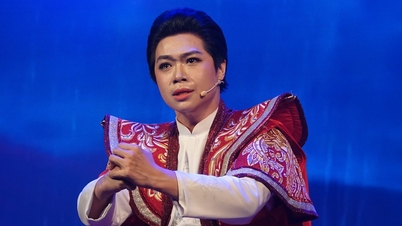
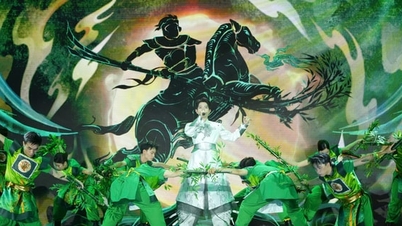
This year, the Cai Luong (Vietnamese traditional opera) play "Ma Dao Thanh Cong" (author: Meritorious Artist Nguyen Tien Duong, Director: Artist Quoc Tin), performed by artists Ngoc Nhin, Minh Thuy, Duc An, Hoang Phuc, and Yen Vang, is still diligently performing in Phu Loi, Ninh Kieu (Can Tho), Vinh Phong ( An Giang ) and filming for broadcast on two television channels, ATV and THTPCT, in the days leading up to Tet.
 At each performance venue, the Cai Luong (Vietnamese traditional opera) segment "Ma Dao Thanh Cong" (Author: Meritorious Artist Nguyen Tien Duong, Director: Quoc Tin) always received enthusiastic applause from the audience. Photo: Duy Khoi
Through each lyric and performance, the excitement over the local development is vividly expressed; love for the homeland and country is subtly conveyed; and above all, an optimistic spirit spreads to the audience.
The new pace of life harmonizes with the new spirit and opportunities. Art must also innovate to keep up with the times. But even if the form changes, the Táo (Kitchen God) show remains a beautiful gathering at the end of the year, where people look back, laugh, and hope together. And then, when spring arrives, that "court session" will forever remain a spiritual "specialty," sowing memories and affection in the hearts of the audience.
Minh Hoang Phuc
Source: https://baocamau.vn/giu-lua-tao-quan-trong-nhip-song-moi-a126299.html



















































Comment (0)