

To protect the production environment, the ecological environment, create clean products, and safeguard human health, the agriculture and rural development sector of the province in particular and the whole country in general is gradually shifting towards organic farming methods. This is not a new production direction, as farmers have practiced it before, but it is now a return after decades of using inorganic farming methods and suffering its harmful effects. However, this return is now accompanied by the application of scientific and technological advancements to build a sustainable production system, adapt to climate change, and bring many economic , social, and environmental benefits. Organic production in the province is currently applied to many types of crops and livestock with effective production linkage models.

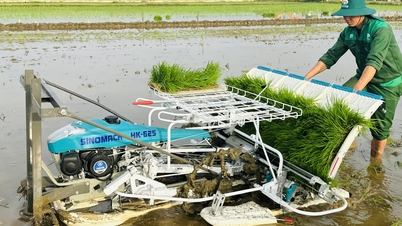
Transplanting seedlings in trays is used in organic rice production in Vinh Linh, replacing the traditional direct sowing method used by farmers. - Photo: VTH
Following the success of organic rice production cooperative models in Hai Lang, Trieu Phong, and Vinh Linh districts, in 2023, the Provincial Agricultural Extension Center continued its cooperation with Quang Tri Trading Corporation to expand this model to many localities in the province. The model of "Organic rice production using tray seedlings and transplanting machines with linked product consumption" at Tien My Cooperative, Vinh Lam commune, Vinh Linh district, covering 14 hectares and using the high-quality ST25 rice variety, was a resounding success in 2023.
Mr. Nguyen Van Tuan, one of the 17 households participating in the model at Tien My Cooperative, said that the implementation of the production model at the cooperative was quite smooth because in previous seasons, the households had already produced organically, and now the techniques are proficient, and the fields have a reliable water supply. By participating in the model, households have their products guaranteed for sale, creating a stable market for farmers, bringing optimal economic efficiency and profits, protecting the ecological environment, and increasing social benefits.
In implementing the model, participating households receive 50% of the seeds and supplies from the Provincial Agricultural Extension Center, while Quang Tri Trading Corporation provides the remaining 50% of the seeds and supplies on loan until the end of the season and purchases all the rice from the farmers within the model.
Farmers participated in training sessions guiding them on the technical process of organic rice production using tray seedlings and transplanting machines, and strictly followed the instructed techniques throughout the production process. The seedlings used for transplanting were 3-leaf seedlings, using 450 trays/ha (equivalent to 50 kg of seeds/ha). Throughout the season, the rice plants grew healthily and suffered less pest and disease damage compared to conventional fields.
Farmers are using homemade biological preparations made from ginger, chili peppers, and garlic to control pests and diseases in rice crops, replacing pesticides. This helps maintain the field ecosystem and produces safe products. Spraying is also done using drones, reducing labor and ensuring a more even and concentrated application of the biological preparation.
Farmers use preparations such as fish protein, fermented plant stem water, bone calcium phosphate, eggshell calcium, etc., instead of chemical fertilizers to help rice plants become stronger and reduce pest and disease damage. Egg and milk preparations supplement minerals and nutrients, resulting in fragrant, delicious rice grains, firm rice, a low percentage of shriveled grains, and products that meet organic standards.
Through the implementation of the model, it was observed that the rice plants developed well, with persistently green leaves of moderate color from the beginning to the end of the season, were less susceptible to pests and diseases, bloomed evenly and densely, and displayed prominent panicles. In particular, the rice stalks were sturdy and did not fall over due to rain and wind. Fresh rice yield reached approximately 60-65 quintals/hectare, with the company purchasing the rice directly from the fields. Farmers achieved a value of over 80 million VND/hectare, with a profit of nearly 33 million VND/hectare, which is 16 million VND/hectare higher than rice cultivated using inorganic methods.
According to Tran Can, Director of the Quang Tri Agricultural Extension Center: The implemented model has had a significant impact on all three aspects: economic, social, and environmental.
In addition to increasing productivity, quality, efficiency, and competitiveness of products, the implementation of the model has raised awareness and changed farming methods among people in producing organic and sustainable rice, ensuring product safety, preventing soil and water pollution, contributing to environmental protection and the preservation of the rice paddy ecosystem, and adapting to current climate change.
The success of this model serves as a basis for other localities to learn from and apply. Based on the results achieved, in this year's winter-spring crop and in the coming years, the Provincial Agricultural Extension Center will continue to develop models and transfer organic farming science and technology to farmers, especially in rice production.
The focus is on building organized production and consumption models to increase added value for farmers and rapidly expand the area of organic farming.
The organic rice model being implemented by the Provincial Agricultural Extension Center is a concrete realization of the Resolution of the 17th Provincial Party Congress, aiming to achieve 1,000 hectares of organic rice throughout the province by 2025.
To produce organic rice sustainably, businesses need to participate in the supply chain, jointly providing input products and services and guaranteeing the purchase of the output product.
According to Nguyen Phu Quoc, Deputy Director of the Department of Agriculture and Rural Development: In the coming time, the department will strengthen coordination with units and localities to organize propaganda and mobilize farmers with fields that meet the conditions regarding internal field transportation, irrigation and contiguous planning to link up for large-scale organic rice production.
Agencies and units under the sector focus on guiding farmers on procedures and technical advancements to implement the model correctly. At the same time, they actively encourage businesses to participate in production linkages to ensure the input and output of agricultural production for farmers.
Linking production in agriculture using organic farming methods is a direction that brings many benefits and is sustainable, building a brand of Quang Tri organic rice for consumption nationwide.
Vo Thai Hoa
Source



























































Comment (0)