

This document provides detailed answers to 16 issues of public concern related to the reorganization of commune-level administrative units and the merger of Long An province with Tay Ninh province .
In addition to basic information such as the purpose, significance, principles, standards, sequence, and procedures for the reorganization of administrative units, the document also publishes a detailed list of the reorganization plans for the remaining 60 communes and wards in Long An province.
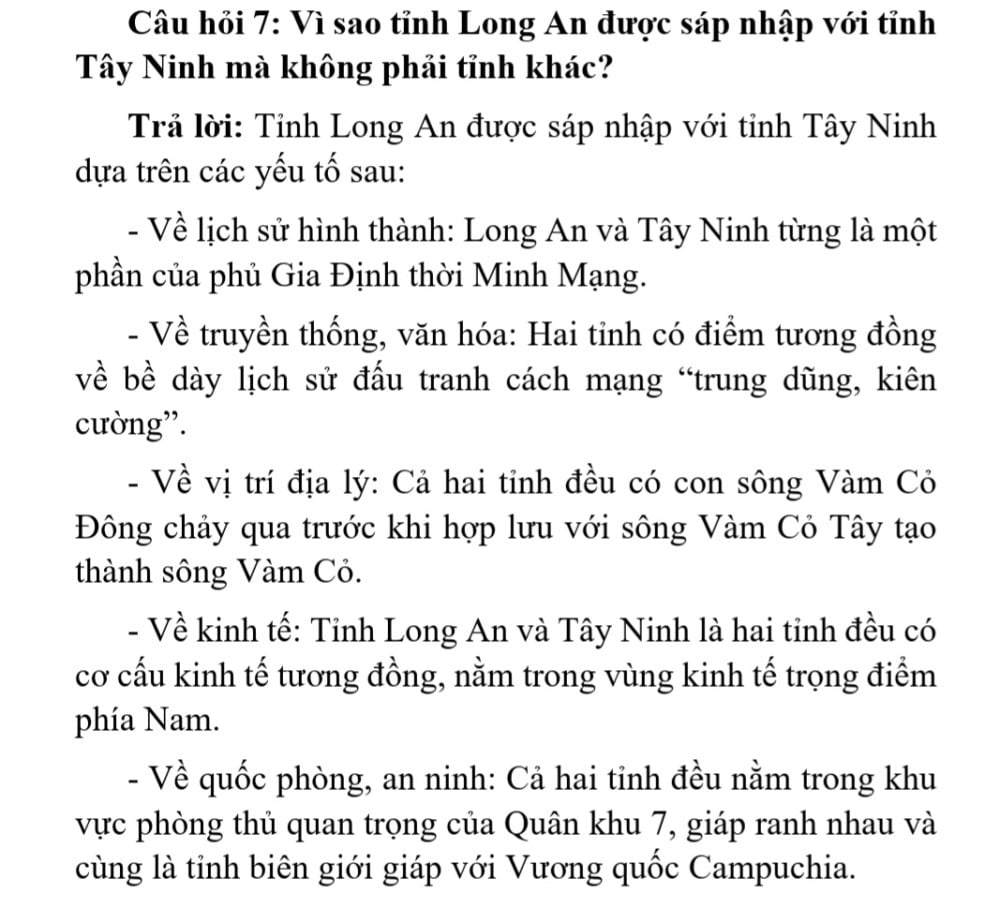
The document also explains why Long An province was merged with Tay Ninh province and not another province, so that the people and voters can understand clearly.
Accordingly, the content of this Q&A section clearly states that Long An province was merged with Tay Ninh province based on the following factors:
Regarding their historical formation: Long An and Tay Ninh were once part of Gia Dinh province during the reign of King Minh Mang.
In terms of tradition and culture: The two provinces share similarities in their long history of revolutionary struggle, characterized by "courage and unwavering determination".
Geographically, both provinces have the Vam Co Dong River flowing through them before merging with the Vam Co Tay River to form the Vam Co River.
Economically : Long An and Tay Ninh provinces have similar economic structures and are located within the Southern key economic region.
Regarding defense and security: Both provinces are located within the important defense zone of Military Region 7, bordering each other and both being border provinces adjacent to the Kingdom of Cambodia.
In addition, the document also details issues closely related to the daily lives of citizens, such as the location of the provincial-level political and administrative center and the 60 communes and wards; the arrangement and handling of offices, finances, and public assets after the reorganization of the new administrative units; the conversion of documents and seals for individuals and organizations after the reorganization; and the implementation of specific regimes and policies for the new administrative units after the reorganization...
Previously, it was planned to merge Tay Ninh and Long An provinces into a new province called Tay Ninh. On April 29th, at the Provincial People's Council meeting, a resolution was passed approving the establishment of Tay Ninh province based on the merger of the entire natural area and population of Long An and Tay Ninh provinces.
After its establishment, Tay Ninh province had a natural area of 8,536.44 km² and a population of 3,254,170 people; its political and administrative center was located in Tan An City, Long An province today.
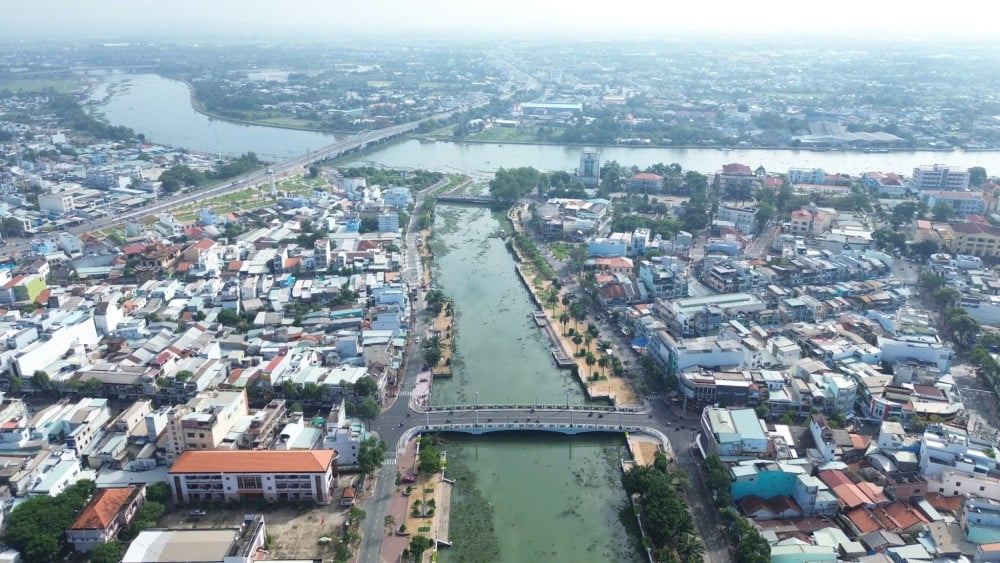
At the same time, the Provincial People's Council also considered and approved a Resolution on the principle of rearranging administrative units at the commune level in Long An province. Accordingly, after the rearrangement, the number of communes, wards, and towns will be reduced from 186 to 60 administrative units (including 56 communes and 4 wards), with guidance on the names and locations of the commune-level political-administrative centers in accordance with regulations and factors related to tradition, history, culture, and future development potential.
These are two particularly important resolutions, of historical significance, opening up new opportunities and spaces for local development.
Le Duc
Source: https://baolongan.vn/hoi-dap-vi-sao-long-an-sap-nhap-voi-tay-ninh-a194577.html


![[Image] Central Party Office summarizes work in 2025](/_next/image?url=https%3A%2F%2Fvphoto.vietnam.vn%2Fthumb%2F1200x675%2Fvietnam%2Fresource%2FIMAGE%2F2025%2F12%2F18%2F1766065572073_vptw-hoi-nghi-tong-ket-89-1204-jpg.webp&w=3840&q=75)
















































































Comment (0)