

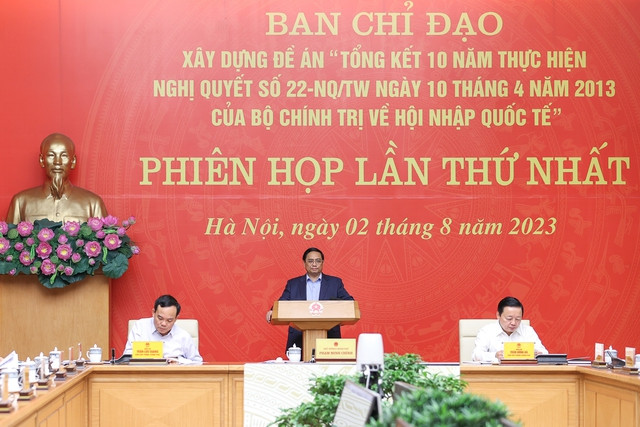
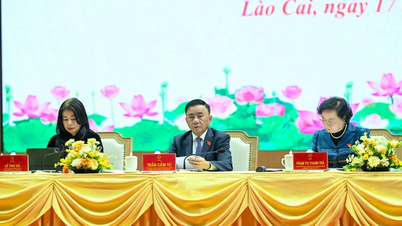
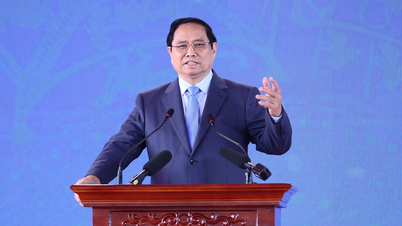
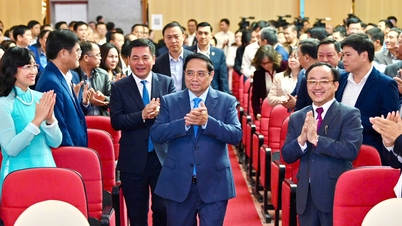
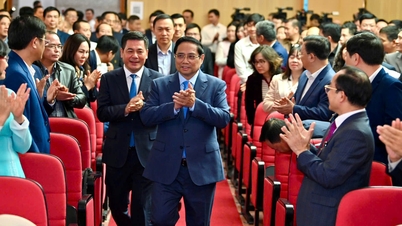
Prime Minister : We must build and promote mechanisms to monitor, urge, review, and accelerate the implementation of cooperation agreements that we have signed with other countries - Photo: VGP
The Government Office issued Notice 321/TB-VPCP summarizing the conclusions of Prime Minister Pham Minh Chinh, Head of the Steering Committee for the project "Review of 10 years of implementing Resolution No. 22-NQ/TW dated April 10, 2013 of the Politburo on international integration" at the meeting on August 2, 2023.
The Prime Minister highly appreciated the proactive and positive efforts of the Ministry of Foreign Affairs and other relevant ministries, agencies, and organizations in closely coordinating and actively implementing many activities to serve the work of summarizing Resolution 22.
The summary report should adhere closely to the spirit and content of Resolution 22, assessing the major achievements in the 10 years of implementing Resolution 22, the difficulties, shortcomings and causes of limitations, and lessons learned from practical implementation; at the same time, it should propose goals, tasks, directions and solutions for international integration in the coming period. The Ministry of Foreign Affairs is requested to incorporate as many suggestions as possible to finalize the summary report.
3 major changes
It is affirmed that Resolution 22 is a correct and timely strategic direction of our Party and State. The implementation of the Resolution has achieved many important results, most notably three major transformations.
In terms of awareness, international integration has become a cause for the entire nation and the entire political system, becoming a major strategic direction of the Party to successfully fulfill the task of building and defending the Fatherland.
In terms of action, Resolution 22 marks a significant shift in the international integration thinking of our Party and State, from international economic integration to proactive, comprehensive, deep, and effective international integration in all fields.
These shifts in thinking and action have contributed to a new qualitative and quantitative transformation, enhancing the country's position, prestige, and potential, leading to great achievements of historical significance, as the 13th Party Congress stated: "Our country has never before had such a foundation, potential, position, and international prestige as it does today."
However, during the implementation of the Resolution, several shortcomings and limitations remain: The level of proactiveness, initiative, and creativity in implementing integration is still low; the role of the State in encouraging and creating a favorable environment for individuals, organizations, and businesses to participate in integration is still passive, hesitant, and sometimes not truly effective; the implementation of international agreements and commitments is still limited; the extent of Vietnamese businesses' global reach and participation in global value chains is still modest;...
Integration across all fields must be closely linked and mutually supportive.
Based on the achievements and limitations, several lessons can be drawn that need to be understood in the implementation of integration in the coming period:
International integration must be the undertaking of the entire population and the entire political system; efforts must be made to create more favorable conditions in terms of mechanisms, policies, and resources to promote the central role of the people and businesses.
Effectively addressing the relationship between independence, self-reliance, and deep, comprehensive, and effective international integration; maximizing domestic strengths and leveraging external resources, with domestic resources being strategic, fundamental, decisive, and long-term, and external resources being important and breakthrough. International integration must be a crucial driving force for innovation and development. Closely linking the process of international integration with enhancing the self-reliance, competitiveness, resilience, and adaptability of our country.
It is essential to have a firm grasp of the international situation and context, as well as domestic development needs, starting from and respecting reality, and using reality as a benchmark. In implementing international integration, we must be quick, proactive, and timely, with a spirit of daring to think and act decisively for the benefit of the nation; "maintaining constancy while adapting to change"; focusing resources, prioritizing key areas, clearly defining priority tasks and implementation roadmaps to achieve tangible and concrete results.
Integration across all fields must be closely linked, mutually supportive, and implemented smoothly and synchronously, with economic integration remaining the focus, and integration in other fields facilitating economic integration and contributing positively to economic development.
To bring about a qualitative transformation in international integration, the fundamental element is building a high-quality workforce that meets the requirements of integration; paying attention to building a team of officials with sufficient capacity and courage in handling and responding to disputes in international trade. At the same time, it is necessary to proactively improve institutional capacity and develop domestic policies that keep pace with integration commitments and changes in the international environment; and enhance implementation capacity in the spirit of harmonizing benefits and sharing risks.
A roadmap and plan are needed to effectively, seriously, and fully implement international agreements and commitments.
Affirming that many major contents, principles, and guiding guidelines of Resolution 22 remain valid, the Prime Minister noted that new practical realities present new requirements and tasks in the implementation of international integration in the coming period. He requested the Steering Committee to continue researching, supplementing, and refining the Project according to the following major directions:
International integration in the new phase must closely adhere to and effectively serve the policy of building a socialist democracy, a socialist rule of law state, and a socialist-oriented market economy; and continue to eliminate bureaucracy and subsidies, and promote a multi-component and multi-ownership system.
Along with that, we will pursue an independent and self-reliant policy, diversify and multilateralize, be good friends, reliable partners, and responsible members of the international community; making integration a powerful driving force to maintain a peaceful and stable environment, and to drive rapid and sustainable national development.
After 10 years of international integration, our country has expanded quantitatively, participating in various levels of integration, both bilateral and multilateral. This is the time to create new qualitative advancements, effectively leveraging new trends in the Fourth Industrial Revolution, the shifting and restructuring of supply chains, the networks of FTAs we have joined, and strategic and comprehensive partnerships to position the country optimally in the new international landscape and maximize resources for national development.
A roadmap and plan are needed to effectively, seriously, and fully implement international agreements and commitments. Mechanisms must be built and promoted to monitor, urge, review, and accelerate the implementation of cooperation agreements signed with other countries, both bilaterally and multilaterally, based on the principle that commitments must be fulfilled and results must be achieved.
Continue researching, supplementing, and refining the Project Proposal.
To further expedite the implementation of the summary work, the Steering Committee and the Editorial Team are requested to urgently carry out the following tasks:
Based on the domestic, global, and regional situation, and the results of 10 years of implementing Resolution 22, we will continue to research, supplement, and refine the Project, and advise competent authorities to issue appropriate directives on international integration in the new context.
The Ministry of Foreign Affairs, the Standing Agency of the Steering Committee, is urgently developing a roadmap, assigning specific, feasible, and effective tasks to member agencies, consulting with experts and affected parties during the development of the Project; and promptly completing the Project dossier, ensuring quality, systematic and scientific approach, and reporting to the Steering Committee for submission to the Politburo in November 2023.
Ministries, departments, localities, and associations should contribute quality, substantive, and timely contributions to the development of the Project based on their respective functions and responsibilities.
Source

![[Photo] Prime Minister Pham Minh Chinh attends the Conference on the Implementation of Tasks for 2026 of the Industry and Trade Sector](/_next/image?url=https%3A%2F%2Fvphoto.vietnam.vn%2Fthumb%2F1200x675%2Fvietnam%2Fresource%2FIMAGE%2F2025%2F12%2F19%2F1766159500458_ndo_br_shared31-jpg.webp&w=3840&q=75)






























































Comment (0)