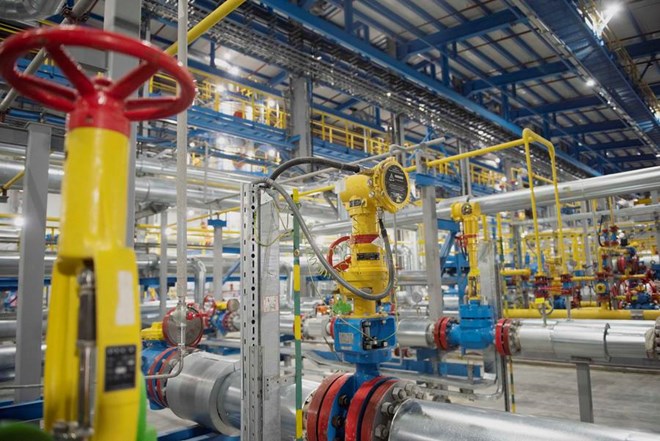
Europe aims to reduce its dependence on Russian gas by 2027. Photo: Xinhua
The European Union sees itself falling into an energy trap: In the west, the US is pushing for liquefied natural gas (LNG) imports; in the east, Russia is attempting to revive the Nord Stream 2 project, reports the German magazine Der Spiegel.
Der Spiegel points out that by cutting imports of Russian gas, the European Union could compensate with liquefied natural gas (LNG) from the United States.
However, the current US president wants to exert pressure on the world through natural gas. Therefore, Europe is caught in the middle. If the US is no longer the guarantor of natural gas supplies, the question is where will the gas come from?
Russia has ideas on this issue, according to Der Spiegel. Last week, Russian Foreign Minister Sergei Lavrov confirmed that the US and Russia are discussing repairs to the Nord Stream pipeline within the framework of peace talks in Ukraine.
"Currently, Brussels is in a bind. If the EU continues to adhere to its plan to abandon Russian gas by 2027, its dependence on the US becomes increasingly unpredictable. If the European Union moves even closer to Russia, it will simultaneously be dependent on two 'undesirable partners'," the German newspaper points out.
According to Der Spiegel, the EU has very little time to think. The EU has never officially banned imports of Russian gas via pipelines. If the Nord Stream pipelines are repaired, deliveries could resume at any time.
According to Reuters' calculations on March 31, compared to February, the average daily amount of natural gas that Russia's Gazprom supplied to Europe via the TurkStream pipeline decreased by 19.4% in March.
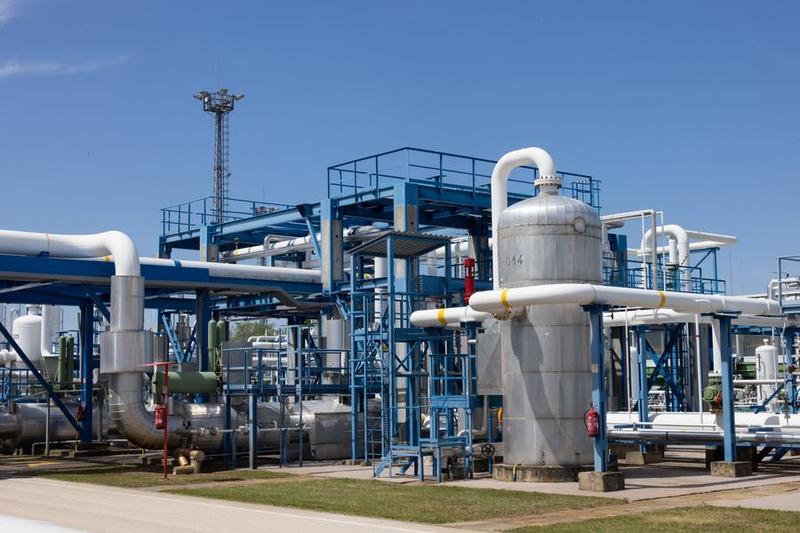
At its peak in 2018-2019, Russia's annual gas exports to Europe ranged from 175 to 180 billion cubic meters. (Photo: Xinhua)
This figure is based on data from the European gas transmission company Entsog. According to this data, Russian gas exports via the TurkStream pipeline fell to 45.0 million cubic meters per day in March, down from 55.8 million cubic meters per day in February. This figure is also down from 46.4 million cubic meters per day in March 2024.
According to Reuters' calculations, the total amount of Russian gas supplied to Europe via TurkStream reached approximately 4.5 billion cubic meters in the first three months of 2025, lower than the 7.7 billion cubic meters recorded in the same period of the previous year.
Data from Gazprom and calculations by Reuters show that Russia supplied approximately 63.8 billion cubic meters of natural gas to Europe via various routes in 2022. This figure dropped sharply by 55.6% to 28.3 billion cubic meters in 2024, but is expected to increase to around 32 billion cubic meters by 2024. At its peak in 2018-2019, Russia's annual gas exports to Europe ranged from 175 to 180 billion cubic meters.
Currently, TurkStream is the only transit route for Russian gas to Europe after Ukraine decided not to renew its five-year transit agreement with Russia, which is set to expire at the end of 2024.
Source: https://laodong.vn/the-gioi/kha-nang-chau-au-tang-nhap-khau-khi-dot-nga-1485329.ldo


![[Photo] Capturing the moment the tide recedes at Yen Binh Son rapids - a million-year-old scenic spot in Quang Ngai.](https://vphoto.vietnam.vn/thumb/1200x675/vietnam/resource/IMAGE/2026/05/19/1779175463885_yen9-1199-jpg.webp)

![[Photo] National Assembly Chairman Tran Thanh Man attends the groundbreaking ceremony for the National Highway 1A spatial axis project.](https://vphoto.vietnam.vn/thumb/1200x675/vietnam/resource/IMAGE/2026/05/19/1779161360398_ndo_br_bnd-1412-jpg.webp)
![[Photo] General Secretary and President To Lam presides over a meeting on the implementation of Directive No. 34-CT/TW of the Party Central Committee.](https://vphoto.vietnam.vn/thumb/1200x675/vietnam/resource/IMAGE/2026/05/19/1779187768672_a1-bnd-2350-631-jpg.webp)

























































![[Photo] General Secretary and President To Lam receives Indian Defense Minister Rajnath Singh](https://vphoto.vietnam.vn/thumb/402x226/vietnam/resource/IMAGE/2026/05/19/1779184046302_anh-man-hinh-2026-05-19-luc-16-46-58.png)





















Comment (0)