

Have you ever felt curious stepping into the tiny airplane restroom? A cramped space made of aluminum, where gravity seems to work differently and strange noises constantly echo.
In essence, airplane toilets are engineering marvels, cleverly combining vacuum technology, pressure manipulation, and stringent safety regulations to keep passengers comfortable at altitudes exceeding 10,000 meters.
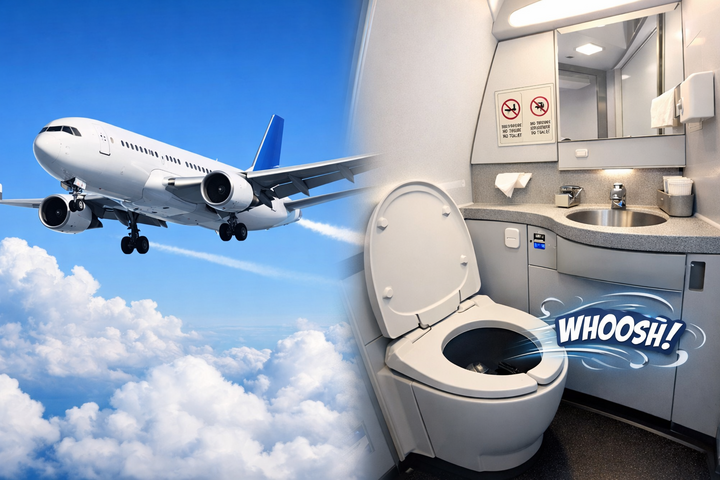
Airplane restrooms have more interesting aspects than you might think. (Source: AI)
Operating principle of the vacuum release system
Modern commercial jet aircraft avoid the use of conventional flush tanks to reduce weight. Instead, they are equipped with vacuum toilet systems.
Nigel Jones, an aerospace engineering expert, explains it simply: "This system works similarly to your household vacuum cleaner – its main mechanism is suction."
When a passenger presses the flush button, a valve at the bottom of the toilet bowl immediately opens. The enormous pressure difference between the passenger cabin and the outside environment (or created by a specialized vacuum pump when the aircraft is moving on the ground) generates a powerful suction force.
This force suddenly pulls all the solid and liquid waste, along with a very small amount of blue deodorizing solution, through a narrow drainpipe to a tank located at the tail of the aircraft. Immediately afterward, the valve slams shut to seal the toilet bowl.
This mechanical mechanism was succinctly described by Duke Armitage pilots: "A vacuum system draws all the waste and cleaning solution into a reservoir through a series of connecting pipes." The extremely high speed of the airflow creates a characteristic loud "whoosh" accompanied by a slight whistling sound like a jet engine, ensuring everything is thoroughly cleaned without clogging.
Therefore, waste on airplanes actually moves using air pressure, not gravity or gallons of water like in a toilet at home.
Odor control and waste treatment solutions
One of the engineers' top priorities was keeping the passenger cabin free of unpleasant odors. The vacuum system solved half of this problem by rapidly drawing waste into a sealed tank, minimizing the time it takes for odors to spread.
Furthermore, the liquid used to clean the toilet bowl is not ordinary water, but a special dark blue chemical solution. This chemical formula is capable of breaking down solid waste, killing bacteria, neutralizing odors, and leaving a fragrant foam that is safe for the plumbing system.
Simultaneously, when passengers lock the doors, the ventilation system automatically activates to draw air from the toilet chamber through activated carbon or ozone filters before recirculating it. At the bottom of the toilet bowl, rotary valves or one-way membranes act as a water trap, preventing odors from the tank from rising back up.
Many flight crews often comment that modern vacuum toilets have a much more pleasant atmosphere compared to the classic tank-type toilets on older generation propeller aircraft.
After the flight ends, all the "blue water" and waste accumulated in the sealed tank will remain intact until the aircraft lands safely; there is absolutely no dumping of waste into the air during the journey as rumored.
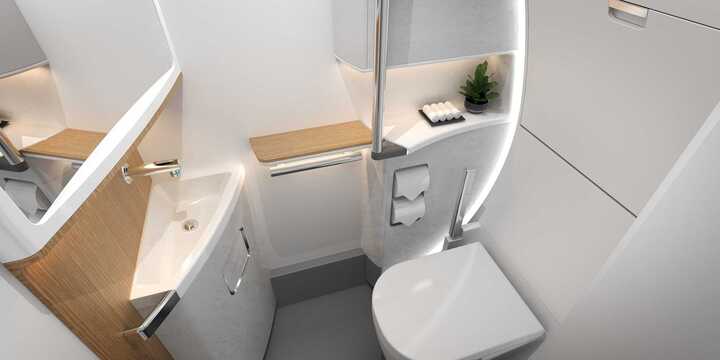
Acumen's new electronic toilet design for A321 and Boeing 737 aircraft. (Source: STEngineering)
Design pressures and safety barriers
Designing a restroom for aircraft models like the Airbus A320 or Boeing 777 is far more complex than shrinking a family bathroom. In a cramped space less than 1.2 meters wide, engineers must strategically arrange everything from the toilet, mirror, and trash can to the changing table by incorporating curved corners, fold-down sinks, and built-in soap dispensers.
Weight is also a critical factor; every component is constructed from aluminum and ultra-lightweight composite materials to save fuel. Boeing says its vacuum system has achieved 30 million flight hours with an extremely low failure rate and has reduced weight by up to 50% compared to previous generations of equipment.
Regarding safety, aviation historian Daniel Bubb asserts: "Passengers are in absolutely no danger if they accidentally press the flush button while sitting on the toilet." While the vacuum suction is strong, it cannot pull a person into the pipe because the body is firmly supported; this hypothesis was thoroughly tested before being put into actual operation.
However, the system is equipped with a safety lock: the drain button will be disabled if the cabin door is not closed and securely locked. Attempting to drain water while the door is open will cause the system to draw a large amount of air from the passenger compartment, reducing efficiency and potentially triggering a vacuum pump malfunction warning.
The aviation authority also imposes strict mandatory regulations for this area, including: smoke detection systems, automatic fire extinguishers (usually using Halon gas), handrails, emergency flashlights, and trash can lids designed to prevent oxygen suffocation.
Even an ashtray must be installed in case passengers smoke secretly. If any fire alarm system malfunctions, that restroom must be locked and out of service until it is repaired.
A significant leap forward compared to older technology.
Before vacuum flushing systems were patented in 1975 and became widespread in the 1980s and 1990s, early commercial aircraft had to use chemical recirculation systems. This older technology required aircraft to carry enormous tanks of flushing fluid located under the floor.
When flushed, the water mixed with chemicals swirls and pushes the waste down by gravity, similar to the toilets on mobile campers. This system is not only bulky and fuel-inefficient due to its heavy weight, but it also frequently leaves behind unpleasant odors.
The advent of vacuum technology based on air pressure completely eliminated the drawbacks of the old chemical storage tank system. The new system is lighter, operates faster, uses virtually no water, and self-balances pressure very well as the aircraft changes altitude.
Today, most major airlines have completely phased out the old recirculating tank technology. Advanced vacuum systems have become standard on all modern aircraft, making personal experiences at altitudes of thousands of meters more civilized and safer than ever before.
Source: https://vtcnews.vn/kham-pha-cach-thuc-hoat-dong-nha-ve-sinh-tren-may-bay-ar1020393.html


![[Image] Nearly 125,000 Hanoi students completed the Literature exam for the 10th grade entrance exam.](https://vphoto.vietnam.vn/thumb/1200x675/vietnam/resource/IMAGE/2026/05/30/1780117233041_ndo_br_thiet-ke-chua-co-ten-2-png.webp)




















































































Comment (0)