

 |
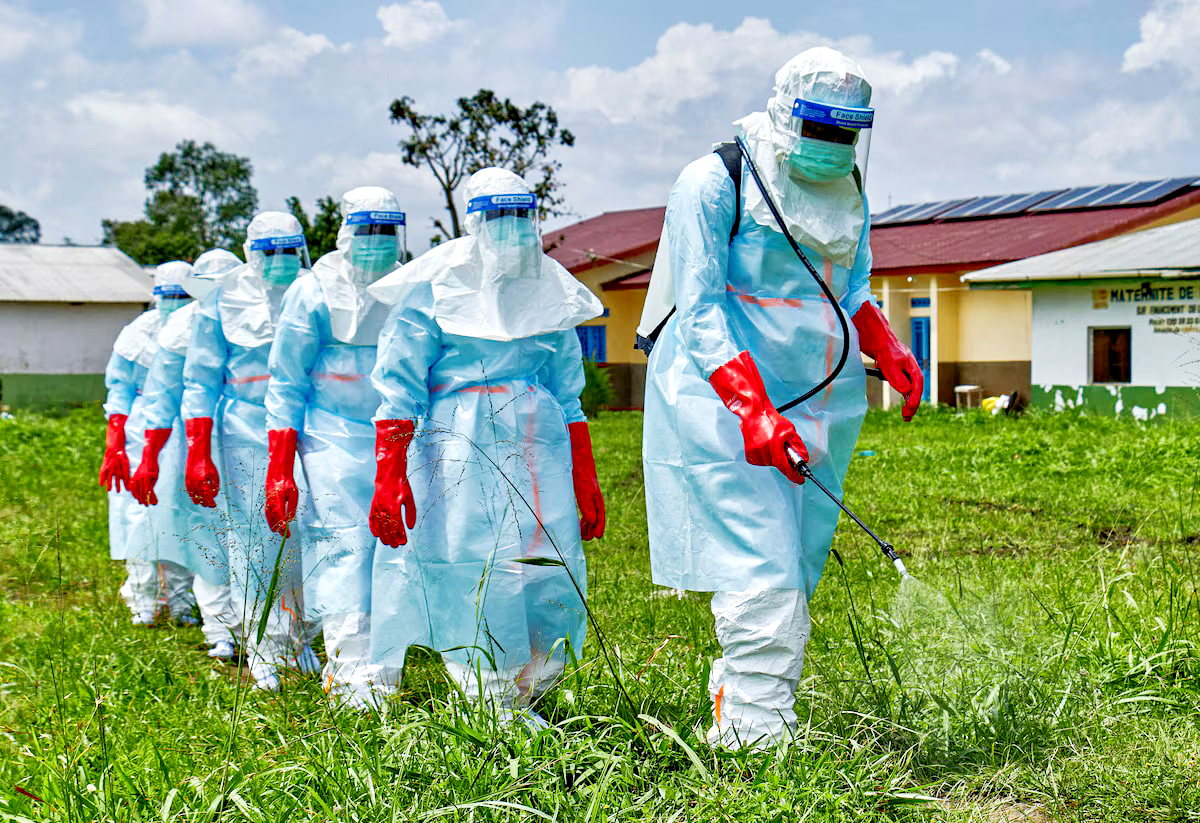
| Medical personnel disinfect Rwampara General Hospital in Ituri province (Democratic Republic of Congo) during the Ebola outbreak, May 21, 2026. |
According to the World Health Organization (WHO), as of May 29, 2026, Congo had recorded over 1,000 suspected cases of Ebola and more than 220 suspected deaths related to the disease, with 121 confirmed cases and 17 deaths.
Uganda reported 7 confirmed cases, including one death. In total, the two countries have had 128 confirmed cases and 18 deaths. The WHO assesses the risk of an outbreak in the Democratic Republic of Congo as very high and the risk at the regional level (including Uganda) as high due to continued community transmission.
What particularly worries the international community is the strain of virus causing the outbreak. Unlike previous Ebola outbreaks, which were mainly linked to the Zaire strain, for which vaccines and certain treatments exist, the current outbreak originates from the Bundibugyo strain, a rare variant for which no vaccine is licensed and no specific treatment is available.
Historically, the mortality rate of the Bundibugyo strain has ranged from 30 to 50%. This means that without early detection and timely medical care, the risk of death for patients is very high.
Meanwhile, experts suggest that the virus may have been silently circulating in the community for weeks before being officially detected. This is one of the reasons why the outbreak spread so rapidly and made contact tracing difficult.
This outbreak is occurring against a particularly complex backdrop. Eastern Congo has been plagued by armed conflict, security instability, persistent migration, and poverty for many years. Its already weak healthcare system is now facing further strain as the number of cases rises rapidly.
Many treatment facilities lacked personnel, medical supplies, and protective equipment. Some Ebola treatment centers were even attacked or set on fire, further hindering the fight against the epidemic.
This Ebola outbreak has once again exposed gaps in the global health research system. For years, Bundibugyo was considered a rare virus strain, with few cases and primarily occurring in poor countries in Africa.
Therefore, it was not among the top priorities of many pharmaceutical companies and international vaccine research programs. Only when the epidemic intensified did the world begin the race to develop vaccines and treatments.
However, the process from laboratory research to clinical trials and authorization for use is a lengthy one. Even in the most optimistic scenario, experts believe it is highly unlikely that a vaccine will be widely available before 2027.
This illustrates a paradox that has been repeated many times in the history of modern medicine: diseases that primarily affect poorer countries often do not receive adequate investment in research and prevention until they become a major global threat.
After COVID-19, humanity expected the world to enter a new phase with a greater capacity to respond quickly to dangerous epidemics. But current developments in Congo show that this lesson has not yet been fully implemented.
Many early warning systems are limited, epidemiological surveillance capacity is uneven, and the gap in access to healthcare between regions of the world remains very large.
However, the current Ebola outbreak also shows positive signs. The WHO, the African Union, the Africa Centres for Disease Control and Prevention (Africa CDC), and many countries have quickly implemented emergency support programs.
Hundreds of millions of dollars have been pledged for epidemic prevention and control efforts. International research teams are also collaborating to develop vaccines and new treatments for the Bundibugyo strain.
Nevertheless, at present, traditional measures remain the most important line of defense. Early detection of cases, timely isolation, contact tracing, safe burial arrangements, and raising public awareness continue to be key to controlling the epidemic.
Source: https://baothainguyen.vn/quoc-te/202605/khong-de-ebola-tro-thanh-cuoc-khung-hoang-tiep-theo-03a3f25/
![[Image] Hanoi Police officially crowned champions of V-League 2025/2026](https://vphoto.vietnam.vn/thumb/1200x675/vietnam/resource/IMAGE/2026/05/31/1780244769054_ndo_br_039d561b692be875b13a-jpg.webp)
![[Photo] Solemn bathing ceremony and Buddha procession in Hue](https://vphoto.vietnam.vn/thumb/1200x675/vietnam/resource/IMAGE/2026/05/31/1780228263543_1-jpg.webp)


![[Photo] Admire the coral "masterpiece" amidst the million-year-old heritage of Dak Lak province.](https://vphoto.vietnam.vn/thumb/1200x675/vietnam/resource/IMAGE/2026/05/31/1780221235105_anh-man-hinh-2026-05-31-luc-16-53-27.png)
![[Photo] The General Secretary, President and his wife begin their state visit to the Philippines.](https://vphoto.vietnam.vn/thumb/1200x675/vietnam/resource/IMAGE/2026/05/31/1780230559452_anh-man-hinh-2026-05-31-luc-19-28-11.png)

















![[Video] Sunset at Lap An Lagoon – Where the sun sets over the fishing nets](https://vphoto.vietnam.vn/thumb/340x192/vietnam/resource/IMAGE/2026/05/31/1780192137701_beach-landscape-sea-water-nature-grass-745871-pxhere-com.jpeg)




























![[Photo] Admire the coral "masterpiece" amidst the million-year-old heritage of Dak Lak province.](https://vphoto.vietnam.vn/thumb/402x226/vietnam/resource/IMAGE/2026/05/31/1780221235105_anh-man-hinh-2026-05-31-luc-16-53-27.png)




























Comment (0)