

(NLĐO) - Numerous round, faint objects, invisible to the naked eye or under normal lighting, have been captured on camera by two radio telescopes.
Presenting on The Conversation, the team of authors, led by Professor Miroslav Filipovic from Western Sydney University and Professor Andrew Hopkins from Macquarie University, introduced the "ghosts of the radio universe" captured by the ASKAP and MeerKAT telescope systems.
They are called "ghosts of the radio universe" because these objects are completely invisible to the naked eye or in visible light, and can only be observed under radio waves.
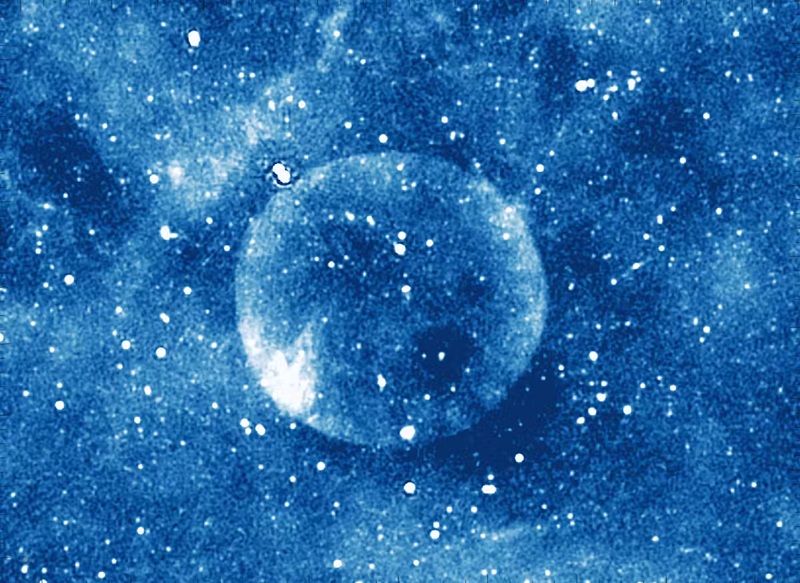
One of the "ghosts of the radio universe" captured by the ASKAP telescope system - Photo: ASKAP
The two space exploration spacecraft, ASKAP and MeerKAT, are two of the world's most powerful radio telescope systems. ASKAP is located in Australia, while MeerKAT is in South Africa.
These "ghosts" all appeared as mysterious, blurry, round objects. Subsequent analyses revealed the true nature of each, showing that they were very different things.
The two circular areas known as the Kyklos Rings and the object WR16 have been identified as Wolf-Rayet stars.
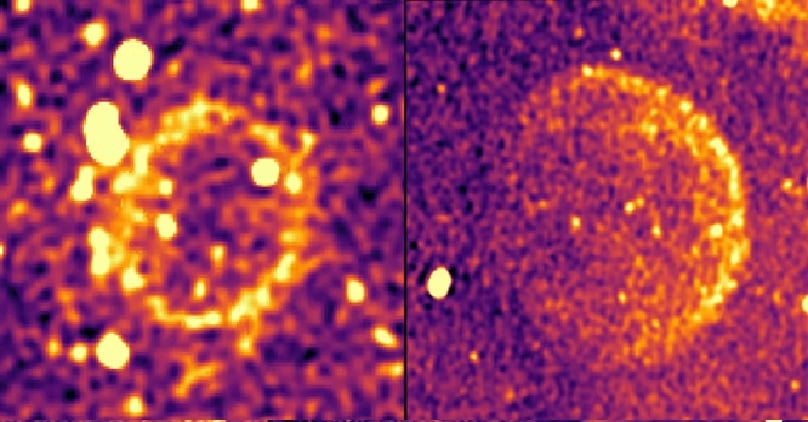
The Kyklos ghost belt and object WR16 - Photo: ASKAP/MEERKAT
When massive stars are running low on fuel, they become unstable as they enter one of the final stages of their stellar life cycle, becoming Wolf-Rayet stars.
They begin to surge and crash, stripping away the outer layers and forming bright nebula structures around the star.
Meanwhile, Stingray 1, Perun, Ancora, and Unicycle are remnants of supernovae, meaning stars that have exploded, leaving behind a sphere of matter that has not completely dissipated in the sky.
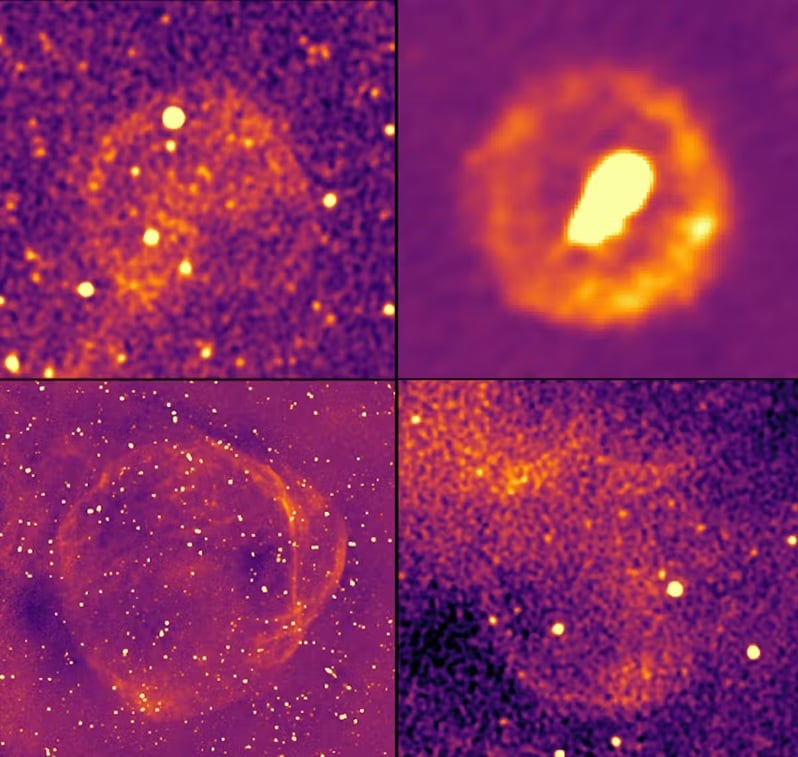
Stingray 1, Perun, Ancora and Unicycle - Photo: ASKAP/MEERKAT
Meanwhile, the circle known as Lagotis is a reflection nebula, a cosmic mirror made of clouds of gas and dust that reflects light from nearby stars.
Additionally, there are some objects classified as Odd Radio Circles (ORCs), solitary radio circles in the sky, a new class of objects with no clear origin.
According to scientists , MeerKAT and ASKAP are revealing astonishing insights into the lower-light regions of the universe. Surveys using these two machines promise to uncover even more previously unknown knowledge.
Source: https://nld.com.vn/kinh-vien-vong-nam-phi-uc-chup-loat-bong-ma-tron-bi-an-196250306095010615.htm

![[Photo] General Secretary and President To Lam works with the Party Committee of the Ministry of Health on the work of Vietnamese traditional medicine.](https://vphoto.vietnam.vn/thumb/1200x675/vietnam/resource/IMAGE/2026/05/20/1779294323718_a1-bnd-2978-3319-jpg.webp)
![[Image] "Journey of Hope" promotes the organ and tissue donation movement in Vietnam.](https://vphoto.vietnam.vn/thumb/1200x675/vietnam/resource/IMAGE/2026/05/20/1779294400833_1-8910-jpg.webp)
![[Photo] National Assembly Chairman Tran Thanh Man working with the Standing Committee of the National Assembly's Delegation Affairs Committee.](https://vphoto.vietnam.vn/thumb/1200x675/vietnam/resource/IMAGE/2026/05/20/1779294340023_ndo_br_1-1691-jpg.webp)
























































































Comment (0)