

Walking backward not only improves mental health but also helps build muscle, increase flexibility, and reduce knee pain.
Many people believe that walking or running backward can burn more calories than walking forward. According to Professor, Doctor Nancy R. Kirsch of Rutgers University (USA), the main benefit of walking backward is improving balance, which is essential for reducing the risk of falls.
Build muscle strength
When walking, the heel touches the ground first, followed by the toes. Conversely, walking backward usually involves touching the ground with the toes. This changes the way the muscles in the hips and legs work. Walking backward requires the legs to work harder than walking forward. Therefore, the quadriceps muscles are fully engaged, helping to build muscle strength in the lower body.
Improve joint health
Walking backward can be gentle on the joints because it reduces the impact on the knees and ankles. This exercise is suitable for people recovering from injury or those who want to participate in lower-impact exercises.
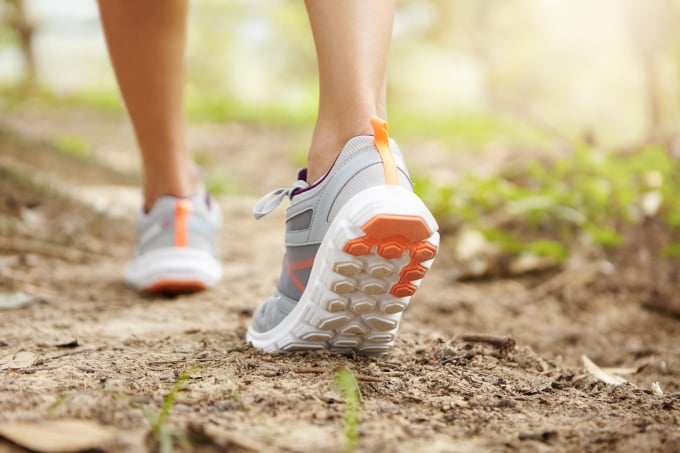
Walking backward usually involves touching the ground with the toes. Photo: Freepik
Improve your balance.
This form of exercise can improve gait, speed, and balance, especially after injury or illness. According to a 2019 study by the University of Witwatersrand (South Africa) involving over 600 people, physiotherapy combined with backward walking improved gait and muscle strength in individuals with osteoarthritis of the knee, juvenile rheumatoid arthritis, and anterior cruciate ligament (ACL) injuries.
Increased flexibility and range of motion.
Walking has long been a popular exercise for improving flexibility and range of motion. When walking backward, the knees straighten before the feet touch the ground. This repetitive movement can improve range of motion, benefiting those who have difficulty straightening their knees due to injury or illness. This form of exercise can also strengthen flexibility in the ankles and hamstrings at the back of the thighs.
Reduce knee pain.
A 2016 study by Daegu University (South Korea), with 33 participants, showed that walking backward requires taking short, frequent steps. This mechanism puts less pressure on the knee joints and patella, and stimulates the muscles in the lower limbs, knee joints, and quadriceps, thereby reducing knee pain. According to the scientists , this exercise has no side effects and does not require any special equipment.
People can trip and fall anywhere. A treadmill is a great option to avoid tripping and stay safe. Start with a speed of 0.5 miles per hour and gradually increase it as your body adjusts.
During the exercise, maintain an upright posture, take even steps, and ensure each step is of equal length. Keep your mind focused and avoid looking at your phone or listening to music while exercising. If practicing backward walking outdoors, you can combine forward and backward walking by taking 10 steps forward and then 9 steps backward for better results. Individuals with balance problems or limited mobility should consult a doctor before attempting this exercise.
Huyen My (According to Health, Live Strong )
| Readers can post questions about bone and joint diseases here for doctors to answer. |
Source link

![[Photo] Ba Lang An Lighthouse - the "eye of the sea" amidst the "rock museum" of Quang Ngai province.](https://vphoto.vietnam.vn/thumb/1200x675/vietnam/resource/IMAGE/2026/05/29/1780038698840_anh-man-hinh-2026-05-29-luc-14-10-42.png)

![[Image] Pleasant weather helps students enter the 10th grade entrance exam with confidence.](https://vphoto.vietnam.vn/thumb/1200x675/vietnam/resource/IMAGE/2026/05/29/1780034401612_ngay-1-thi-lop-10-minh-duy-8-5009-jpg.webp)































































































Comment (0)