

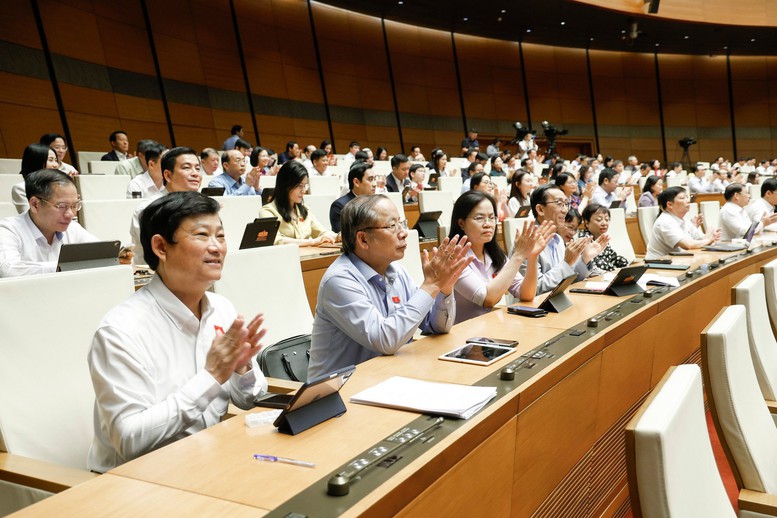
The National Assembly passed the Law on the Capital City (amended) with 488 out of 492 participating delegates voting in favor - Photo: VGP/Nhat Bac
The amended Capital City Law, recently passed by the National Assembly, consists of 9 chapters and 36 articles. The law will take effect from July 1, 2026; however, the provisions in Clause 4 of Article 8 and Clause 6 of Article 36 will take effect from the date the law is passed.
The law also stipulates that, from the date of its adoption, the drafting and promulgation of implementing documents for the Capital City Law shall be carried out in accordance with the provisions of this law.
Presenting the report on the acceptance, explanation, and revision of the draft Law before the National Assembly proceeds to vote, Minister of Justice Hoang Thanh Tung stated that, regarding some general issues, in response to the opinions of National Assembly deputies, the Government has conducted a comprehensive review of the draft Law, ensuring that it fully institutionalizes Resolution No. 02-NQ/TW and other key resolutions of the Politburo, in line with the requirements of reforming the thinking on lawmaking.
Review and focus on the substantive and comprehensive decentralization and delegation of power to the Hanoi government, coupled with establishing a strict power control mechanism, strengthening accountability, and ensuring transparency in implementation.
Continue to improve the specific and superior mechanisms and policies, while clearly defining the authority between different levels of the city government, in the direction that the People's Council decides on major policies; the People's Committee regulates the procedures for implementation; and the Chairman of the People's Committee directs, manages, and coordinates implementation.
This will be accompanied by a review of the draft law's provisions to ensure their constitutionality and compliance with relevant international treaties to which Vietnam is a signatory.
After receiving feedback and making revisions, the draft Law retains its original structure of 9 chapters and 36 articles; 26 out of 36 articles have been revised; and it grants the Hanoi City government 199 special and superior powers (including 127 for the People's Council, 56 for the People's Committee, and 16 for the Chairman of the People's Committee), creating a comprehensive and synchronized legal basis for the City to maximize its potential, position, and proactive and creative role in building and developing the Capital according to the motto "local authorities decide, local authorities act, local authorities take responsibility".
Regarding some major contents that have been incorporated and revised, Minister of Justice Hoang Thanh Tung said that, concerning the drafting and promulgation of legal documents; piloting mechanisms and policies; and controlling power, incorporating the opinions of National Assembly deputies, the draft Law has been revised to affirm the proactive role of the Hanoi government in designing, organizing implementation, and testing policies.
At the same time, additional regulations were added to ensure strict adherence to procedures, including prohibiting the use of simplified procedures in the drafting of legal documents; clarifying the authority of the Chairman of the People's Committee to issue documents; and adding requirements for establishing mechanisms for inspection, supervision, accountability when issuing documents, responsibility for evaluating the effectiveness of documents after issuance, and summarizing practical experiences.
The pilot scope should be expanded to include "other mechanisms and policies as directed by competent authorities" to ensure comprehensiveness; the pilot period for new policies should be limited to no more than 5 years, and a mechanism for temporary suspension should be established when risks exceed the predicted levels.
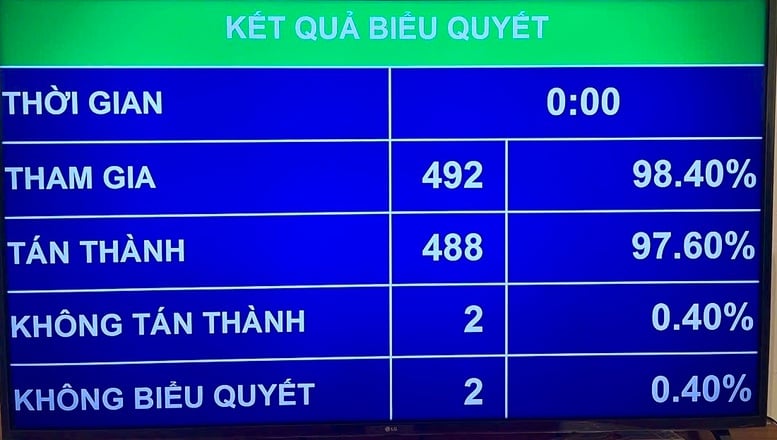
The results of the National Assembly's vote on the amended Capital City Law on the afternoon of April 23rd.
Regarding the specific mechanisms and policies for the development of the capital city, Minister of Justice Hoang Thanh Tung stated that the regulations on specific mechanisms and policies have been reviewed and improved to be rigorous, feasible, ensure control, and be consistent with reality. The focus is on clarifying the authority of the city government in planning and managing development space and the need for coordination with relevant ministries, especially for high-rise spaces.
At the same time, it empowers the City People's Council to decide on policies and criteria for urban renovation, upgrading, and reconstruction to address issues of population density, environment, and urban development; inheriting the 2024 Capital City Law, it retains specific regulations on cases of suspending electricity and water services to ensure security and order.
The revised regulations allow the City People's Committee to supplement local education programs without changing the core objectives and content of the national education program; and refine specific policies in the health sector to clearly define the responsibilities of healthcare facilities in the area in supporting the capital's health system, especially in pre-hospital emergency care and coordinated healthcare.
The City People's Council is empowered to decide on the application of special mechanisms and policies for large and important projects, based on the approval of competent authorities and after consultation with relevant ministries and agencies, and to decide on extending the time for completion of construction conditions for projects implemented under Resolution No. 258 of the National Assembly by no more than 6 months to complete the necessary conditions for commencement of construction.
Regarding financial management, budget, and tax incentives (Article 21), the draft Law has been revised to inherit current regulations, avoiding the issuance of tax incentive policies that exceed the general legal framework, ensuring the consistency of the legal system and the leading role of the central budget. It selectively adds beneficiaries of incentives and support to promote priority sectors; and includes flexible budget management mechanisms to meet the requirements of development and macroeconomic stability.
Regarding the exclusion and exemption from legal liability (Article 34), the draft Law has been refined to clearly stipulate the principle of exclusion and exemption from legal liability in cases where actions are performed within the proper authority, procedures, and without self-interest, but still result in damage.
At the same time, it should be clarified that this is not the only condition, but rather placed within the overall mechanism of power control and accountability monitoring.
Hai Lien
Source: https://baochinhphu.vn/luat-thu-do-sua-doi-trao-199-tham-quyen-dac-thu-cho-ha-noi-102260423164952775.htm




![[Photo] Standing Committee member of the Party Central Committee Tran Cam Tu working with the Central Inspection Committee](https://vphoto.vietnam.vn/thumb/1200x675/vietnam/resource/IMAGE/2026/05/28/1779969579668_ndo_br_bnd-2495-jpg.webp)































































































Comment (0)