

Astronomers have detected a massive plume of water vapor emanating from Enceladus, Saturn's small moon, which holds the prospect of harboring extraterrestrial life.
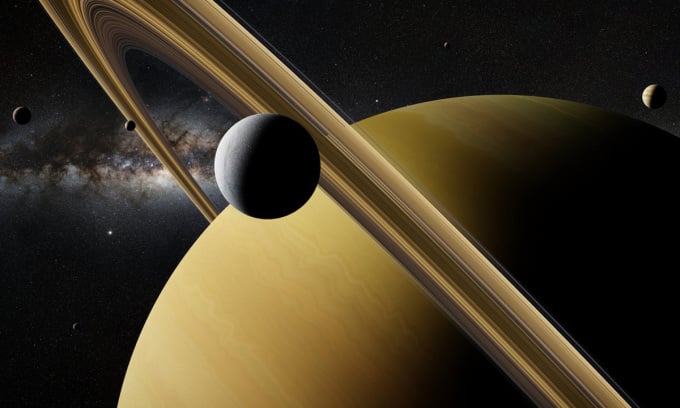
The moons, including Enceladus (in the foreground), orbit Saturn. Photo: dottedhippo/Getty/iStock
A plume of gas, approximately 9,600 km long—the distance between Ireland and Japan—sprayed water into space at an estimated rate of 300 liters per second, the Guardian reported on May 30. Experts have long believed that Enceladus, a moon about 500 km wide, contains a deep saltwater ocean beneath its icy crust and may be ejecting water vapor into space. However, this is the first time they have observed such a large-scale ejection.
"We were really impressed by the size and length of the plume of vapor," said planetary scientist Geronimo Villanueva at NASA's Goddard Space Flight Center, a member of the research team. The new study was published in the journal Nature Astronomy.
The research team observed Enceladus, Saturn's sixth-largest moon, with the James Webb Space Telescope last November. Measurements from the telescope showed that the vapor plume causes Enceladus to lose 300 kg of water per second—enough to fill an Olympic-sized swimming pool in a few hours.
Previous observations of Enceladus have revealed plumes of water vapor, carrying ice particles and organic chemicals, erupting like geysers on Earth through cracks known as tiger stripes on the moon's surface. Because Enceladus orbits Saturn so rapidly, completing an orbit in just over a day, the water vapor spills into the moon's orbit and forms a giant toroidal ring. According to telescope data, about 30% of the water escaping from Enceladus is trapped within this toroidal ring, with the remainder escaping into space around Saturn.
In 2017, NASA scientists reported that Enceladus possesses almost every component necessary for life known to humankind, including water, energy, and chemical elements. The energy source is believed to be similar to hydrothermal vents that spawn life-bearing bodies on Earth's oceans. Future missions to explore Enceladus will help study the thickness of its icy outer crust and the depth of its underlying ocean.
Thu Thao (According to Guardian )
Source link






























![[Photo] Reception to welcome General Secretary and President To Lam and his wife on their State visit to the Philippines](https://vphoto.vietnam.vn/thumb/1200x675/vietnam/resource/IMAGE/2026/06/01/1780295488620_vna-potal-chieu-dai-chao-mung-tong-bi-thu-chu-tich-nuoc-to-lam-va-phu-nhan-tham-cap-nha-nuoc-toi-philippines-8798060-7855-jpg.webp)




































































Comment (0)