
Doctors from the Provincial General Hospital provided consultations and examinations for local residents during a mobile medical examination program in Quang Duc commune.
Healthcare is becoming more accessible to people in disadvantaged areas.
The Quang Duc Commune Health Station was busier than usual as people from the villages arrived early to wait for examinations. For many people in the highlands, this was a rare opportunity to have doctors from the provincial level bring equipment to their homes for free examinations and medication, early disease detection, and treatment advice, reducing travel time and costs. Meanwhile, for the doctors and nurses of the Provincial General Hospital, the weekend was a day to travel to the remote areas to help the people.
Having been notified several days in advance, Ms. Nguyen Thi Khanh (Hamlet 1, Quang Duc Commune) arranged her farm work early to come to the examination point, hoping to "get a clear diagnosis." Ms. Khanh said that the feeling of heaviness and fatigue in her legs had appeared for quite some time. The veins under her skin were sometimes visible, sometimes faint, but she only massaged them and rested, feeling better, so she hadn't sought specialized medical attention.

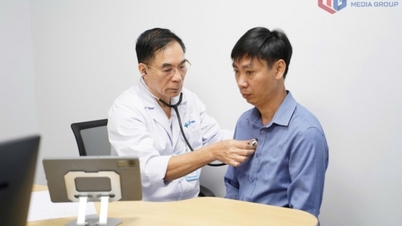
Ms. Nguyen Thi Khanh (village 1, Quang Duc commune) is undergoing a cardiac ultrasound screening at the Provincial General Hospital.
Based on the symptoms Ms. Khanh described, the doctor performed an ultrasound of the blood vessels in her legs and discovered varicose veins. When the doctor explained her condition and advised on specialized treatment options at the Provincial General Hospital, Ms. Khanh listened attentively, nodding occasionally. She said, “Before, I just thought my leg pain and fatigue were due to working in the fields and walking a lot, and didn’t realize it was a disease. Now that the doctors have come to my home and examined me with modern equipment, knowing exactly what the disease is, I feel much more at ease. The doctor also warned that if I don’t treat it early, the condition could worsen and affect my mobility later. I will discuss it with my family to arrange for treatment at the Provincial General Hospital as soon as possible.”
Holding the test results in her hand, Mrs. Khanh carefully folded them and put them in her jacket pocket. For her, the most important thing after the examination was knowing her illness and having a specific treatment plan.
Outside the clinic, Mr. Doan Van Luat (from Hamlet 5, Quang Duc Commune) sat waiting for his turn, holding his medical record book, occasionally glancing towards the ultrasound area. This wasn't the first time Mr. Luat had come to the mobile medical clinic in the area. Whenever the commune health station announced that a team of doctors from the provincial level was coming, he always tried to arrange his schedule to go.
Mr. Luat confided: "The older I get, the more illnesses I have, but going for checkups at higher-level hospitals isn't always easy for people in the highlands. A trip to a regional hospital, over ten kilometers away, or to the provincial hospital is a long journey, and you need someone to accompany you. So sometimes, when I'm tired and want to go for a checkup for peace of mind, I think about the hardship and expense of traveling, and then I give up. As a result, many illnesses are left untreated, and by the time I go to the doctor, it's too late."
Therefore, for Mr. Luat and many other villagers, these mobile medical check-ups are almost an "unmissable" opportunity. "Whenever there's an announcement, we all go. Doctors come right to our doorstep, they have the necessary equipment, and they explain things clearly and give specific instructions. That's great. At least we know what's wrong with us and how we need treatment, instead of being so uncertain like before," Mr. Luat added.

Mr. Doan Van Luat (village 5, Quang Duc commune) received advice on medication from a pharmacist at the Provincial General Hospital.
Around Mr. Luat and Mrs. Khanh, people continued to arrive and wait for examinations. Some came from distant villages, others had traveled since before dawn. No one was in a hurry, but everyone wanted a thorough examination and medical advice from the doctors. In just one day, more than 500 people were screened by a team of 27 doctors and medical staff from the Provincial General Hospital with techniques such as ultrasound, electrocardiogram, eye examination, echocardiogram, ENT endoscopy, and dental examination… All were given prescriptions and medication free of charge.
According to Dr. Nguyen Van Linh (Secretary of the Youth Union of the Provincial General Hospital), the mobile medical examination and treatment program and free medicine distribution of the Hospital have been directed and maintained by the Department of Health since 2016. The Hospital has assigned the Youth Union as the core force to organize and implement it. In 2026 alone, the Youth Union of the Provincial General Hospital plans to organize 18 medical examination trips to many remote, border, and island areas of the province such as Quang Duc, Duong Hoa, Dam Ha, Quang Tan, Hai Son, Hai Ninh, Mong Cai, Ban Sen, Ngoc Vung, Quan Lan, Minh Chau, Co To... with an expected examination of more than 4,900 people. Before each trip, we carefully plan the personnel and equipment. Through this, each trip not only brings medical services closer to the people but also helps raise awareness about disease prevention and early health care.

Doctors from Vietnam-Sweden Uong Bi Hospital provided free health checkups for residents in Mong Cai 1 ward.
Spread the spirit of disease prevention to every citizen.
Quang Ninh province has diverse topography, with many mountainous areas, border regions, and islands far from the central hub. In many places, a trip to regional or provincial hospitals for medical check-ups remains a long journey for residents, costly in terms of time, money, and effort. For the elderly, those with underlying health conditions, and those in difficult circumstances, accessing specialized medical services is therefore not always easy.
Based on this reality, for many years, the Quang Ninh Health Department has maintained mobile medical examination campaigns, bringing doctors, equipment, and medicines to remote villages, hamlets, and islands. Major hospitals such as the Vietnam-Sweden Uong Bi Hospital, the Provincial General Hospital, Bai Chay Hospital, the Obstetrics and Pediatrics Hospital, and the Cam Pha Regional General Hospital regularly coordinate and carry out hundreds of trips each year. Destinations include highland communes such as Hoanh Mo, Binh Lieu, Luong Minh, Ba Che, Dam Ha... or remote islands like Co To, Vinh Thuc, and Van Don... Thanks to this, people do not have to travel far to access highly qualified doctors from the provincial level.

Dr. Nguyen Ba Viet, Director of the Provincial General Hospital, examines and provides health consultations to residents of Quang Duc commune.
Joining the working group in Quang Duc commune, Dr. Nguyen Ba Viet, Director of the Provincial General Hospital, said: "The need for medical examinations and screenings among people in mountainous areas is very high, while access to specialized medical services remains limited. Through mobile medical examinations, we not only examine patients and dispense medicine, but also focus on early detection of diseases and provide appropriate treatment advice so that people can access medical services promptly. This is also a way to help reduce the pressure on higher-level hospitals when many diseases are detected and intervened early."
Mobile medical examinations go beyond simply detecting illnesses. They also include caring conversations, gentle advice on diet, lifestyle, and maintaining good health. Cases suspected of chronic diseases or showing dangerous symptoms are specifically guided to higher-level facilities for treatment. People receive free medication. On average, these mobile medical examinations serve over 17,000 people in disadvantaged areas each year. Many people are happy to have their illnesses detected promptly, elderly people living alone feel reassured, and children in mountainous regions smile brightly when they receive a doctor's examination right on the spot without having to travel far.

Doctors from Bai Chay Hospital conducted screening for congenital chest deformities for students at Nguyen Trai Secondary School (Viet Hung Ward).
From mobile medical examinations, a subtle but significant change is gradually emerging: people are paying more attention to early check-ups and regular health monitoring, instead of only going to the hospital when their illness is severe. This direction also aligns with the current demands for innovation in public health care, where the focus is not only on treatment but also on prevention, early detection, and health management starting from the community.
The 10th session of the 15th National Assembly (December 10, 2025) passed the Law on Disease Prevention, marking a shift from a "cure-first" mindset to a "proactive prevention" approach, placing the people at the center and aiming for comprehensive health care throughout the life cycle. Notably, April 7th is designated as "National Health Day," demonstrating that the protection, care, and improvement of people's health are increasingly placed in the socio -economic development of the country.
Nguyen Hoa
Source: https://baoquangninh.vn/luu-dong-cham-care-health-for-people-3401544.html



![[Image] Nearly 125,000 Hanoi students completed the Literature exam for the 10th grade entrance exam.](https://vphoto.vietnam.vn/thumb/1200x675/vietnam/resource/IMAGE/2026/05/30/1780117233041_ndo_br_thiet-ke-chua-co-ten-2-png.webp)





















![[Photo] Admire the coral "masterpiece" amidst the million-year-old heritage of Dak Lak province.](https://vphoto.vietnam.vn/thumb/1200x675/vietnam/resource/IMAGE/2026/05/30/1780107638639_y25-jpg.webp)























































Comment (0)