"Hold on to your faith, my dear."
Reading the chapter written by Ms. Nguyen Thi Binh about her love story, it's very short, but profound and full of hope. She says: "I am happy to have a warm family and a husband who is my 'support system' while I 'go to war'."
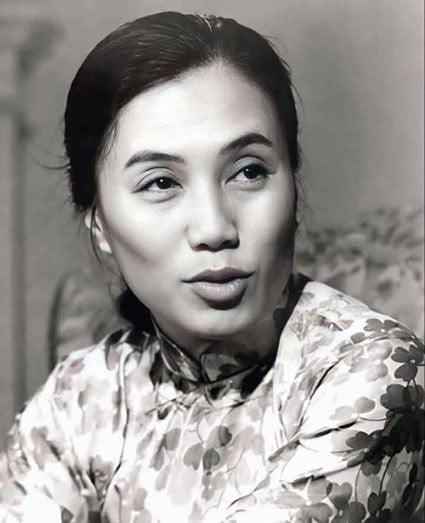
According to her memoir, Ms. Binh stated that her family moved to Cambodia when she was 16 years old. Her father worked at the Surveying Agency at the time, and her mother also passed away at the age of 16 on the way from Cambodia to Saigon due to multiple pregnancies and illness: "My mother gave birth seven times, one child died from illness, so there were six siblings left." Ms. Binh was the eldest child in the family. She recounted that among the trainees was Mr. Dinh Khang, a young man who loved sports , so she and Mr. Khang often met on the basketball court. "Our feelings for each other blossomed and grew stronger. But my father was very cautious because he didn't know Mr. Khang's family well; on the other hand, he also wanted me to finish my studies first. At that time, I also had several boyfriends, but my love was only for Mr. Khang. We made promises to each other...", Ms. Binh said in her memoir.
|
Khang returned to Saigon before joining the Viet Minh. When the resistance against the French broke out, Mrs. Binh also returned to Saigon and went in search of her lover. In 1946, they met at the temple of Phan Chu Trinh (Mrs. Binh's maternal grandfather). They were inseparable for several months while Khang stayed at her house before he returned to the North: "Before leaving, he told me: 'I have to go to the North to join the Viet Minh army; I have many friends there. The situation in the South is complicated and I don't know what to do.'" Mrs. Binh promised to meet Khang again soon, but it wasn't until nine years later, after she went to the North for regrouping (in 1954), that the two reunited.
“Throughout those nine long years, all I received from him was a few words: ‘Wishing you and your family safety and good health.’ A single line written on a small, crumpled piece of paper, delivered by an official from the central government who came to the South, could be considered a letter. Nevertheless, I was very happy to know he was still alive and still thinking of me,” Mrs. Binh confided.
Their long-distance relationship, lacking letters and phone calls, drew concern from the leadership. Ms. Binh said she had received advice to consider "whether we should wait for each other," as they didn't know when peace would come or the resistance would be victorious. However, Ms. Binh remained steadfast in her love for the man she had chosen, even if the resistance were protracted: "I told myself that if there was anyone I loved more than Khang, I would consider him, but truly, until then, he would be the only one in my heart."
In 1949, a delegation of officials from the South went to the North and asked if she wanted to go with them, but she declined because she thought of her siblings who needed her at that time. It wasn't until the Geneva Accords were signed that Ms. Binh went to the North and reunited with her brother Khang and her father: “Before that, my father told me that Khang was ‘unmarried’ and worked in the engineering corps. I was deeply moved when I saw him in his green military uniform, thoughtfully looking at me. He gently asked, ‘How are you?’ He probably noticed I was thin, since I had only been out of prison a few months earlier. I will never forget those moments,” Ms. Binh recalled.
Later, they had a warm, wartime wedding on Dinh Le Street. Mrs. Binh's father prepared a heartfelt speech, wishing them a long and happy life together. In her memoir, she emotionally recounted their tumultuous yet faithful love story: “I am a happy woman. I married the man I loved, and it was my first love. Because of our work, Khang and I were often apart. But the bond between us helped me stand firm and complete my mission. In 1956, I gave birth to Thang, and in 1960, to Mai.”
It was truly a beautiful love story during wartime, like the "Love Songs" of composer Hoang Viet or the "Song of Hope" of Van Ky. This sincere love brought a sweet flavor amidst the upheavals of history.
A living heritage
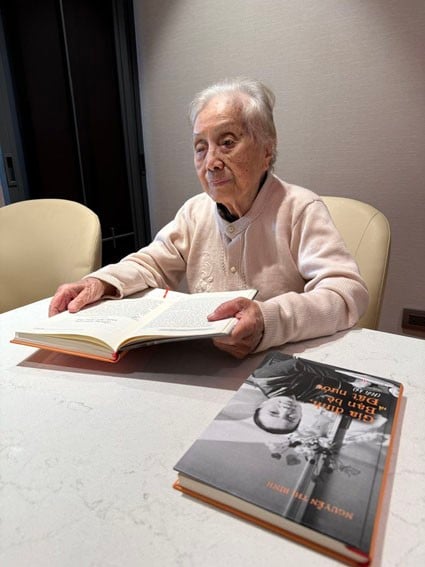
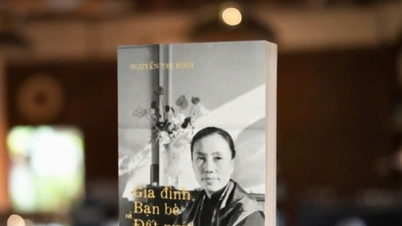
Nguyen Thi Binh's memoir, "Family, Friends, and Country," recounts her life as a living witness who participated in and observed the ups and downs of history, from her childhood to her revolutionary activities, the important milestones in the struggle for national independence, and even after her retirement.
|
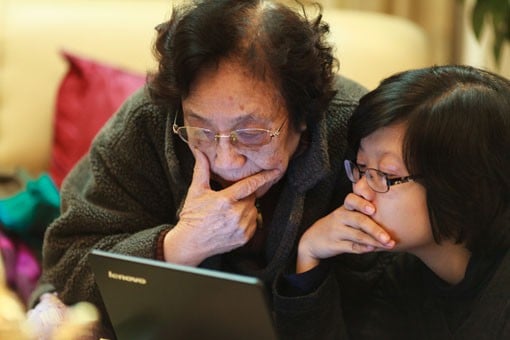
Ms. Nguyen Thi Binh and editor Nguyen Phuong Loan. (Photo: Provided by the interviewee) |
The book was begun by Ms. Nguyen Thi Binh in 2007, completed at the end of 2009, and subsequently supplemented and revised in 2013, 2014, and 2023. Each page of the memoir is written in simple, everyday language, yet it deeply moves the reader with its portrayal of a generation dedicated to the revolution.
“After the book was completed, I felt a change in myself. More than just an editor, I felt a responsibility: to enrich and enliven the culture, history, and knowledge of the nation with my heart, so that history would no longer be unfamiliar, but become close and inspiring. Through conversations with her, I understood that, in her view, the greatest legacy of April 30, 1975, was not the military victory, but the opportunity to build a peaceful, unified, and developed country. That is the responsibility not only of her generation but also of future generations,” shared Ms. Nguyen Phuong Loan, editor of the first edition of the memoir, about her journey alongside Ms. Nguyen Thi Binh on this work.
Ms. Loan shared her experience with this historically valuable memoir, which brought her many positive thoughts: “I didn’t come to her just to gather and edit the words, to shape the pages into form and structure. I came to understand more about her indomitable leadership spirit, about innovation in both wartime and peacetime, and about what she – and her generation – left us after April 30, 1975. It is a vibrant legacy – both personal and vast, profound like a river that never stops flowing.”
Speaking about the reunification of the country on April 30, 1975, editor Nguyen Phuong Loan observed, through the months spent close to Mrs. Binh and listening to her stories: “Through her retelling, I sensed that in that moment, Mrs. Binh saw April 30 not only as the end of the war, but as the beginning of a journey towards peace and national unity. Through her memoirs, I understand that she and her generation were deeply aware that victory was only the first step. Ahead lay a long road to rebuild the country…”
|
Image source: National Political Publishing House. |
Ms. Nguyen Thi Binh was one of Vietnam's outstanding and resilient female leaders. In the history of world diplomacy, the Paris Conference on Vietnam was the longest-running talks, lasting from 1968 to 1973. The conference had four heads of delegations, including only one female head – Ms. Nguyen Thi Binh, Minister of Foreign Affairs and head of the negotiating delegation of the Provisional Revolutionary Government of the Republic of South Vietnam at the Paris Conference on Vietnam. She was known in the media as "Madame Binh". To achieve this historic diplomatic victory, along with the contributions and sacrifices of the entire Vietnamese nation, it is impossible not to mention Ms. Nguyen Thi Binh – one of the representatives of the parties who signed the Paris Agreement in 1973 and the only woman to put her signature on the agreement.
Tuan Ngoc
Source: https://baophapluat.vn/madame-binh-niem-tu-hao-cua-ban-linh-dam-phan-viet-nam-post546641.html


![[Photo] Capturing the moment the tide recedes at Yen Binh Son rapids - a million-year-old scenic spot in Quang Ngai.](https://vphoto.vietnam.vn/thumb/1200x675/vietnam/resource/IMAGE/2026/05/19/1779175463885_yen9-1199-jpg.webp)
![[Photo] General Secretary and President To Lam presides over a meeting on the implementation of Directive No. 34-CT/TW of the Party Central Committee.](https://vphoto.vietnam.vn/thumb/1200x675/vietnam/resource/IMAGE/2026/05/19/1779187768672_a1-bnd-2350-631-jpg.webp)
![[Photo] National Assembly Chairman Tran Thanh Man attends the groundbreaking ceremony for the National Highway 1A spatial axis project.](https://vphoto.vietnam.vn/thumb/1200x675/vietnam/resource/IMAGE/2026/05/19/1779161360398_ndo_br_bnd-1412-jpg.webp)

































![[Photo] General Secretary and President To Lam receives Indian Defense Minister Rajnath Singh](https://vphoto.vietnam.vn/thumb/402x226/vietnam/resource/IMAGE/2026/05/19/1779184046302_anh-man-hinh-2026-05-19-luc-16-46-58.png)

















Comment (0)