

M expands the scope of information that must be made public.
Representing the agency drafting the policy document, Ms. Nguyen Thi Hanh, Director of the Criminal and Administrative Law Department ( Ministry of Justice ), stated that the implementation of the Law on Access to Information has received close guidance from the Government and the Prime Minister, as well as the involvement of ministries, sectors, and localities. Information disclosure has been carried out regularly and promptly; providing information upon request has gradually become a regular practice. The conditions ensuring the provision of information are increasingly emphasized, contributing to guaranteeing citizens' right to access information, and enhancing transparency, accountability, and responsibility of state agencies.
.jpg)
In addition, Ms. Nguyen Thi Hanh also pointed out that the implementation of the Law still faces some obstacles, such as: the lack of guidance on the agency responsible for providing information previously established at the district level; inconsistent understanding of the scope of accessible information; and limited application of information technology. Therefore, the Law needs to be amended and supplemented to suit practical realities.
Based on that, the policies of the Law on Access to Information (amended) focus on the following aspects: the agencies and units responsible for providing information; the scope of information under the responsibility of the People's Committees at the commune level; the scope of information citizens can access, information citizens cannot access, and information citizens can access under certain conditions; the forms, methods, procedures, and processes of information provision; and the application of information technology and digital transformation in information provision, with six main policies: expanding the entities providing information; adjusting the scope of information that the People's Committees at the commune level must provide; expanding the scope of information that must be made public; clarifying the scope of information that cannot be accessed or can be accessed under certain conditions; diversifying methods of information provision; and adjusting regulations on the cost of information provision.
At the meeting, the majority of the Appraisal Council members agreed on the necessity of issuing the policy. Some opinions suggested clarifying Policy 5 to avoid confusion when providing information; specifying the list of information that is accessible, inaccessible, or subject to conditions under Policy 4 to ensure transparency.
Regarding the regulations on effective date, delegates requested that the drafting agency provide a clear explanation in the submission document and specify the effective date, instead of stating "effective from the date of signing and promulgation," to ensure compliance with the Law on the Promulgation of Legal Normative Documents.
Promoting digital transformation in information provision activities.
After listening to the opinions expressed at the meeting, Deputy Minister Phan Chi Hieu stated that the Appraisal Council unanimously agreed with the six proposed amendments to the Law on Access to Information, focusing on three major objectives: institutionalizing the Party's policy on accountability and ensuring the right to access information; aligning with the restructuring of the government apparatus according to the three-tiered model; and resolving obstacles encountered during the 10 years of implementing the Law.
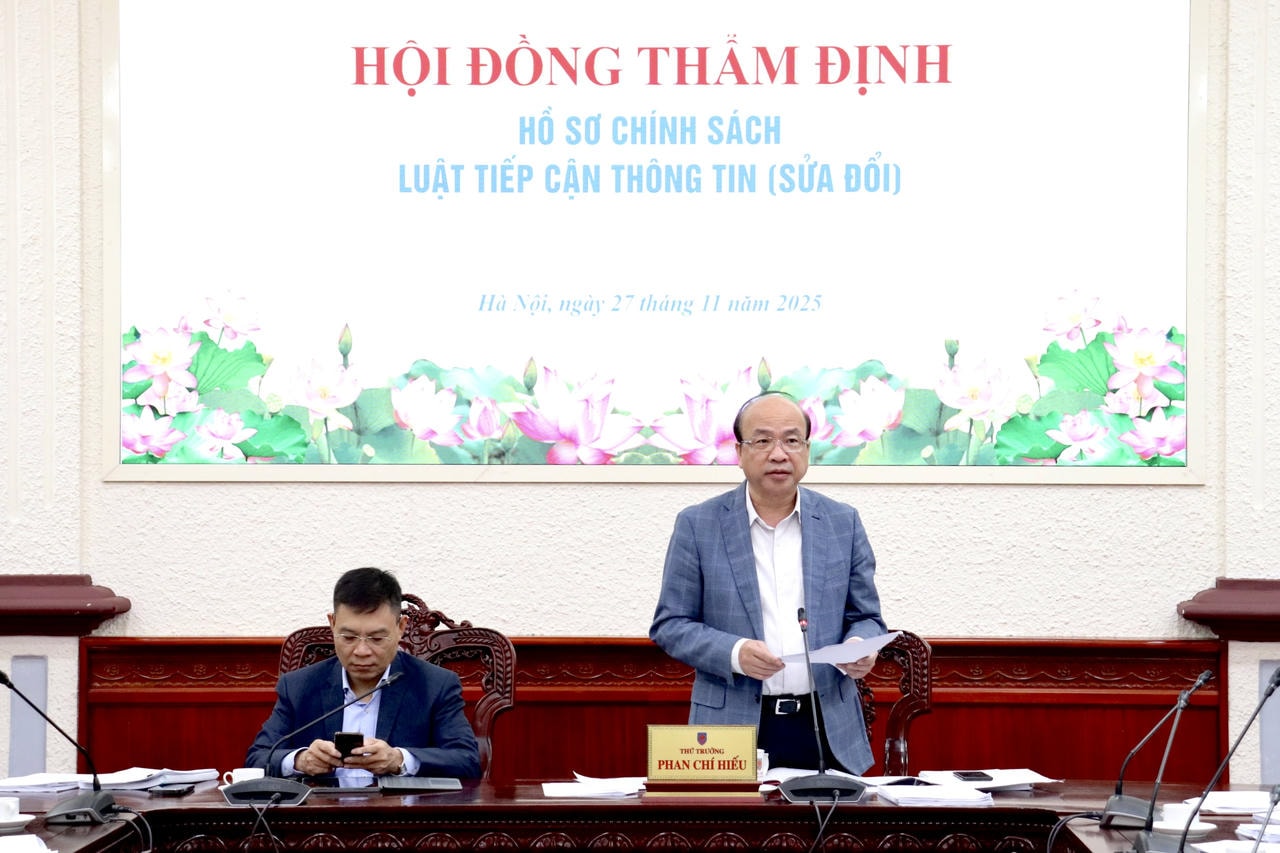
The Deputy Minister requested the drafting agency to further clarify the necessity of the amendments to ensure consistency with related laws such as the Law on Grassroots Democracy, the Data Law, the Archives Law, the Law on Personal Data Protection, etc. At the same time, the policy document needs to continue reviewing the Party's guidelines, especially the Politburo 's Regulation 178 on controlling power and preventing corruption in lawmaking; and the Government's Resolution 126 on perfecting the legal system to prevent vested interests…
The policies ensure constitutionality and legality, but regulations on information disclosure and the right to request information need careful review to avoid overlap with existing laws.
Regarding Policy 1, the Deputy Minister assessed that the proposed expansion of information providers is appropriate. In addition, the Deputy Minister requested clarification on the criteria for identifying public service units providing essential basic public services and the scope of their responsibility for providing information. For Policy 2, the proposed solution of exempting commune-level People's Committees from providing information they receive is consistent with international practice and the capacity of the grassroots level, but needs to be reviewed to avoid conflicts with regulations on decentralization and delegation of authority, and to incorporate the opinions of the Appraisal Council. Regarding Policy 3, the expansion of the scope of information that must be made public needs to be reviewed to avoid conflicts with regulations on state secrets, business secrets, investment secrets, personal data protection, and cybersecurity.
Regarding the promotion of science and technology , innovation, and digital transformation, the lead agency has developed a policy on the application of information technology in information disclosure. However, the content on "providing information on demand" remains vague. Based on this, the Deputy Minister suggested that further research into digitalization solutions such as virtual assistants, artificial intelligence, or automated information delivery systems is needed, and also proposed a stronger push for digital transformation in information provision activities.
Source: https://daibieunhandan.vn/mo-rong-chu-the-cung-cap-thong-tin-la-phu-hop-10397408.html















































































































Comment (0)