On the 39th night at the camp, Manuel Ranoque performed the sacred tea-drinking ritual of the Amazonian indigenous people, "yagé," to "open his eyes" and find the children.
On the night of June 8th, the exhausted indigenous people gathered at their camp, surrounded by towering trees and dense vegetation in the Amazon rainforest. They, along with Colombian soldiers, had been continuously searching for four children lost in the forest for 39 days, ever since the plane carrying them crashed on May 1st.
Day 40 was a crucial point, when the entire search team was exhausted after weeks of fruitless searching. They sensed the Forest Spirit was not yet ready to help find the four missing children.
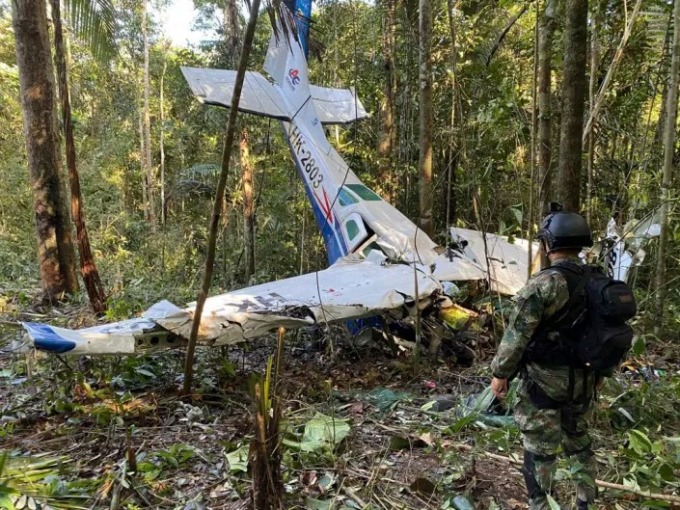
A Colombian soldier stands next to a downed plane in the Amazon rainforest on May 18. Photo: AP
Indigenous volunteers and Colombian army soldiers discovered many hopeful clues such as children's water bottles, half-eaten fruit, and soiled diapers. But the relentless heavy rain, harsh terrain, and the rapidly passing time were draining their spirits and strength.
The indigenous people believed that when the body, mind, and faith weakened, they would be unable to find the children in the forest. Therefore, that night, Manuel Ranoque, the father of the third and youngest children, decided to perform yagé, one of the most sacred rituals of the Amazonian indigenous people.
This is a ritual involving the preparation of a bitter tea made from ayahuasca, a wild grape growing in the Amazon rainforest, and chacruna shrub. For centuries, this hallucinogenic herbal tea has been used by people in Colombia, Peru, Ecuador, and Brazil as a remedy for all kinds of ailments.
Henry Guerrero, a volunteer in the search, said his aunt had prepared yogurt for the group. They believed the drink would open their eyesight, leading them to the children.
"I told them, 'There's nothing we can do in this forest. We can't find the children with the naked eye. The last resort is yagé,'" said Guerrero, 56. "The trip took place at a special moment, something incredibly sacred about it."
After the indigenous people had finished preparing the yagé, Ranoque took a sip of tea, while the others watched him for the next few hours.
Late at night, they were disappointed when Ranoque said the ritual had not worked. They packed their belongings, preparing to leave the forest the following morning.
But before they set off from the forest early on the morning of June 9th, the village elder José Rubio decided to drink the remaining yogurt, believing it would help him find the children.
Rubio suddenly fell into a dazed state, occasionally vomiting due to the side effects of the psychoactive tea. This time, he said the tea had worked. Rubio believed his eyesight had been restored, allowing him to see the children, and told Guerrero: "We will find the children today."
Rubio's statement sparked hope among the search team, and they decided to stay in the forest, continuing their efforts.
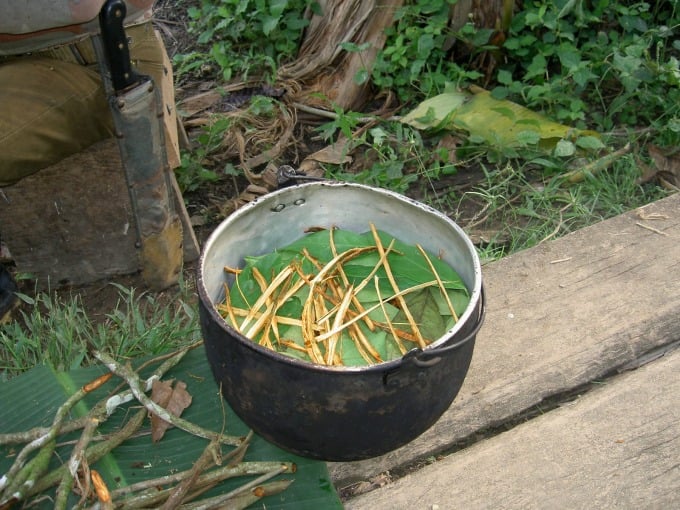
Yagé, an herbal tea made from the ayahuasca vine (Banisteriopsis caapi) and the chacruna shrub (Psychotria viridis), has hallucinogenic effects. Photo: Wikipedia
The four children, Lesly, Soleiny, Tien, and Cristin, grew up in Araracuara, a small village in the remote Amazon rainforest of southern Colombia, accessible only by boat or small plane. Ranoque says the children lived happily and independently because he and his wife, Magdalena Mucutui, were often away from home.
Lesly, 13, was mature but quiet. Soleiny, 9, was playful. Tien, nearly 5 years old before the tragedy, was extremely energetic. Cristin, when she disappeared, was only 11 months old and learning to walk.



At home, Magdalena Mucuti grows onions and cassava, using the cassava to make flour for the family's food and for sale. Lesly learned to cook at the age of eight. Whenever her parents were away, she would take care of her younger siblings.
On the morning of May 1st, four children, along with their mother and an uncle, boarded a light aircraft to the town of San José del Guaviare. A few weeks earlier, Ranoque had left the village, situated between rebel groups and drug plantations that had existed for decades. Ranoque said he was under pressure from some people involved in the illegal activity, but declined to provide details.
"The work there isn't safe," Ranoque said. "It's also illegal, involving other people in the field I can't name because it would put myself in greater danger."
Ranoque said that before leaving the village, he left his wife 9 million pesos (US$2,695) to buy food, necessities, and pay for airfare. He wanted the children to leave the village because he feared they would be recruited by rebel groups in the area.
The five family members were on their way to meet Ranoque when the pilot of their Cessna light aircraft reported an emergency due to engine failure. The plane disappeared from radar screens on May 1st.
The Colombian army searched for the plane, and after 10 days without finding any sign of the victims, a group of indigenous people decided to join the search. They were familiar with the Amazon rainforest and the families in the area. One indigenous man said he heard the engine sound when the Cessna flew over his house. This information helped them plan their search along the Apaporis River.
The soldiers and natives toiled through the forest, despite the many dangers lurking. One man was nearly blinded by a tree branch. Others began to experience allergy and flu-like symptoms, but they persevered.
In the past, the military and indigenous groups were enemies, but deep in the jungle, they shared food, water, satellite phones, GPS devices, and even hope.
Sixteen days after the crash, with everyone's spirits low, they found the wreckage of the plane nose-down in the forest floor. They thought the worst had happened when they found bodies inside. Guerrero said he and the others began dismantling the camp. But a man who approached the plane to examine it suddenly said, "Hey, I don't see the children's bodies."
Guerrero approached the plane and noticed several objects that appeared as if someone had pulled them out after the crash.
The bodies of three adults were recovered from the plane, but there were no children, nor any signs that the children were seriously injured. The search team changed tactics, relying on evidence suggesting the children were still alive. They no longer moved silently through the forest out of fear of insurgents as they had done before.
"We're moving on to phase two," said Sergeant Juan Carlos Rojas Sisa. "We'll use the noisiest search method possible so the children can hear us."
They shouted Lesly's name and played back a recorded message from the children's grandmother in Spanish and the Huitoto language, asking them to stay put. Helicopters dropped food and leaflets into the forest. The army also brought in sniffer dogs, including Wilson, a Belgian Shepherd, the dog that had found the children's milk bottle before disappearing into the woods.
Nearly 120 soldiers and over 70 indigenous people searched for the four children day and night. They attached whistles to trees for the children to use if they saw them, and used a total of 11 kilometers of specialized rope to mark the areas they had searched, hoping the children would recognize it as a sign to stay put.
They continued to find clues about the children, including footprints believed to be Lesly's, but no one found them. Some people walked a total distance of over 1,500 km in the search.
Many soldiers were exhausted, and the army had to replace them. That's when Guerrero called home, asking his aunt to prepare yagé tea. Two days later, the tea was delivered by the soldiers.
On the 40th day, after the village elder Rubio drank some yogurt, they searched the forest again, starting from where the diaper was found. The "sacred tea" didn't help Rubio pinpoint the children's exact location, so the groups split up in different directions.
Hours passed, and as the indigenous people grew disheartened by the lack of new clues, a soldier suddenly announced over the radio that four children had been found 5 kilometers from the crash site, in a relatively clear patch of forest. Rescue teams had repeatedly searched this area but had not found the children.
"They found all four children," the soldier told Guerrero, weeping as he hugged him.


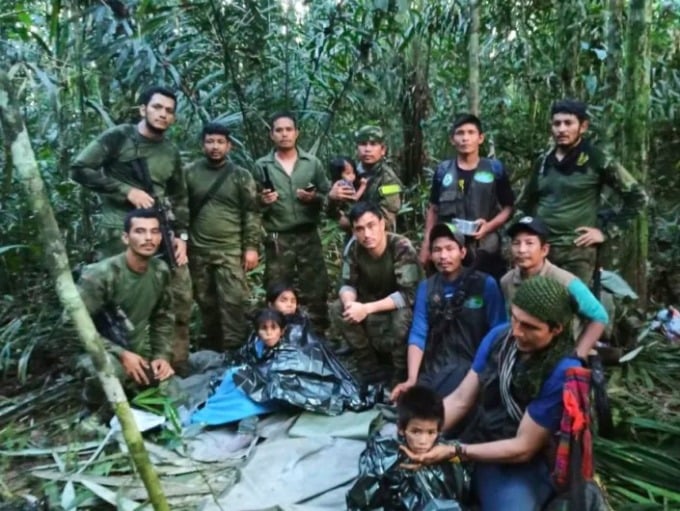
The four sisters were found about 5 km from the plane crash site on June 9. Photo: AP
When found, Lesly was in a near-delirious state and unable to walk further. Lesly's siblings were also exhausted and severely malnourished, their limbs covered in scratches and insect bites.
The search team quickly administered first aid and warmed the children, then called in a helicopter to airlift them out of the dense jungle. They were taken to San José del Guaviare, and then transferred by military medical aircraft to a hospital in the capital Bogota, where doctors and nurses were waiting.
Colombian officials, medical experts, the military, and many others praised Lesly's leadership. General Pedro Sanchez, who was in charge of the search operation, said that Lesly, the eldest sister, had fed her younger sibling by chewing up fruit, mixing it in a container with a little water, and feeding it to her.
The little girl and her three siblings became symbols of resilience and a lesson in survival worldwide. The Colombian government is proud of the cooperation between indigenous communities and the military in its efforts to resolve national conflict.
"The forest saved these children," said President Gustavo Petro. "They are children of the forest and now also children of Colombia."
Ranoque acknowledged President Petro's words, but added that the indigenous people's culture and spiritual rituals had saved his children. "It was the spiritual world ," he said, referring to yagé as one of the most revered rituals of the Amazonian indigenous people. "We drank tea in the forest so that the goblins would release my children."
Hong Hanh (According to AP )
Source link


![[Image] National conference summarizing one year of operation of the overall organizational model of the political system, the three-tiered government model.](https://vphoto.vietnam.vn/thumb/1200x675/vietnam/resource/IMAGE/2026/07/01/1782882811691_ndo_br_1-jpg.webp)