Good rice varieties will yield high productivity.
Dr. Dao Minh So, Head of the Plant Breeding Department at the Southern Institute of Agricultural Science and Technology, stated: “Previously, farmers often said, 'First water, second fertilizer, third care, fourth seeds,' but modern agriculture must consider seeds as the foundation. If farmers use poor-quality seeds that haven't undergone strict quality control, the quality will deteriorate after each harvest. These seeds are prone to segregation, mixing, loss of inherent characteristics, prolonged growth time, loss of aroma in the rice grains, leading to lower selling prices, and even rejection for export. Not only does this cause economic losses for farmers, but poor seeds also risk damaging the reputation of Vietnamese rice brands in the international market. A few batches of poor-quality rice can affect an entire production region, or even the national reputation.”
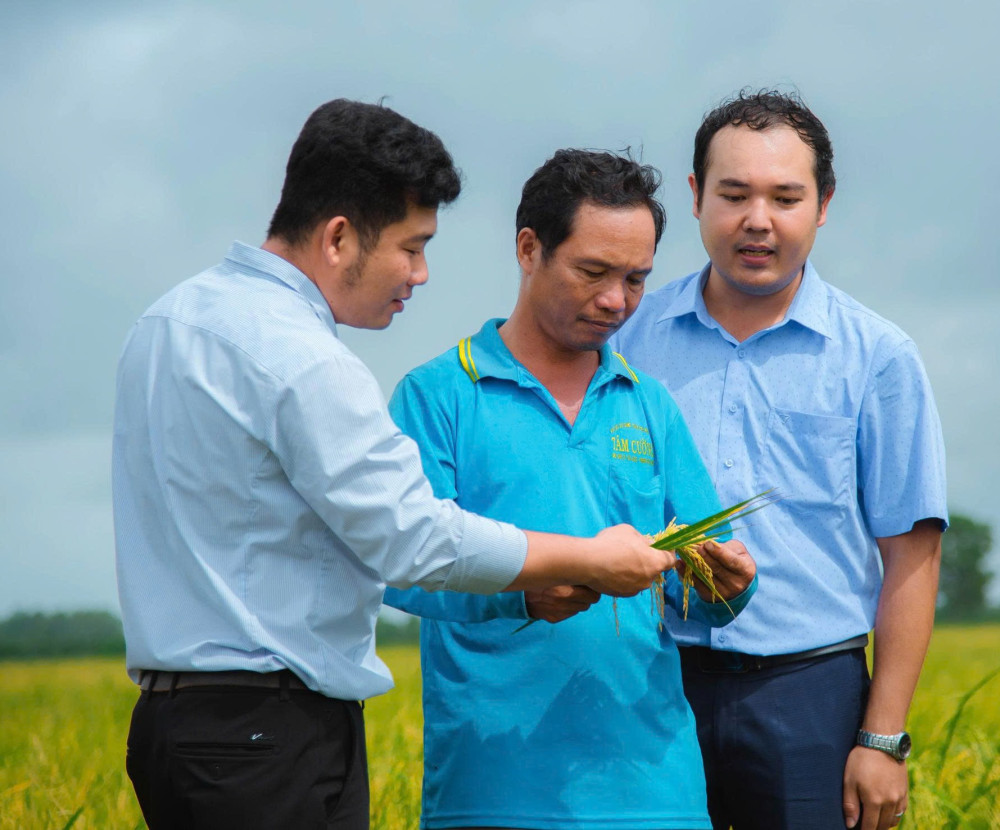
The rice variety is the first factor in ensuring healthy plants that are resistant to pests and diseases from the beginning of the season.
In practice, many farmers using poor-quality rice seeds not only affect yield but also increase production costs. Mr. Nguyen Quang Hau (residing in Tan Hung commune) said: “Normally, I only buy certified seeds for the Winter-Spring crop, and for the Summer-Autumn crop, I use the rice from the Winter-Spring crop as seeds again. Therefore, for the Summer-Autumn crop, I have to hire laborers to cut the rice stalks, weed, replant, etc. Production costs increase while yield decreases, the rice grains are not beautiful, and traders buy them at a lower price. The cost of hiring laborers equals the cost of buying certified rice seeds, so for the past few years, I have bought certified rice seeds for sowing, which gives me peace of mind and ensures quality.”
Rice yield is a top concern for farmers, and the first factor in achieving high yields is selecting high-quality varieties that are suitable for the region's ecological conditions. Rice yield is influenced by four main components: the number of panicles per unit area, the number of grains per panicle, the percentage of filled grains, and grain weight.
However, according to research by specialized agencies, whether a variety maintains its purity depends on the cultivation conditions and environmental factors that the rice plant has to endure. Consequently, many rice varieties have degenerated, affecting yield and reducing farmers' income.
For the 2024-2025 Winter-Spring crop season, the province implemented 67 models covering a total area of 2,708.6 hectares/1,096 households. As a result, the models received certified seed support, resulting in high seed purity (96-98%), germination rates of 95-98%, and uniformity of the rice plants. Average yields reached 7.23-7.65 tons/ha, 0.13-0.18 tons/ha higher than outside the models. Average profits within the models reached 27.8-31.36 million VND/ha, an increase of 1.3-2.5 million VND/ha compared to outside the models. For the 2025 Summer-Autumn crop season, the province implemented 87 models, covering a total area of 3,523.55 hectares/1,681 households. The models received support with certified seeds, resulting in high seed purity (94-98%), germination rates of 94-97%, and uniformity of the rice plants. Average yields reached 5.2-6.1 tons/ha, equal to or higher than yields outside the models by 0.15 tons/ha. Average profits within the models reached 12.2-16.6 million VND/ha, an increase of 1-2 million VND/ha compared to outside the models. |
Research, restoration, and testing of high-quality rice varieties.
Faced with the degradation of rice varieties, the Hoa Phu Research and Experiment Station has been striving to research, restore, and test high-quality rice varieties over the years. According to Nguyen Thi Lan, Deputy Head of the Agricultural Extension Department at the Provincial Agricultural Extension and Services Center: “The station is conducting trials, demonstrations, and tests of new rice varieties, while maintaining and producing rice varieties from super-elite to certified levels that are widely produced in the market. The station focuses on restoring the IR4625 glutinous rice variety from within production. This means the station will retain the original characteristics of IR4625 glutinous rice such as clustered panicles, sticky grains, opacity, and high yield. To restore this glutinous rice variety, the station needs to experiment for at least three production seasons to produce a super-elite variety.”
Through diligent effort and determination, the farm maintains the original seed level, with many local specialty rice varieties; maintains the certification level for 4 varieties: LA2, LA5, MLA1, PLA2 and 3 varieties originating from the Taiwan cooperation program: IR4625, R33, R78 along with 1 control variety OM4900.
According to Vo Thanh Nghia, Deputy Director of the Provincial Agricultural Extension and Services Center: “The rice varieties at the farm are all high-quality, have good pest and disease resistance, and stable yields. These high-quality rice varieties have proven their clear economic value in the fields. Many familiar names to farmers, such as ST25, ST24, IR4625, etc., have brought high value, and the cultivated area is increasing.”
Change production practices
In addition to effectively conducting research, restoration, and testing of high-quality rice varieties, the Provincial Agricultural Extension and Services Center also fully implements policies to support the price of high-quality rice seeds and obtain certification.
To participate in the model, farmers need to meet the following conditions: they must be located in communes within the province's planned high-quality rice-growing areas; the rice-producing areas have a low rate of using certified seeds; and the low-quality rice-producing areas need to switch to suitable varieties to meet market demands.
Specifically, farmers must participate voluntarily, follow the instructions correctly, and commit to investing sufficient matching funds to implement the model.
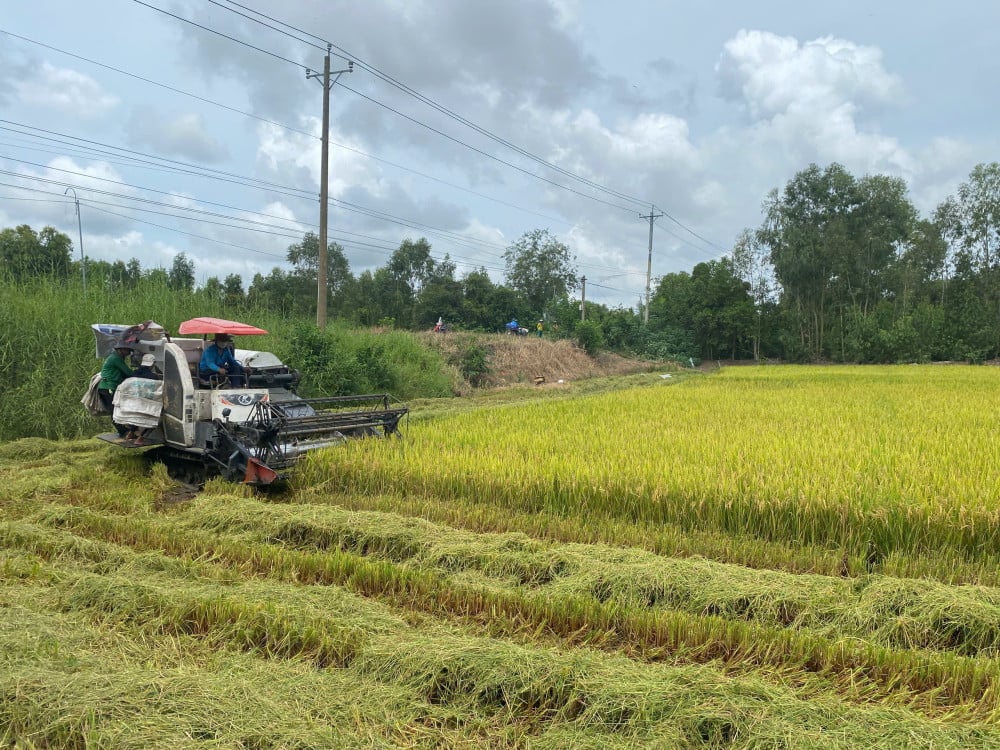
Farmers are increasingly using certified and super-elite rice varieties.
Each model covers an area of 30-50 hectares (total support not exceeding 40 million VND/model); each participating household covers an area of 0.5-3 hectares. The supported rice varieties include IR4625, OM18, OM5451, ST24, ST25, Nang Hoa 9, Dai Thom 8, etc. When participating in the model, farmers will receive seed price support according to regulations when purchasing certified rice seeds or higher.
Mr. Nguyen Van Thanh, Head of Hamlet 2, Nhon Ninh Commune, said: "Hamlet 2 has a total agricultural production area of nearly 240 hectares. Previously, farmers mainly used rice from the previous crop as seeds for the next crop. Since receiving support from the provincial Department of Agriculture in terms of rice seed prices, along with the efforts of the local government in disseminating information, farmers have focused on sowing certified rice varieties and applying science and technology to production."
As the 2025-2026 Winter-Spring rice crop is beginning, the provincial Department of Agriculture advises farmers to use certified rice varieties and a rational variety structure; in addition to prioritizing the production of rice varieties suitable for the cropping season and market demand, attention should also be paid to varieties suitable for the changing water resources and saline intrusion situation.
Specifically, farmers are advised to use the following rice varieties: fragrant and glutinous rice varieties: ST25, ST24, RVT, VD20 and glutinous rice varieties; high-yield, high-quality and mildly fragrant rice varieties: OM4900, OM5451, OM7347, Dai Thom 8, Nang Hoa 9; and rice varieties with good drought and salinity tolerance: OM6976, OM576, etc.
Deputy Director of the Department of Agriculture and Environment, Dinh Thi Phuong Khanh, affirmed: "Using high-quality, certified rice varieties, while reducing the amount of seeds sown, are the first requirements for healthy rice plants right from the start of the season. Reducing the amount of seeds sown not only saves costs but also contributes to reducing greenhouse gas emissions."
Previously, the sowing rate in many areas reached 100-150 kg/ha, but now, thanks to modern equipment and improved public awareness, many models have reduced it to 80-100 kg/ha, and some even to 60-70 kg/ha while maintaining productivity.
Therefore, localities and specialized sectors need to strengthen information and communication to help farmers understand the role of rice varieties and sowing density; continue to transfer science and technology; focus on improving research capacity and promoting cooperation between the State, research institutes, and businesses in the field of research, testing, and restoration of high-quality rice varieties;...".
The province requires localities to proactively arrange rice production seasons in accordance with local conditions, adapting flexibly to changes in water resources for production according to the general planting schedule for the entire province. Specifically: - Phase 1, from October 10th to 20th, 2025, for communes in hilly and border areas, and some communes that may experience water shortages at the end of the season. - Phase 2, from November 8th to 18th, 2025, for communes in medium-sized areas and areas with dikes. - Phase 3, from December 5th to 20th, 2025, for communes in areas with incomplete dike systems and the remaining communes of the province. |
Le Ngoc
Source: https://baolongan.vn/nang-tam-thuong-hieu-lua-gao-tay-ninh-a207661.html


![[Photo] Life on both banks of the river returns to its bustling pace on the day the Long Bien Bridge opens to traffic.](https://vphoto.vietnam.vn/thumb/1200x675/vietnam/resource/IMAGE/2026/05/28/1779949763708_cau-long-bien-minh-duy-7-3610-jpg.webp)

![[Image] Checking the security conditions at the exam site, ready for the 10th grade exam.](https://vphoto.vietnam.vn/thumb/1200x675/vietnam/resource/IMAGE/2026/05/28/1779943458889_z7872507660648-d764421a26e8cd7b61d70d142a48a685-jpg.webp)

![[Photo] The heat at the fireworks display site on the opening night of the Da Nang International Fireworks Festival 2026](https://vphoto.vietnam.vn/thumb/1200x675/vietnam/resource/IMAGE/2026/05/27/1779889741485_ndo_br_z7872039145157-fecaba5112f39e8352544099d7ef4738-5140-jpg.webp)





































































Comment (0)